Five trends that give community colleges a surprising edge in 2026
Public debate about higher education has intensified over the past year, and many of the headlines have not been favorable. Concerns over student debt, declining trust, and questions about the value of a college degree have shaped public perception and made the landscape more challenging for institutions of all types. All of this has left many institutional leaders wondering whether higher education is approaching a breaking point or a turning point in the year to come.
Yet despite these pressures, two-year institutions across the country are showing early signs of renewed momentum and are well positioned to succeed in the coming year. Enrollment has already been on the upswing, with community colleges growing by 4% in fall 2025 and outpacing all other sectors. On top of this, emerging cultural and policy shifts—including a growing emphasis on career and technical programs, heightened focus on affordability, and a steady demand for dual enrollment—create opportunities that community colleges are uniquely equipped to meet.
These trends signal that community colleges may be entering a period of opportunity even as much of the higher education sector faces headwinds. Below are five trends that community colleges can capitalize on to gain momentum in 2026.
1. Rising Public Trust Gives Community Colleges a Strategic Edge
In a national environment where skepticism toward higher education has been high, community colleges emerge as a clear exception. Recent reporting shows that public confidence in higher education as a whole is rebounding, growing to 42% in 2025, up from 36% in 2023 and 2024. The share of adults who said they have very little or no confidence also dropped from 32% to 23%. These shifts represent a meaningful improvement in public sentiment.
Within this broader rise, community colleges appear to be leading the way. The same study found that confidence in two-year colleges reached 56%, compared to 44% for four-year institutions. This suggests that the public is not viewing higher education as a single category. Instead, they are drawing distinctions and placing stronger trust in community colleges.
Please indicate how much confidence you have in four-year colleges and universities. Please indicate how much confidence you have in two-year colleges or community colleges.
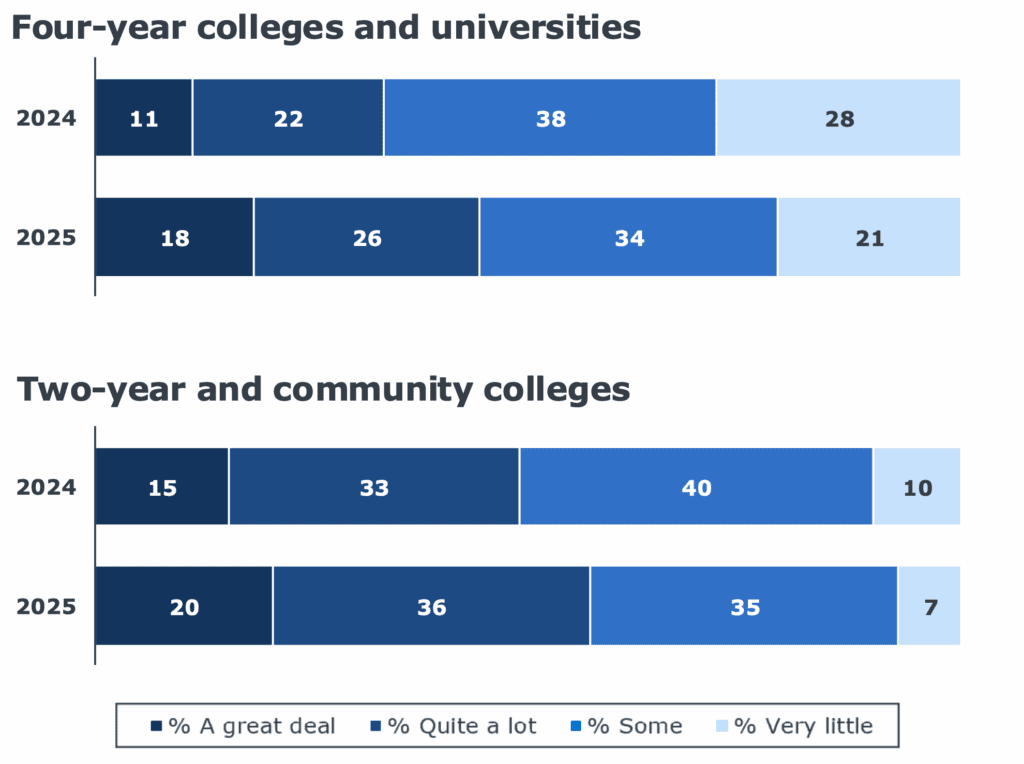
Lumina Foundation-Gallup Confidence in Higher Education survey
Growing trust is more than a reputational boost. It influences recruitment, funding, partnerships, and community support. When students are choosing among higher education options, perceptions of integrity and value matter. Community colleges can build on this trust advantage by sharing a clearer and more consistent story about who they serve and the outcomes they deliver.
How to Capture This Opportunity:
Colleges can use this trust advantage by embracing their identity as two-year institutions and highlighting the distinct value, outcomes, and mission that set them apart. Strong public confidence can also strengthen funding efforts, since lawmakers and local leaders are more likely to invest in colleges that their communities trust.
2. Affordability Gives Community Colleges a Powerful Enrollment Advantage
After several years of flat or modest tuition increases during and after the pandemic, new data from the College Board shows that community college tuition not only remains significantly lower than tuition at four-year institutions, the sector has seen the smallest tuition increases heading into 2026, averaging 2.7% compared to up to 4% at four-year colleges. Nationally, full-time community colleges’ tuition averages $4,150 per year, compared to $11,950 for instate students at public four-year institutions and $45,000 at private nonprofit four-year colleges.
As four-year tuition climbs, students and families are paying closer attention to price and are becoming more debt-averse. EAB research shows that cost is the top barrier to enrollment for prospective students and a major factor influencing current students’ decisions to stop out.
As you consider your future college experience, what makes you most concerned or nervous? (Top five responses, n=2,815)
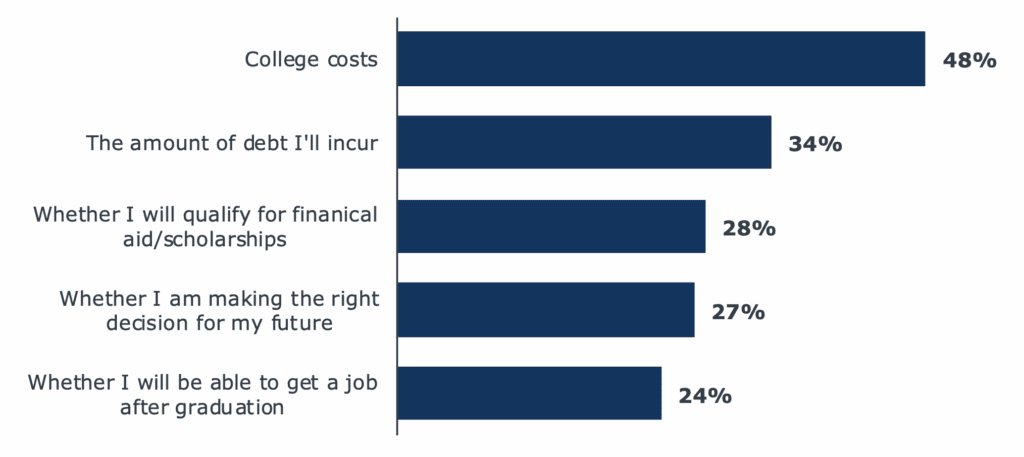
Five insights about changing student preferences, EAB
How to Capture This Opportunity:
Communicate savings clearly by using cost comparison tools, highlighting available financial aid, including scholarships, and showcasing resources that offset non-tuition costs like books and transportation. Pair this affordability messaging with wage outcomes and job placement data to help students understand the long-term benefits.
3. Career and Technical Growth Signals a Major Opportunity for Community Colleges
Community colleges have a powerful story to tell about the value of programs in the trades, health care, and technical fields. As more students look for a clear path to stable, high-demand jobs, career and technical programs could be poised to grow in popularity. These programs are already gaining new traction and demonstrating the high ROI outcomes students are looking for-
Recently:
- National Student Clearinghouse data shows that enrollment at public two-year colleges with a vocational or trade focus has grown nearly 20% since spring 2020, reaching about 871,000 students.
- Over 56% of all community college awards in 2022-23 were workforce credentials.
- More than 75% of workforce-oriented associate degrees lead to median earnings at or above a living wage within two years of completion.
These results are stronger than the public may realize, and they align with a labor market that increasingly values skills and experience over traditional four-year degrees. The Bureau of Labor Statistics projects millions of new jobs in healthcare support, advanced manufacturing, information technology, clean energy, and construction by 2030. This, combined with an aging workforce and a stronger career and technical footprint than four-year colleges, creates a significant opportunity for community colleges to lead the way in closing workforce gaps.
How to Capture This Opportunity:
Community colleges can capitalize on the growing skilled-trades shortage and strong trades outcomes by launching targeted New Year outreach that highlights quick-start programs, strong wages, and immediate job opportunities. Partnering with local employers, streamlining enrollment, and showcasing successful alumni can help clear the path for career and technical motivated students.
4. A New Era for Short-Term Credentials and Workforce Pell Is Taking Shape
Short-term credentials are rapidly moving from a niche workforce strategy to a mainstream entry point into higher education—particularly for younger learners—and upcoming Workforce Pell eligibility is poised to further accelerate this shift.
- Youth participation is rising sharply: In 2023–24, certificate completers aged 24 and younger outnumbered older completers for the first time.
- Fastest growth among the youngest learners: Credential earners ages 18–20 grew by 18%, while participation among students under 18 increased by 27%.
- Dual enrollment is fueling momentum: Many high school students are earning credentials that can anchor stackable academic and career pathways.
These trends make clear that short-term credentials are becoming a mainstream on-ramp into higher education for younger learners, not just an upskilling option for mid-career adults.
The launch of Workforce Pell in July 2026 will only heighten this demand. By allowing Pell Grants to support accredited programs shorter than 15 weeks, the policy will open federal financial aid to a wide range of short-term credentials that have historically been inaccessible to low-income students. Colleges that begin preparing now can build the reporting systems, employer partnerships, and quality assurances needed to meet growing interest from younger learners while expanding access for those who stand to benefit most. The good news is that most two-year colleges already offer short-term, high-value programs, putting them ahead of the curve as they develop a strong Workforce Pell strategy.
How to Capture This Opportunity:
Review program quality and reporting processes, ensure stackability from short-term programs into degree pathways, design targeted outreach to both students and working adults, and strengthen employer partnerships in high-demand sectors.
5. Two-Year Colleges Are Dominating the Dual Enrollment Market
Dual enrollment has long served as an on-ramp for traditional-aged students, but the recent surge in participation represents a new and significant opportunity for community colleges. National data from the 2023–24 academic year show dual enrollment climbing rapidly, with 2.8 million high school students taking college courses, a 12.7% increase over the prior year. Community colleges remain the primary providers, enrolling 71% of all dual-enrolled students and growing their dual-enrollment participation by 11% in just one year.
High school dual enrollment rates (2022-2024)
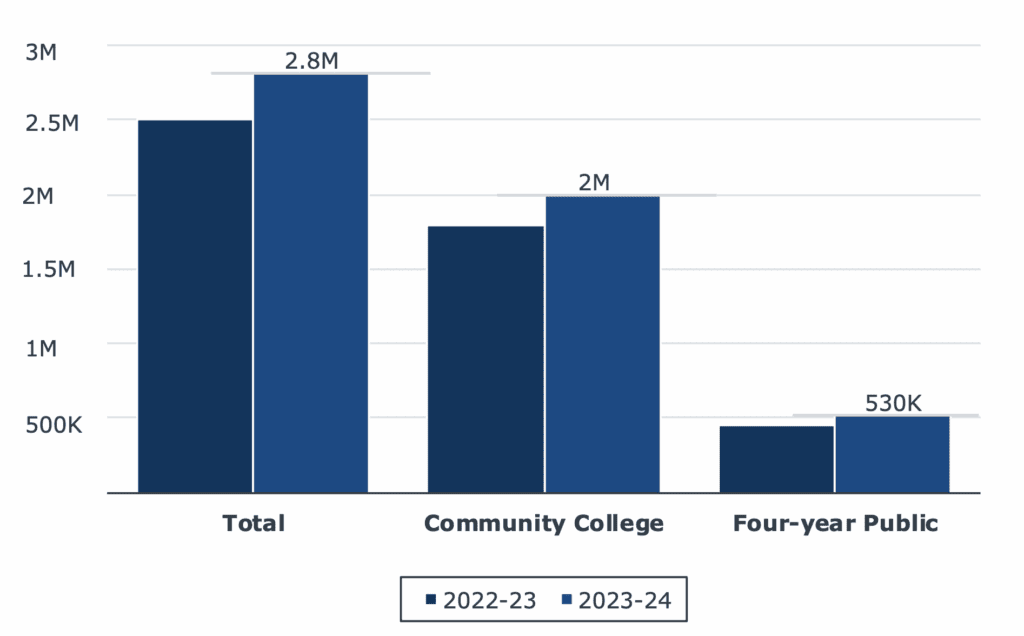
Community College Research Center Analysis
This level of early engagement can create a powerful advantage in downstream enrollment and credential completion when colleges intentionally design clear pathways from dual credit to degree. The surge reflects rising student interest in earning early college credit, exploring career pathways, and completing stackable credentials, particularly at institutions with strong workforce programs. As younger learners pursue short-term credentials in greater numbers, community colleges are increasingly positioned to shape early college access and guide students into high-demand fields.
How to Capture This Opportunity:
Expand dual credit offerings in both academic and CTE pathways, formalize partnerships with school districts, create clear stackable maps that help students understand how high school coursework leads to certificates or degrees, and provide advising support to help dual enrolled students transition smoothly into postsecondary programs.
Equip your team for the future of community college student success
New opportunities to improve community college enrollment and retention can be unlocked through proactive interventions, robust data insights, and a compelling value proposition for learners. To learn how EAB’s Navigate360 can help streamline student success interventions and manage prospective student communications, fill out the form below.

More Blogs

Students no longer search like they used to

AI search is reshaping brand and enrollment strategy. Is your institution ready?