How community colleges can prepare graduates for an AI-disrupted workforce
Today’s community college graduates are stepping into an entry-level job market that is growing more competitive as generative AI reshapes both how work gets done and how employers define early-career roles.
For community college leaders, this moment calls for a sharper focus on workforce readiness and students’ AI literacy. Community colleges have long led the way in making higher education accessible, but the next phase of their mission is to ensure students leave not just with credentials, but with the AI fluency and real-world skills necessary for post-graduation success. This includes not only technical fluency, but also the soft skills that support graduates in navigating changing roles and expectations.
Supporting students’ readiness for an AI-driven economy is not just mission-aligned, but non-negotiable in an environment where institutions are judged by the employment and earnings outcomes of their graduates.
Below, I’ve outlined four ways entry-level work is changing and what those shifts mean for community college students.
Four ways AI is changing entry-level work
1. Entry-level opportunities are already shrinking
The labor market may look strong overall, but that growth is not reaching everyone. New research shows a clear pattern emerging as entry-level workers are being squeezed out of AI-exposed roles like software development and customer service, while more experienced workers in those same fields continue to see stable or growing employment. An analysis of more than 62 million workers across 285,000 U.S. firms finds that junior roles are already declining relative to senior positions, a trend that has accelerated alongside the adoption of AI tools.
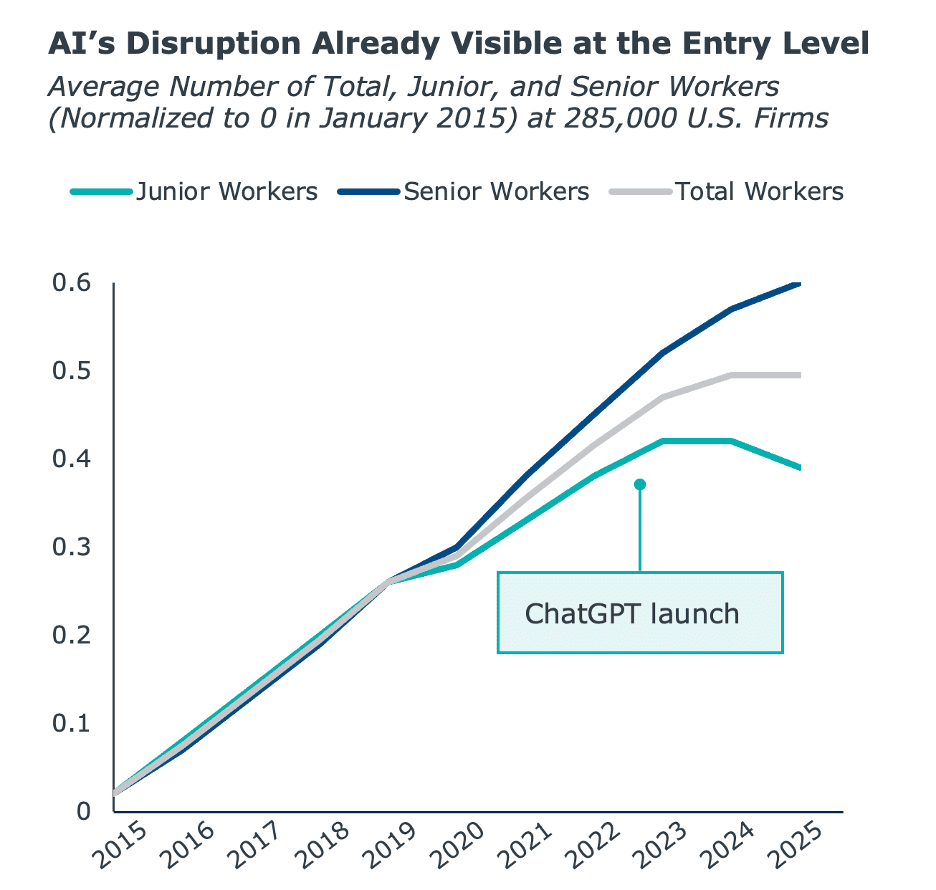
For young workers, the impact stands out: employment among 22 to 25-year-olds has largely stalled since 2022. In fact, employment for young workers has declined in AI-exposed roles, while older workers in those same roles continue to see growth. Together, these shifts suggest AI is not eliminating work broadly but is making it harder to access the first step on the career ladder.
2. Employers are restructuring the career ladder
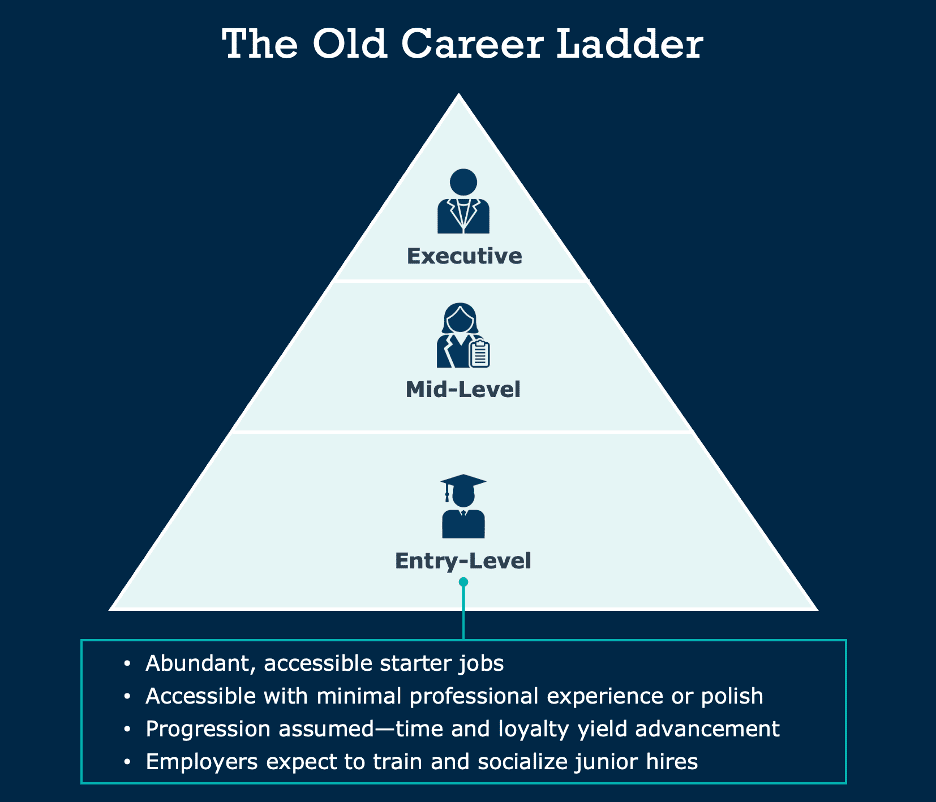
Traditionally, the career ladder in most fields resembled a pyramid, with a wide base of entry-level roles where new hires could learn and grow over time. As AI takes on many routine tasks once handled by entry-level workers, true starting roles are shrinking, making them more competitive and harder to access. The result is a narrower “door” into the workforce for new graduates. At the same time, the pool of middle-career roles remains wide as companies continue to seek and hire more experienced employees.
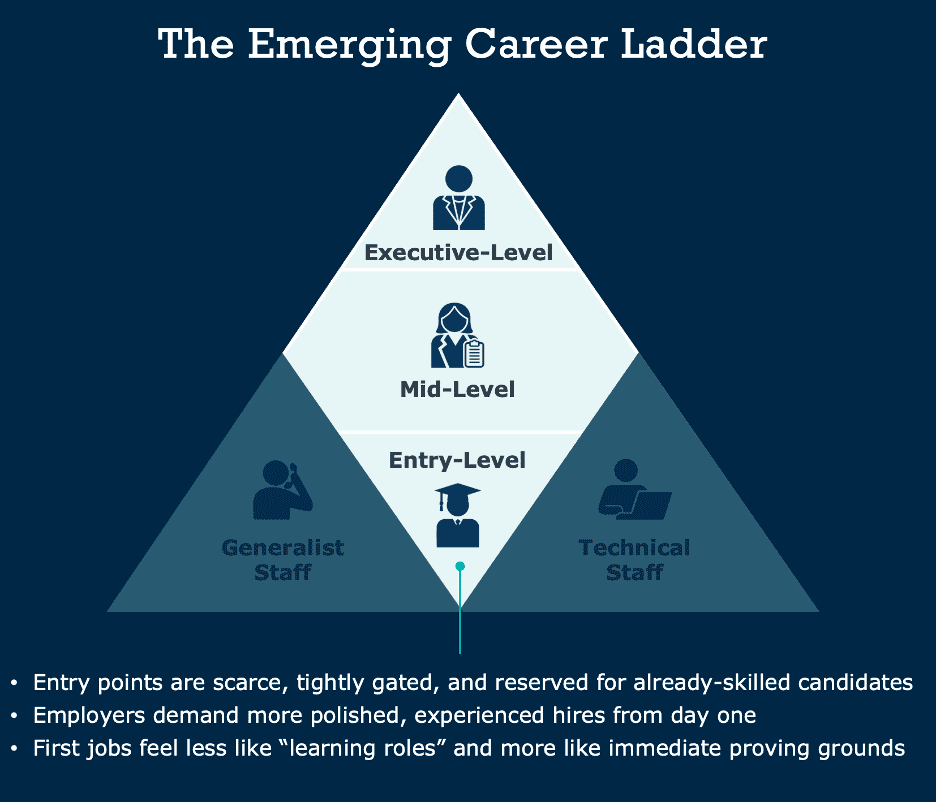
And while entry-level roles are shrinking, expectations for new hires are rising, with employers no longer hiring primarily for potential. Instead, they expect candidates to contribute immediately, with stronger technical skills and applied experience from day one. This shift has significant implications for community college students, some of whom bring work experience in their field, but many of whom rely on entry-level roles to build or formalize their skills.
As the labor market provides fewer broad opportunities for early skill development, institutions will need to play a larger role in helping students build those skills within the community college experience. This may mean expanding experiential learning opportunities, internships, and employer partnerships to help students build a resume outside of just their credential.
3. Career opportunities are shifting, even in traditionally “safe” fields
Fields once seen as “safe” pathways to stable entry-level employment are changing as employers raise expectations for AI fluency, applied experience, and durable interpersonal skills. Programs offering relevant degrees for these fields have historically been strong enrollment generators for institutions because they were widely seen as practical, reliable routes to good jobs. As labor market conditions shift, however, they are exposing gaps between academic programs and employer expectations. If students begin to lose confidence in these pathways, institutions could also face enrollment implications in some of their most in-demand programs.
For example, in fields like IT and computer science, which have long been viewed as reliable routes to employment, changing skill demands are making it harder for graduates to compete without current, hands-on experience. In IT alone, computer programmer employment in the United States has fallen 28% in just two years, and the unemployment rate for computer science majors now stands at 6.1%. Similar trends are showing up in adjacent fields, with unemployment at 6.0% for information systems management, 5.7% for graphic design, and 5.8% for mathematics.
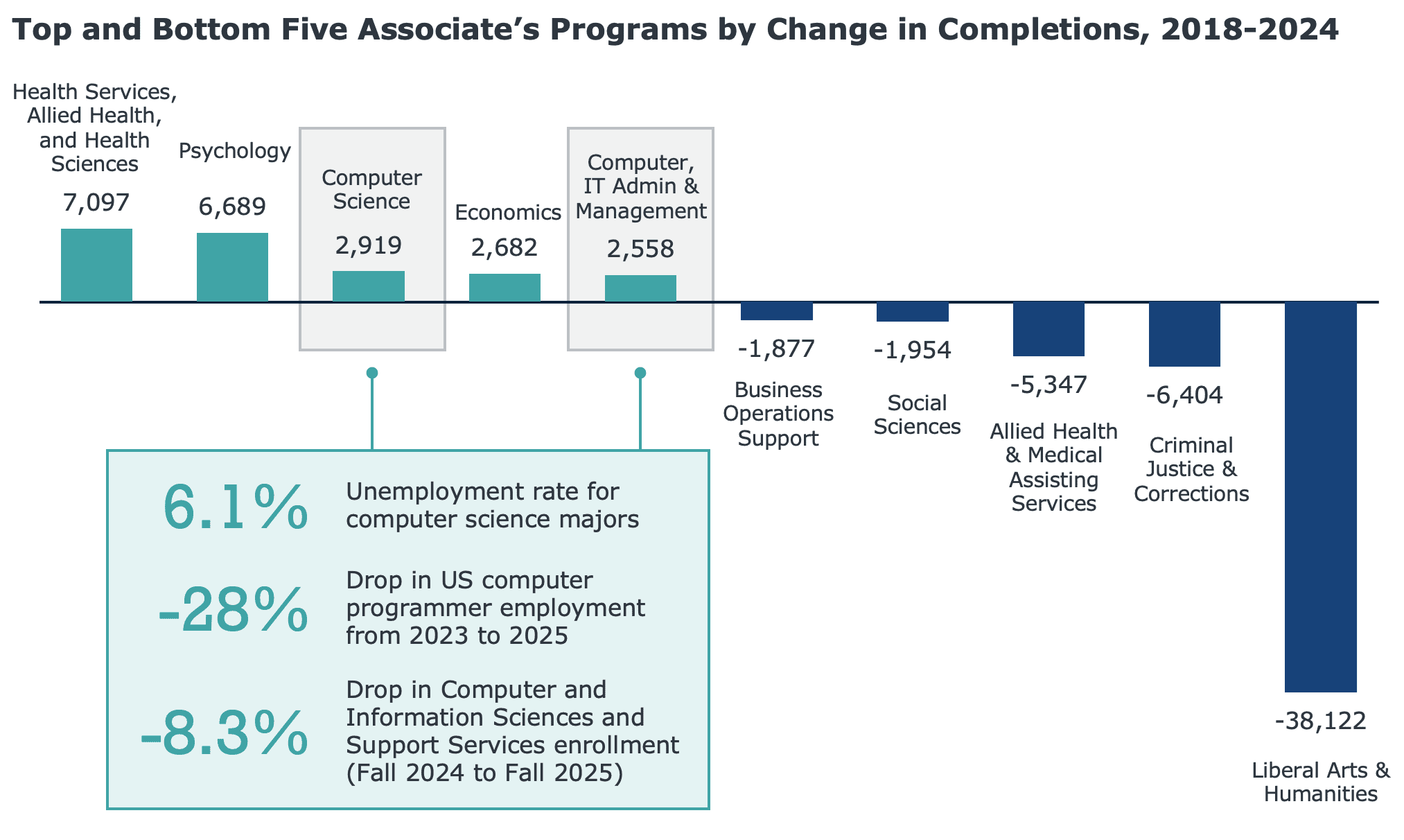
These shifts do not mean institutions should stop offering programs in IT, computer science, or related fields. Rather, colleges need to modernize curriculum quickly and develop a much sharper understanding of the technical, applied, and human skills employers are now looking for in these fast-changing fields.
4. The hiring process is breaking down under AI pressure
Compounding these challenges, changes in the hiring process itself are making it more difficult for applicants to stand out. As job seekers submit applications at unprecedented scale, employers are increasingly using AI to manage the volume, with 43% of HR professionals now relying on these tools. At the same time, 61% of Gen Z candidates report submitting at least 100 applications, often using AI to generate application materials quickly. In effect, many employers are now using AI to screen AI-assisted resumes, which raises the bar for candidates and makes it even harder to stand out. So how can candidates find an edge? Right now, referred candidates have a 50% chance of advancing past resume review, compared to just 12% of non-referred applicants. In short, access to opportunity is increasingly shaped by who students know, not just what they know.
For many community college students, this trend presents an additional barrier. While some bring existing networks, many do not have strong professional connections to draw on. This is where institutions can lean in, serving as stronger brokers between students and employers and helping ensure that access to opportunity is not determined by network alone.
How can community colleges respond?
Taken together, these trends point to a new set of priorities for community colleges. Institutions will need to move beyond trying to outpace AI and instead redesign how they prepare students for a workforce defined by greater competition, higher expectations, and a growing need for both technical and human capabilities.
How community college leaders can prepare
- Hardwire AI literacy: Ensure every student can effectively use AI tools, understand their limitations, and apply them responsibly in real-world contexts
- Elevate relational intelligence: Prioritize communication, teamwork, and interpersonal skills that are harder to automate and increasingly valued by employers
- Redesign for a dual edge: Blend technical and human skills across programs so graduates can both leverage AI and differentiate themselves from it
- Incentivize faculty innovation: Support and reward faculty for updating curriculum, integrating AI, and experimenting with new teaching models
- Guarantee work experience: Build structured pathways so every student graduates with applied, real-world experience
- Reimagine career services: Shift from transactional support to proactive coaching, earlier career engagement, and stronger employer connections
- Scaffold network-building: Intentionally help students build professional networks through mentorship, employer partnerships, and alumni engagement
- Enable lifelong learning: Extend institutional value beyond graduation with reskilling opportunities and ongoing access to career support
How EAB can help
Responding to these shifts will require not just strategy but capacity, as institutions must reinvest time and attention into career readiness, employer engagement, and helping students navigate more complex pathways into the workforce even as many teams are already stretched thin.
Navigate360 helps institutions get their students ready for the modern workforce by supporting career readiness across their time on campus with integrated academic and career planning, streamlined appointment scheduling, access to job simulations, and AI-enhanced automations to keep students on track.
Ready to learn more?
If your institution is looking to improve career readiness support and empower students to launch confidently into the workforce, contact EAB to learn how Navigate360 can support your goals.

More Blogs

How to improve student success in short-term credential programs

How to improve graduate student retention