Where is college athletics headed next? Four potential futures
Over the past several years, structural changes within athletics have rapidly increased the cost of competing. NIL has introduced new benchmarks for athlete compensation and support, deregulation of the transfer portal has intensified recruiting demands, and conference realignment has increased travel costs. Emerging revenue-sharing requirements will add further financial obligations in the years ahead.
The financial returns from athletics are also becoming increasingly concentrated. Power conference programs continue to benefit from media deals and national exposure, while mid-major and lower resource institutions face rising costs without a comparable increase in revenue, resulting in diminishing returns on athletics investments.
The result? A familiar but widening divide, with the middle of the market struggling to sustain athletic programs as Power 4 institutions increasingly capture resources and competitive advantage.
As part of our annual State of the Sector research, we identified four potential futures for college athletics based on evolving market pressures and competitive dynamics—and the no-regrets actions savvy institutions can take to prepare for what comes next.
Where college athletics may be headed
Four potential futures (and how likely each one is)
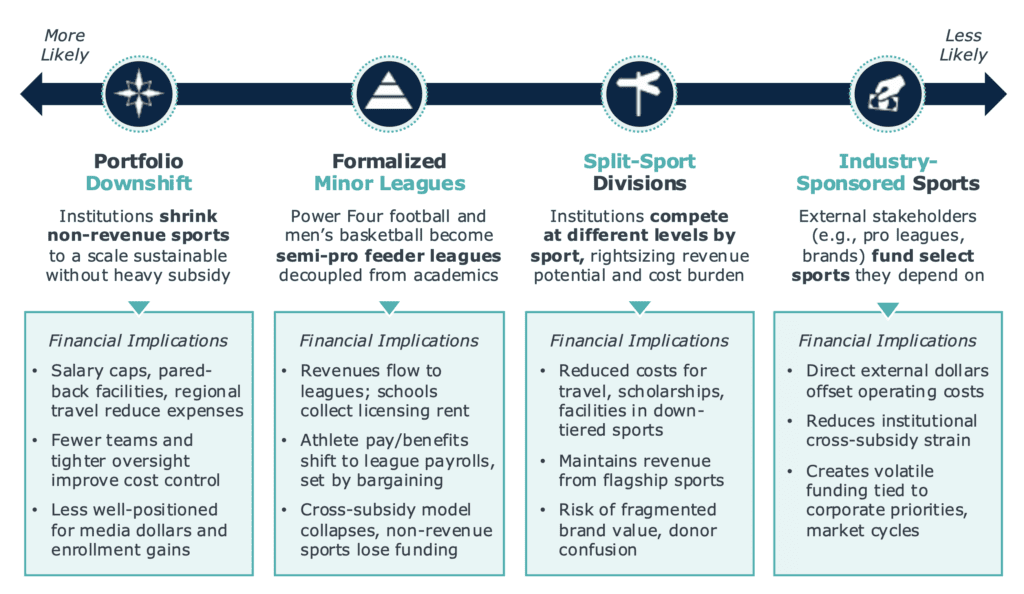
Future #1: A portfolio downshift, where institutions scale back their athletics footprint and concentrate resources toward a smaller set of priority sports programs. This could mean fewer teams, reduced operating expenses, and a more focused approach to aligning athletics with institutional priorities. Many institutions are already taking steps in this direction.
Future #2: The emergence of formalized minor leagues, where Power 4 football and men’s basketball continue to professionalize and increasingly operate independently from the rest of the institution. In this scenario, these sports could function as standalone commercial enterprises, shifting costs away from institutions but raising fundamental questions about how remaining sports are funded. While this future may have seemed unlikely a few years ago, NIL and revenue sharing are early signals of continued professionalization in college athletics.
Future #3: A more flexible system of split-sport divisions, where institutions compete at the division level that best fits each sport’s competitive and financial position. This would allow them to concentrate resources where they have a true competitive edge while reducing costs elsewhere. This model exists in few exceptional cases today, but broader adoption would require meaningful NCAA rule changes, making near-term expansion less likely.
Future #4: An industry-sponsored model, where professional leagues or corporate partners invest in select sports they rely on as talent pipelines, helping to offset institutional costs. While there’s certainly opportunity in growing external partnerships and diversifying funding, there’s limited precedent and unclear incentives for leagues and sponsors to invest at scale.
Planning for an uncertain future
No one has a crystal ball—and not all of these futures will materialize—but savvy leadership teams can use them to navigate ambiguity in this space, spark productive conversations about future strategy, and identify proactive steps to stay ahead of potential disruptions.
Across our work with partners, we’ve identified a set of actions that leading institutions are taking to better position themselves, regardless of how the future unfolds:
What this means for institutional strategy
These dynamics reflect a broader set of pressures explored in our State of the Sector 2025-26 research, as institutions navigate sustained financial strain and rising expectations for relevance and value.
If you’re interested in how peers are approaching these decisions, or what this could mean for your institution, we invite you to connect with our team or explore the full State of the Sector brief.
Let’s Talk About Your Priorities
Connect with a Strategic Advisory Services expert to explore how EAB can help you drive forward your leadership team’s most important initiatives.

More Blogs

Is University College Cork’s Market Attractive Index the answer to our diversification challenge?

Should a student’s journey on campus be as challenging as Odysseus’ journey home?