4 ways to protect your enrollment after students say yes
Admissions teams put enormous effort into getting students from inquiry to deposit. But some of the biggest threats to yield come after students have already said yes: an unfinished FAFSA, a missed orientation deadline, confusion about course registration, or a question that gets bounced from one office to another.
In a recent EAB survey, 72% of students said they expect answers to enrollment questions within a day, but only 21% said their college responded that quickly. And 56% of students said they considered not enrolling at some point during the admissions and onboarding process. For enrollment leaders, there is real risk of losing students in the stretch between admission and day one. A smoother handoff to student success can keep students moving, help staff intervene sooner, and protect the enrollment your team has worked hard to earn.
Here are four places I would start.
1. Make it clear who owns the student relationship at every stage
Ask a few different people on campus who is responsible for an admitted student’s progress between deposit and registration. Do you get the same answer?
At many institutions, ownership gets fuzzy after admission. Admissions may still be communicating with a student while financial aid, orientation, advising, and other teams begin their outreach. That ambiguity makes it easier for a deadline to pass unnoticed or for two offices to send competing instructions.
We often recommend that partners map the journey from inquiry through census and assign an owner to the major transition points, including:
- FAFSA completion
- Orientation registration
- Placement or testing requirements
- The first advising appointment
- Course registration
- Housing and other pre-enrollment tasks
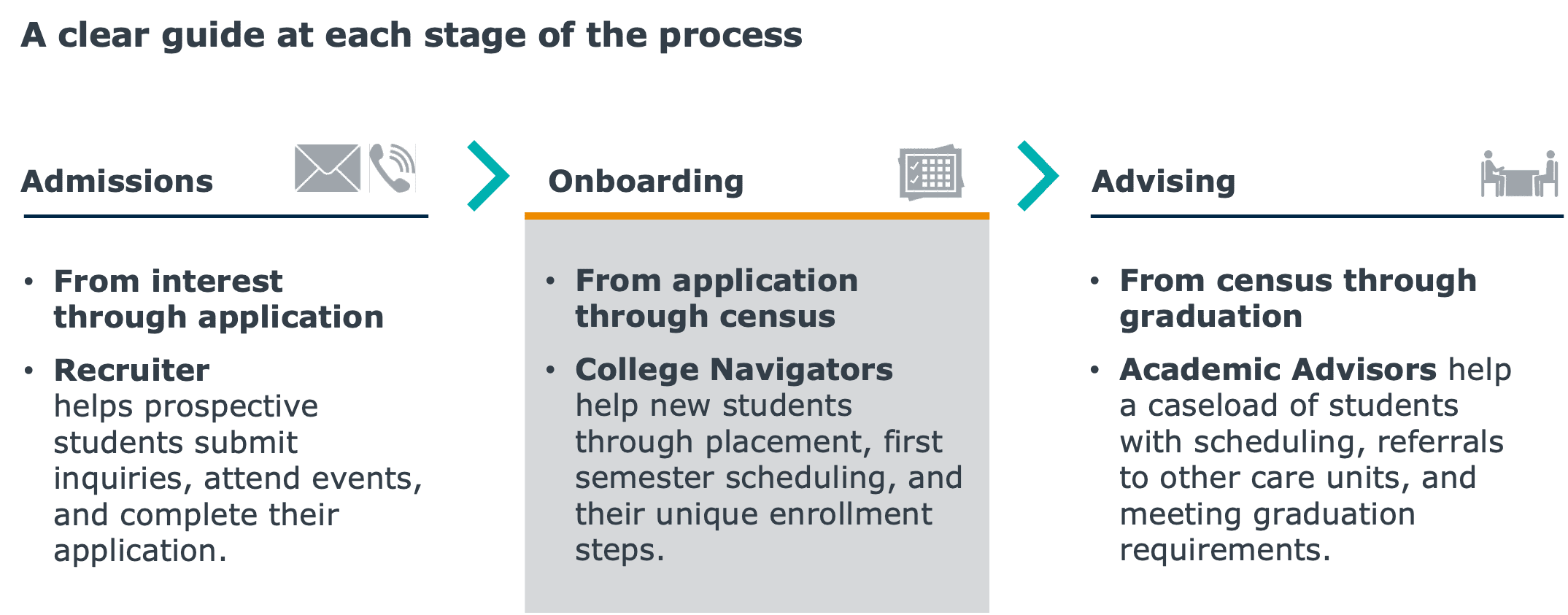
One EAB partner, Central Virginia Community College, created especially clear lanes: the Recruiter owns the journey from interest through application. College Navigators support students from application through census. Then Academic Advisors take over from census through graduation. Your staffing model may look different, and that is fine. The important part is knowing who should notice when a student stalls out and who is responsible for helping them move forward.
2. Let student success teams see what admissions already knows
By the time a student enrolls, your admissions team has probably learned quite a bit about them. Maybe the student is worried about paying for college. Maybe they work full time or have family responsibilities. They may have changed majors, attended several events, talked with financial aid, or stopped responding after weeks of steady engagement. That context is incredibly useful to the academic advisor or faculty member who works with them next.
Yet on many campuses, it is difficult to find this information once the student leaves the admissions workflow. And students feel that disconnect when they are forced to repeat their story or question multiple times.
As you evaluate your handoff, make sure the next team can answer four questions:
- Who did the student talk to? Which offices and staff members have already interacted with the student?
- What messages did they receive? What emails, texts, reminders, and nudges have already gone out, and how did the student respond?
- What difficulties did they reveal? Did the student mention financial, academic, work, family, or other concerns that could affect enrollment?
- Where are they stuck? Is there milestone or task that the student seems stuck on? Who is the right team member to pull them through?
3. Look for stalled student momentum before it’s too late
Most admissions teams know the milestones that tend to trip students up. The harder part is seeing quickly enough which individual students are having trouble. Some signals are obvious: an incomplete FAFSA, a missed orientation registration, or an unfinished enrollment task. Others are easier to overlook. A student may stop opening emails, delay housing selection, miss a payment, stop engaging with the LMS, or suddenly become less responsive to outreach.
I would start by identifying a handful of behaviors that tend to precede melt at your institution. Then ask:
- Can we see the signal while there is still time to intervene?
- Who receives that information?
- Who follows up with the student?
- What happens next?
That first question is especially important. During yield season, a report that takes two weeks to produce may tell you what happened without giving your team much opportunity to change the outcome.
4. Stop giving students all onboarding tasks at once
I suspect most of us in enrollment have sent (or inherited) an admitted-student email containing a list of 25 things the student needs to accomplish before fall. Every item may be important. But together, it’s too much to manage.
The better question is: What does this student need to do next? Breaking onboarding into smaller steps and prompting students based on where they are in the process is much more effective. For example:
- Remind a student about the one unfinished task keeping them from registration.
- Follow an orientation RSVP with the next relevant action.
- Stop sending reminders for steps the student has already completed.
- Tailor financial aid outreach to students who actually need it.
- Route a student to a person when their question requires more than a standard answer.
This also reduces one of the most common frustrations students encounter during a messy handoff: multiple offices sending overlapping or contradictory messages.
Protect the enrollment you have already earned
Enrollment leaders cannot remove every obstacle between admission and matriculation. We can make many of those obstacles easier to spot and easier for students to navigate. Start with your process and ownership—but also ensure that you have the right technology in place to monitor the student signals that matter, simplify their next steps, and ensure continuity from first inquiry through the first day of class and beyond.

More Blogs

Students no longer search like they used to

AI search is reshaping brand and enrollment strategy. Is your institution ready?