Five enrollment priorities leaders are focused on in 2026
Twice a year, EAB’s Enroll360 team polls enrollment leaders to ask which issues are most relevant to their work. In June, we surveyed interest in 10 topics, spanning recruitment marketing, pricing strategy, student choice, international enrollment, workforce alignment, and inclusion.
What stood out as I looked through the results was the degree of consensus around a shared enrollment challenge: institutions are trying to stand out in a market where students have more options, more skepticism, and less patience for generic value propositions. This concern frequently emerges as a priority when I do workshops with our enrollment partners.
The five areas below reflect the strongest signals from your peers, along with my read on what those priorities reveal about where enrollment leaders are prioritizing their efforts.
1. Standing out in a crowded recruitment market
The clearest priority among respondents was “The Science of Standing Out in Recruitment Marketing: How to Spot the Gap Between Your School’s Student Appeal and Its Marketing,” selected by 87% of participants.
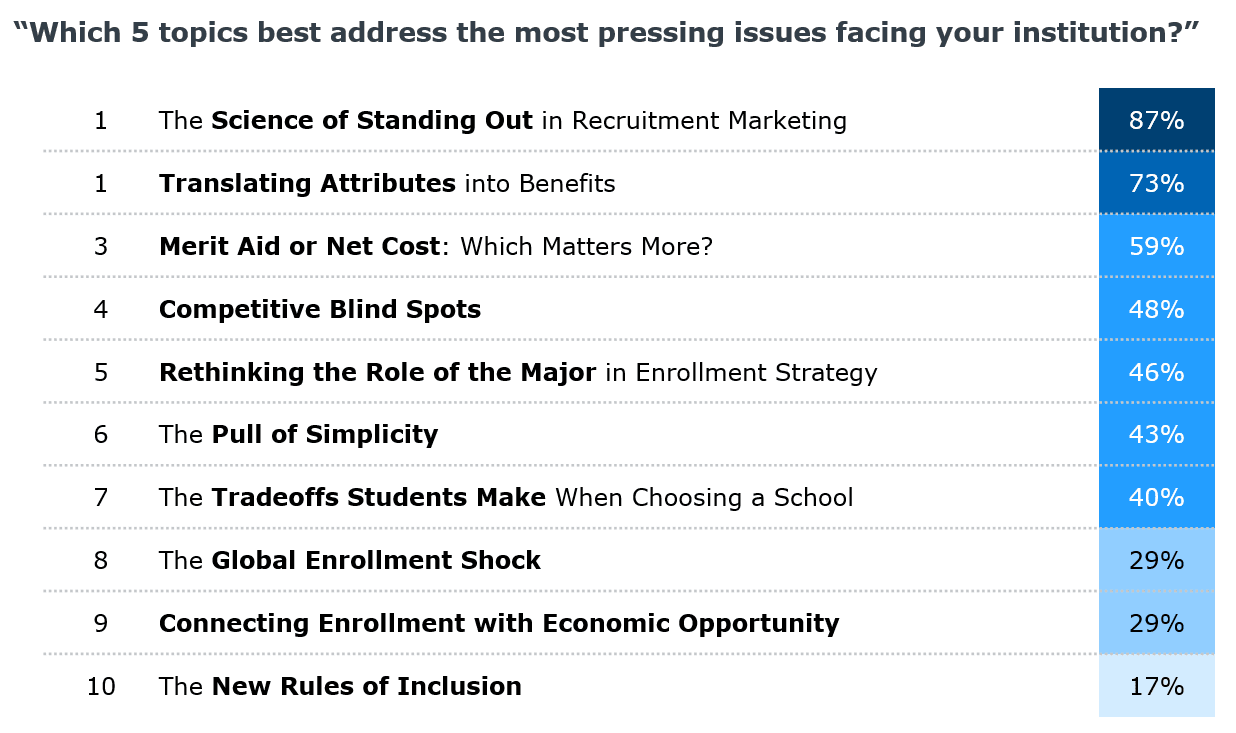
The topic resonated across institution types, with consistently high interest among the four segments: large privates, small privates, large/flagship publics, and small/regional publics. That level of agreement indicates to me that enrollment leaders are reckoning with a difficult but meaningful question: what is memorable, meaningful and distinct about our institution to the students we are trying to enroll?
I hear this concern frequently in conversations with enrollment teams. Many institutions can name their strengths (e.g., academic quality, student support, community, outcomes, location, faculty access), but struggle to understand which of those attributes (or combinations of attributes) drive enrollment decisions. The risk is that schools end up communicating broadly appealing but indistinct messages that sound too much like everyone else.
Finding success with differentiation means thinking beyond building visibility; it requires you to drill down to understand any gap between what students find compelling about your institution and what your recruitment marketing currently emphasizes.
-


9 Institutional Personas
Which one of 9 institutional personas does your school match? Click here to find out!
2. Translating institutional strengths into student value
The second-highest priority was “Translating Attributes into Benefits: How to Talk About Institutional Strengths in Ways That Actually Resonate with Students,” selected by 73% of participants. Like the top-ranked topic, it had broad appeal across both executive and non-executive respondents, and across school segments.
To me, this is best understood as a companion concern to the previous topic. Enrollment leaders are not only asking, “What makes us different?” They are asking, “How do we express that difference in terms students and families immediately understand and value?”
When I look at higher ed marketing materials, I often see schools leading with attributes: small class sizes, strong advising, internship access, honors programs, alumni networks, campus life, faculty mentorship. Students and parents, however, are often listening for benefits: Will I belong here? Will I get the support I need? Will this be worth the investment? Will this help me get where I want to go in life? Will I be job-ready at graduation?
This is why message translation is becoming such an important enrollment skill. A school may have real strengths, but if those strengths are communicated in institution-centered language, they will fail to move the audience. The more student-centric and personalized your messaging is, the more it will move the needle.
3. Making affordability and value easier to understand
The third major priority was “Merit Aid or Net Cost: Which Matters More?” selected by 59% of participants. This was the only other topic beyond the top two to cross what I would consider a “broad interest” threshold.
It’s no surprise to see this topic ranked so high. Pricing, aid, affordability and perceived value remain central to enrollment strategy, but the student and family decision-making process is rarely straightforward. Some students are influenced by the size of a merit award. Others are focused on net cost. Many are trying to compare offers across institutions with different pricing models, financial aid terminology, and value narratives.
Even when an institution is more affordable than students and their supporters assume, that message can be difficult to convey early enough and clearly enough to affect behavior. Conversely, even a generous aid package may fall flat if students and families do not understand what it means for their actual cost, their likely debt, or the value of their investment.
Interest in this topic polled especially high among large private institutions, but it is relevant well beyond that segment. In a market where students are weighing college against alternative pathways, enrollment leaders need clearer ways to communicate price that are always linked with value, affordability, and return on investment.
-

More insights
See results from our recent survey of 9,500 students into their perceptions of college value in the age of AI.
4. Testing assumptions about competitors and student choice
Further down the list of priorities is developing a stronger understanding of the overall student decision-making process. “Competitive Blind Spots: Testing Institutional Assumptions Against Inquiry, Application, and Persona Data” was selected by 48% of participants, while “The Tradeoffs Students Make When Choosing a School: A Deep Dive into How Students Balance Competing Institutional Traits” was selected by 40%.
I read this as evidence that enrollment leaders are increasingly aware of how costly bad assumptions can be. Many institutions still benchmark against traditional competitors and aspirational peers. But students may be making comparisons that do not fit neatly into those categories. A student might be choosing between a regional public, a private college with strong aid, an online option, or a community college transfer pathway (and in other cases, entering the workforce directly).
“Who do we compete with?” is an important question, but “Who do students see as comparable options, and what tradeoffs are they making when they choose someone else?” is a much more valuable question to consider.
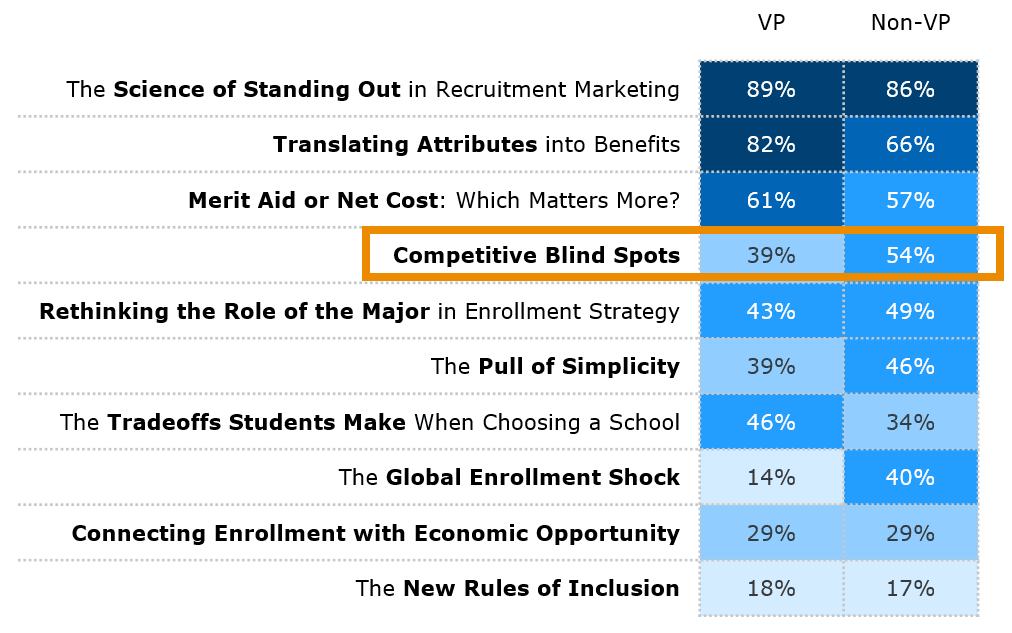
This topic had an interesting split by role. Non-VP respondents showed greater interest in Competitive Blind Spots than VPs did. That tracks with what I often hear from enrollment professionals closest to funnel performance. They are the ones managing campaigns, inquiry conversion, application behavior, and yield conversations. When assumptions about audience, competition, or message-market fit are wrong, they feel the operational consequences quickly.
5. Connecting programs and process to student priorities
The last set of priorities break down differently by market segment.
Several topics landed in the middle of the overall rankings, including:
- “Rethinking the Role of the Major in Enrollment Strategy: Are Flexible, High-ROI Programs the Key to Attracting Career-Focused Students?” at 46%,
- “The Pull of Simplicity: How Streamlined Admissions Processes Are Now a Competitive Advantage” at 43%
- “Connecting Enrollment with Economic Opportunity: How State-level Workforce Conditions Reshape Enrollment Competition” at 29%.
But the segment-level results show why these topics should not be dismissed as merely “middle tier” priorities. For small/regional publics in particular, interest was much higher in the role of the major, admissions simplicity, competitive blind spots, and economic opportunity.
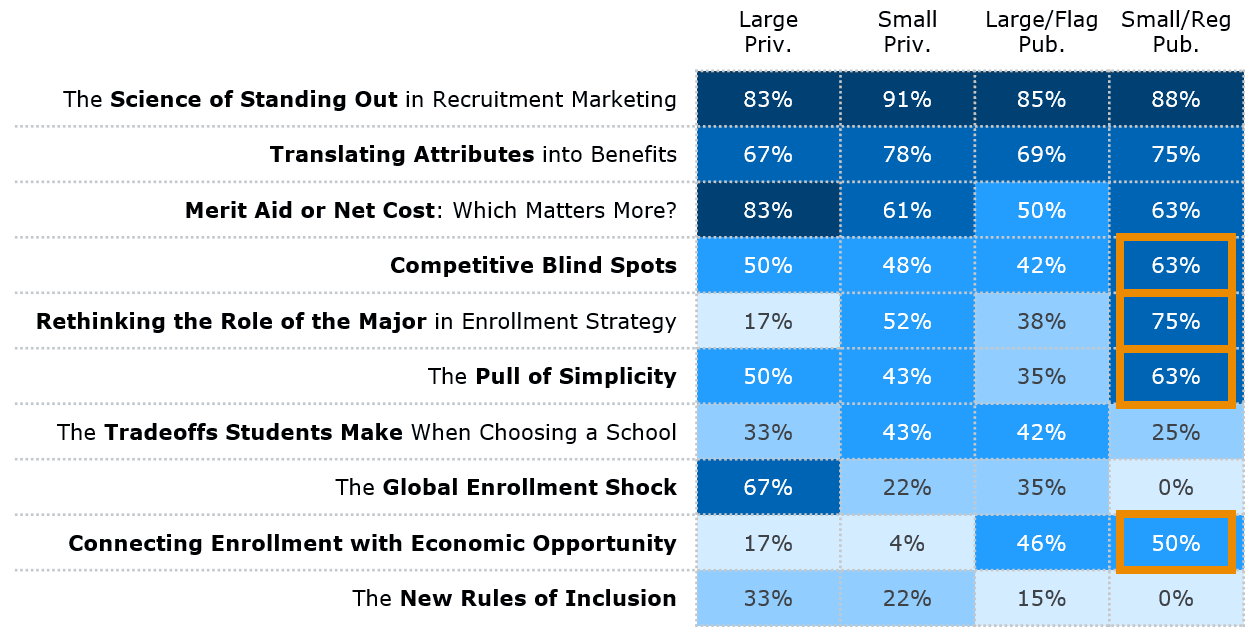
Public institutions also showed stronger interest than private institutions in connecting enrollment with workforce conditions.
My interpretation is that many enrollment leaders are thinking holistically about the role academic offerings, ease of application, and evidence that graduates get jobs impact how students evaluate institutional fit.
Full List of Ten Topics Included on the Poll
Ranked by popularity
1. The Science of Standing Out in Recruitment Marketing
How to Spot the Gap Between Your School’s Student Appeal and Its Marketing
2. Translating Attributes into Benefits
How to Talk About Institutional Strengths in Ways That Actually Resonate with Students
3. Merit Aid or Net Cost: Which Matters More?
Decoding How Pricing Strategy and Transparency Affect Your Ability to Attract Students
4. Competitive Blind Spots
Testing Institutional Assumptions Against Inquiry, Application, and Persona Data
5. Rethinking the Role of the Major in Enrollment Strategy
Are Flexible, High-ROI Programs the Key to Attracting Career-Focused Students?
6. The Pull of Simplicity
How Streamlined Admissions Processes Are Now a Competitive Advantage
7. The Tradeoffs Students Make When Choosing a School
A Deep Dive into How Students Balance Competing Institutional Traits
8. The Global Enrollment Shock
How International Student Losses Reverberated Across Schools in Every Market Segment
9. Connecting Enrollment with Economic Opportunity
How State-level Workforce Conditions Reshape Enrollment Competition
10. The New Rules of Inclusion
What Today’s Policy Climate Means for Recruiting Diverse Student Classes
Looking to the future
Thanks to those of you who shared your perspective. Your input helps us focus our research on the questions your peers are actively trying to solve amid recruitment pressures, resource constraints, and evolving student preferences.
Ultimately, our goal at EAB is to conduct research and create solutions to your thorniest problems. If any of these issues resonate with you, please complete the form below; we’d love to chat further.
Let’s strengthen your student search strategy
Whether your focus this cycle is on differentiation, affordability, program fit, or competitive positioning, the right student audience matters as much as the message. Connect with us to explore how Appily Leads can help you source prospective students aligned with your institution’s priorities.

More Blogs

AI is impacting students’ college selections

The enrollment recovery masks sharp divides