Infographic
The CIO’s starter guide to leading AI adoption on campus
Lay the groundwork to meet the AI moment
Chief information officers, often serving as de facto AI leaders, face the colossal task of ushering their campuses safely and swiftly into an AI-enabled future. CIOs can use this starter guide to understand and communicate the organizational groundwork necessary to successfully govern, enable, and apply AI on campus. Completing the steps outlined below in our infographic will help CIOs accelerate responsible AI innovation and adoption.
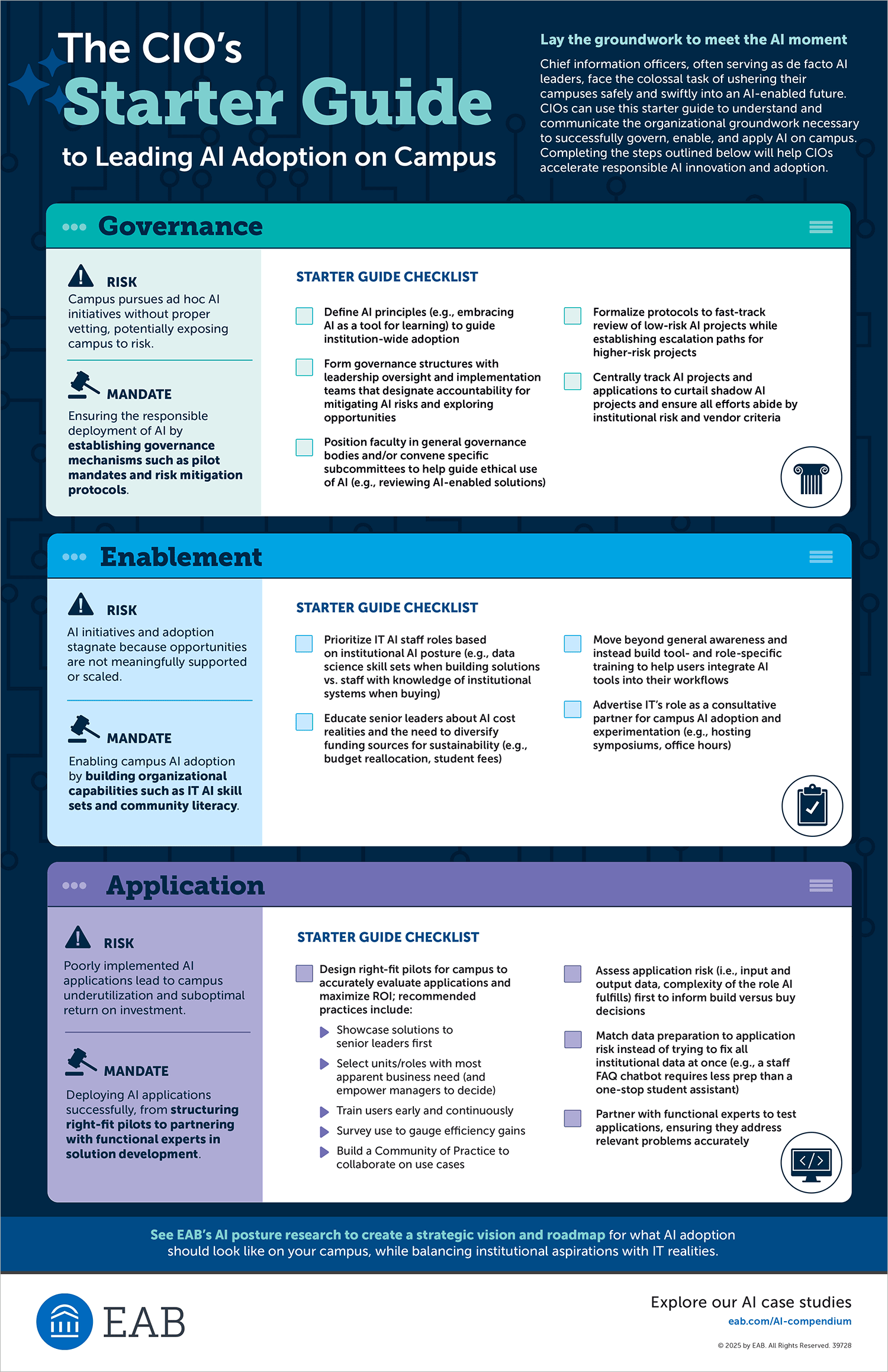
Three steps for AI adoption on campus
Governance
Starter guide checklist:
- Define AI principles (e.g., embracing AI as a tool for learning, committing to digital inclusion) to guide institution-wide adoption
- Form governance structures with leadership oversight and implementation teams that designate accountability for mitigating AI risks and exploring opportunities
- Position faculty in general governance bodies and/or convene specific subcommittees to help guide ethical use of AI (e.g., reviewing AI-enabled solutions)
- Formalize protocols to fast-track review of low-risk AI projects while establishing escalation paths for higher-risk projects
- Centrally track AI projects and applications to curtail shadow AI projects and ensure all efforts abide by institutional risk and vendor criteria
Enablement
Starter guide checklist:
- Prioritize IT AI staff roles based on institutional AI posture (e.g., data science skill sets when building solutions vs. staff with knowledge of institutional systems when buying)
- Educate senior leaders about AI cost realities and the need to diversify funding sources for sustainability (e.g., budget reallocation, student fees)
- Move beyond general awareness and instead build tool- and role-specific training to help users integrate AI tools into their workflows
- Advertise IT’s role as a consultative partner for campus AI adoption and experimentation (e.g., hosting symposiums, office hours)
Application
Starter guide checklist:
- Design right-fit pilots for campus to accurately evaluate applications and maximize ROI; recommended practices include:
- Showcase solutions to senior leaders first
- Select units/roles with most apparent business need (and empower managers to decide)
- Train users early and continuously
- Survey use to gauge efficiency gains
- Build a Community of Practice to collaborate on use cases
- Assess application risk (i.e., input and output data, complexity of the role AI fulfills) first to inform build versus buy decisions
- Match data preparation to application risk instead of trying to fix all institutional data at once (e.g., a staff FAQ chatbot requires less prep than a one-stop student assistant)
- Partner with functional experts to test applications, ensuring they address relevant problems accurately
-


What should AI adoption look like on your campus?
Contact your Strategic Leader or [email protected] to explore EAB’s AI posture research, get guidance on creating a strategic roadmap for campus AI adoption, and discuss how to balance institutional aspirations with IT realities.
More Resources

Insight Paper
What 10,000 Student Conversations Reveal About the Role of AI Agents in Higher Ed
Discover what 10,000 student conversations reveal about AI chat agents and student support in higher education.
Navigate360
Infographic
Where are you on your journey to becoming an AI-enabled institution?
Assess your institution’s AI maturity and identify practical steps to advance teaching, research, and administrative efficiency.
Strategic Advisory Services

Video
How Colorado School of Mines Is Building an AI-Ready Data Ecosystem with Edify
Discover how the Colorado School of Mines unified their campus data and how a strong data foundation is…
Edify