
How the University of Pittsburgh Built a Stronger Pipeline in an Uncertain Market



Impact Highlights as of Fall 2025
22%
Increase in applications from FY24-FY261
16%
Increase in deposits from FY24-FY25
600K
Impressions generated
Challenges
As enrollment headwinds intensified nationwide, the University of Pittsburgh (Pitt) knew it needed to evolve its top-of-funnel strategy to meet future enrollment goals. They set to move beyond broad awareness tactics and build a more intentional pipeline—one that supported right-fit recruitment, program-level priorities, and long-term enrollment stability.
Solutions
Pitt partnered with Enroll360 to reimagine the top of their enrollment funnel. Together, they launched coordinated omnichannel outreach, applied advanced segmentation, and used Appily to identify high propensity, right-fit students. The teams aligned digital and print campaigns with parent engagement and predictive modeling to support academic rigor, program priorities, geographic mix, ability to pay, and social mobility goals. Clear likelihood-to-apply insights helped focus resources where they would drive the strongest return.
This division of labor allowed Pitt to concentrate on high-engagement relationship building. At the same time, EAB scaled identification, engagement, and ongoing optimization across the enrollment ecosystem.
Results
The partnership drove measurable growth across the funnel. Pitt increased applications by 22% across two years and deposits by 16% in their first year. Appily prospects delivered higher admit and deposit rates than other primary sources and improved yield predictability. By building a smarter, right-fit pipeline instead of simply generating more names, Pitt expanded its reach and improved performance across key channels.
How EAB and Pitt Achieved Partnership Success
Reimagining the Top of the Funnel
| Challenge | Solution | Results |
|---|---|---|
| Declining high school populations and rising competition | Launched coordinated omnichannel outreach across digital, print, and virtual experiences | Expanded reach with 24M emails and 7M paid social impressions |
| Overreliance on broad awareness tactics | Introduced earlier engagement for stealth visitors and added clear calls to action | Increased applications by 22% |
| Limited engagement with parents as key influencers | Conducted tailored parent messaging and paid campaigns | Reached 80K individual parents and generated 600K impressions |
Right-Fit Recruitment at Scale
| Challenge | Solution | Results |
|---|---|---|
| List source disruptions and missed prospects |
Leveraged Appily to identify engaged students aligned to Pitt’s profile |
Appily prospects were 13% more likely to be admitted and 10% more likely to deposit |
|
Program-level and demographic enrollment gaps |
Deployed targeted campaigns for priority programs and key demographic focus areas |
Strengthened performance in strategically important academic and population segments |
A Model of Strategic Partnership

Identifying and reaching right-fit students at scale and bringing them into EAB’s extensive enrollment ecosystem.
+

Investing more energy in the high-engagement, relationship-building work that converts interest into enrollment,
=
Stronger performance across the full enrollment funnel by effectively reaching and engaging more students.
Attracting and Finding Right-Fit Students
University of Pittsburgh Gains a Strategic Advantage with Appily
Appily Leads
Appily enables Pitt to build a pool of engaged student inquiries and connect with prospective students who match Pitt’s profile.
Pitt works with EAB to set lead criteria, ensuring incoming inquiries are high quality and right fit.
Amid list source disruptions, Appily connects Pitt with students traditional sources may have missed.
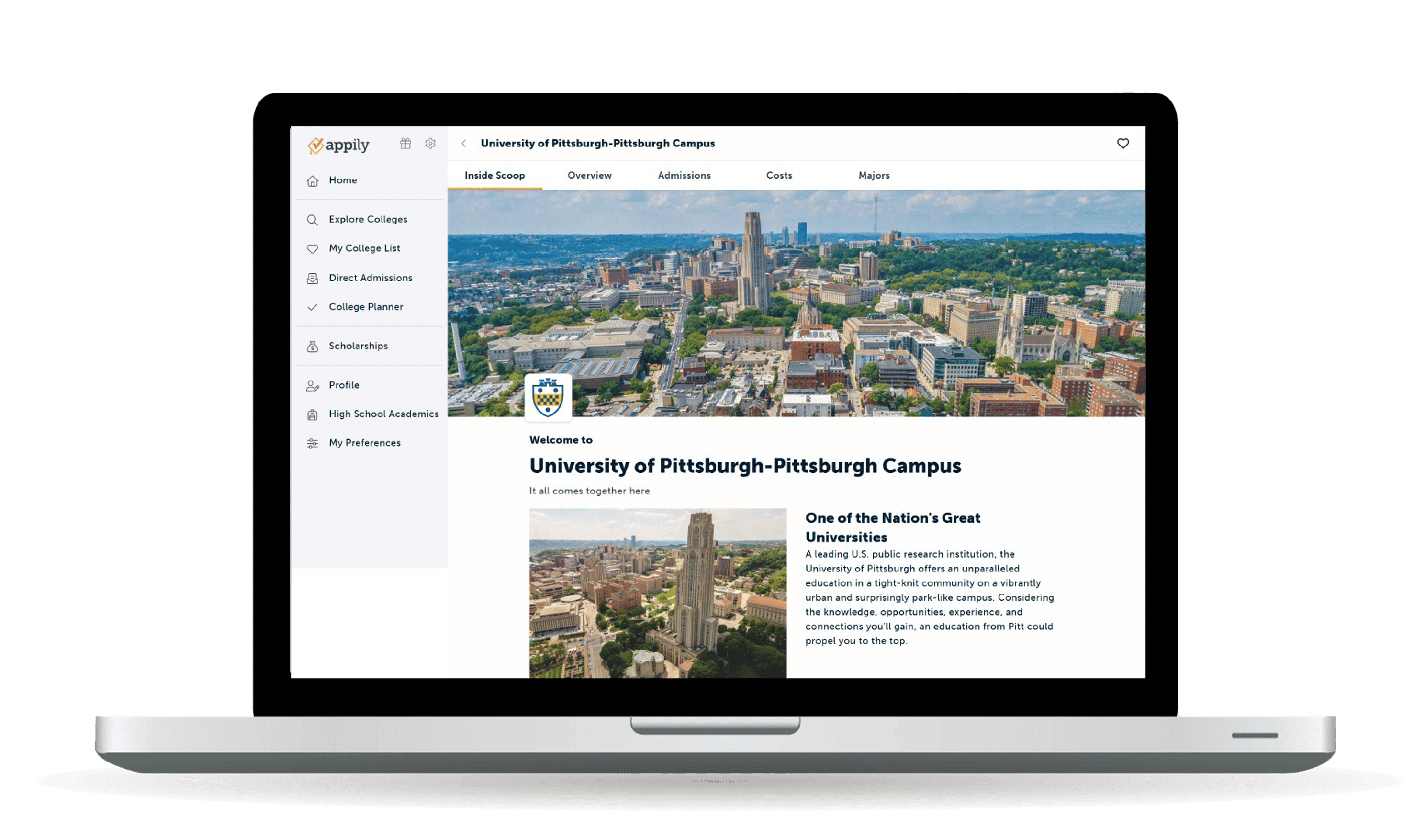
Pitt’s Appily prospects are 13% more likely to be admitted and 10% more likely to deposit than prospects from other main sources.
-


13%
more likely to be admitted
-

10%
more likely to deposit
Appily Tours
Pitt’s Appily tour increases visibility among prospective students, with more than 27,000 visitors spending more than five minutes on average and engaging deeply with the experience.
Paired with their Appily leads strategy, this added exposure helps connect Pitt with more right-fit students while expanding reach beyond traditional sources.
Explore Pitt’s Campus Tour
Your institution could be our next enrollment success story
Your enrollment goals and challenges are unique. Enroll360 brings together tailored marketing, advanced data and AI, and dedicated experts to help your team reach right-fit students, improve yield, and achieve stronger enrollment outcomes.