Four Possible Futures for College Graduates in the AI Workforce
The entry-level labor market is changing rapidly as AI becomes embedded in everyday work. Employers are automating junior tasks, redesigning teams, and redefining expectations for recent graduates. As a result, landing a strong first job is becoming more complex—and less predictable.
For student success leaders, this shift raises questions about career readiness, experiential learning, and how to prepare graduates for a changing early-career landscape. Drawing on strategic foresight methodology, EAB developed four future scenarios that college graduates could face when entering the workforce in the next five to ten years. Explore the futures below to consider how your institution might prepare.
Six Forces Shaping the Early-Career Landscape
Six major forces will determine the trajectory of the entry-level labor market for college graduates over the next decade.
-


Pace of AI adoption
How quickly will AI reshape entry-level work, and what new skills will graduates need to stay competitive?
-

Legacy work models
How will employers redesign teams and early-career pathways as AI takes on more junior work?
-

Popular opinion of AI
Will public trust and policy accelerate AI adoption or slow it down?
-

Supply of recent graduates
What happens if the number of new graduates continues to outpace available entry-level opportunities?
-

Value of college skills
What skills will employers still care about and where do today’s graduates fall short?
-

Emerging AI careers
Who will benefit most from new AI-enabled careers and how will that shape opportunities for graduates?
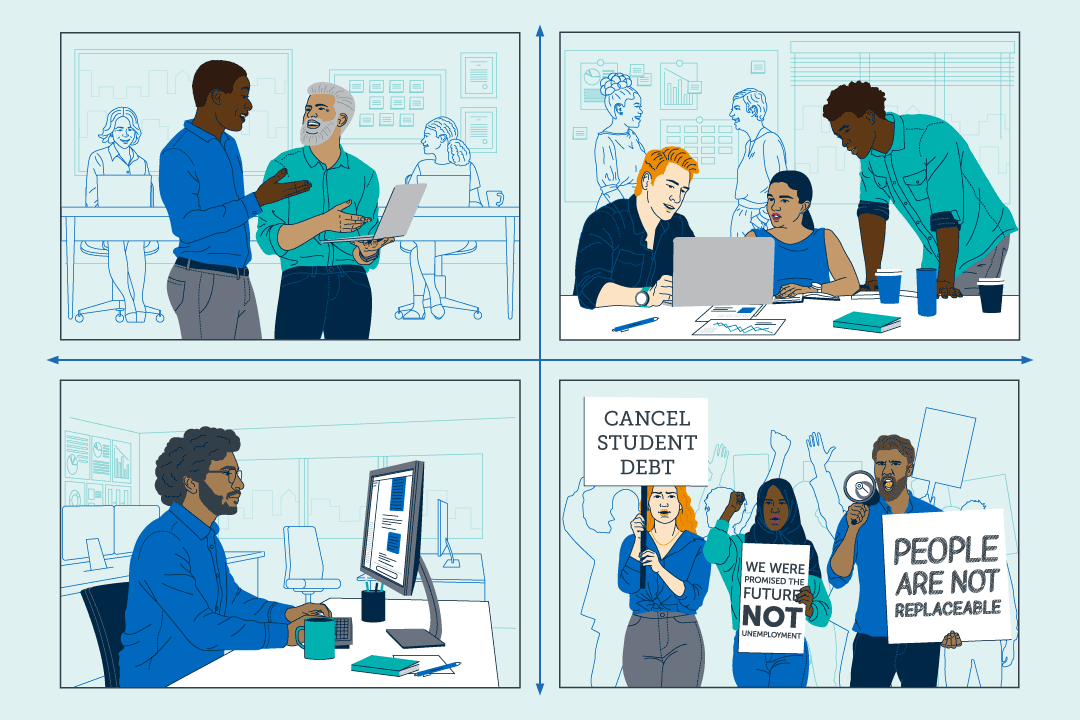
Four Possible Futures
The four futures below represent different potential conditions for the early-career workforce, ranging from stabilization to disruption. Each reflects how institutions and employers should respond to emerging pressures and opportunities.
Future 1: Back to Normal
AI progress slows, and the efficiency gains from automation start to plateau. Companies rediscover the value of human judgment and mentorship, restoring demand for junior talent. Economic growth and retirements reopen entry-level pipelines.
What might this look like?
- Efforts to replace junior workers stall as organizations confront the limits of AI in real-world contexts.
- Companies rebuild early-career cohorts and reinvest in structured mentoring and promotion pathways.
- Preference grows for candidates who demonstrate AI literacy alongside core professional skills.
- Colleges formalize institution-wide definitions of career readiness that blend AI fluency with communication, teamwork, and problem-solving.
- Paid internships, co-ops, and industry-aligned capstones become standard features of undergraduate programs.
Future 2: Copilot Corporations
AI shrinks entry-level roles and concentrates opportunity among experienced, highly technical workers. Teams grow leaner, and traditional career ladders shorten.
What might this look like?
- Large organizations integrate AI deeply into workflows, reducing the need for junior cohorts.
- Entry-level hiring declines; HR shifts toward contract and just-in-time talent models.
- Human-centered fields such as health care and education absorb more graduates.
- Colleges expand flexible certificates and AI-adjacent programs aligned to evolving labor-market demand.
- Student success leaders track how AI is affecting each program and steer students toward more future-proof careers.
Future 3: Social Unrest
Automation displaces entry-level work at scale, growing un- and underemployment among adults in their early and mid-twenties and eroding public trust in higher education. Economic strain intensifies political and social pressure.
What might this look like?
- Unemployment for recent graduates reaches double digits; underemployment becomes common.
- An AI-driven recession slows hiring across sectors.
- Public skepticism about the value of college grows; enrollment declines.
- Institutions face financial and political strain while scrambling to prove career outcomes.
- Student success teams integrate advising, career, financial, and mental health support into holistic models.
- Colleges expand pathways into public, nonprofit, and community-based roles that offer stability and purpose.
Future 4: Next-Gen Entrepreneurs
AI lowers the cost and complexity of launching a business, fueling a surge of freelancers, founders, and micro-firms. Career pathways become fluid and entrepreneurial.
What might this look like?
- AI copilots handle coding, marketing, customer service, and data analysis for small teams.
- Graduates move between freelancing, founding, and contract work rather than traditional employment.
- Corporations contract with or acquire AI-driven startups to supplement innovation.
- Colleges embed AI toolkits and business formation skills across majors.
- Career development shifts from job placement to ecosystem building—mentors, accelerators, lenders, and digital platforms.
Navigate360 helps in every future
By uniting advising, career services, and faculty in one student CRM, Navigate360 helps teams track work-based experiences and guide students from enrollment to career—no matter how the labor market evolves. Fill out the form to connect with an EAB expert or schedule a demo.
More Resources

What matters to student success teams in 2026
The Future of College Graduates in the AI Workforce