Inside Utah Tech’s semester-long strategy to improve retention
As an open-access institution, Utah Tech has worked to remove barriers to enrollment including not requiring a registration deposit. Once students have indicated they plan to attend, advisors register them for classes and send them their schedules. This removes barriers for students, but it can also create an unintended challenge when students don’t fully understand their registration status—whether they’ve registered for classes at all, or what steps to take if they’ve registered and then decide not to attend.
Utah Tech is an open-access public university in St. George, Utah, serving approximately 13,200 students. At the start of this work, the university had a 67% retention rate and a 34% graduation rate. Historically, leaders had approached retention as what Associate Provost for Academic Success Dr. Helen Tate calls a “post-mortem,” analyzing indicators after students had already left. They needed a more proactive approach that would help them understand what was happening while students were still enrolled, spot emerging problems, and connect students with support before those problems became reasons to stop out.
To make that shift, Utah Tech created a semester-long intervention strategy supported by EAB’s Navigate360 and Edify. This blog post outlines the five touchpoints that make up this strategy, and how you can implement them on your campus.
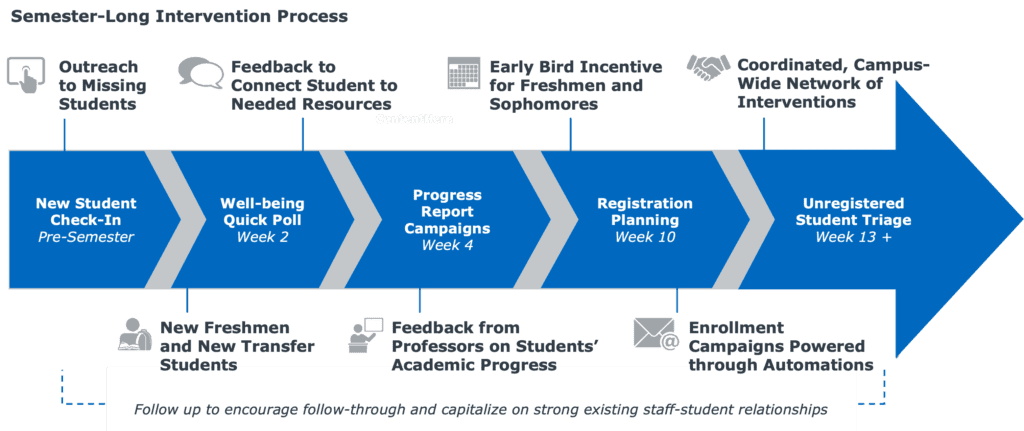
Pre-semester: Check in with new students and spot signs of melt
As an open-access institution, Utah Tech has worked to remove barriers to enrollment including not requiring a registration deposit. Once students have indicated they plan to attend, advisors register them for classes and send them their schedules.
To identify students who might not understand their registration status, Utah Tech surveys new freshmen a few weeks before its multi-day orientation course, which takes place before the semester begins. Responses prompt automated, individualized follow-up:
- Students who plan to enroll but expect to miss the orientation course receive information about how the absence could affect their grade and are encouraged to contact their instructor.
- Students who no longer plan to attend are connected with the formal withdrawal process, so they do not remain responsible for tuition and fees.
- Students who plan to participate in orientation receive confirmation about the course schedule and check-in process.
On the first day of the courses, students check in through QR codes in Navigate360. Staff compare attendance with the list of expected students and send a more urgent follow-up survey to those who are absent. Missing the course may be an early sign that a student’s plans have changed or that they’ve run into a barrier, so each survey response is mapped to an automated outreach campaign that connects students to support before the semester is fully underway.
Week #2: Ask students what they need and automatically route them to the right supports
Utah Tech created its week-two well-being poll after finding that even small problems early in the semester could eventually keep students from returning. The goal was to identify those problems before students fully understood how serious they might become and provide individualized support at scale.
The short poll appears in the Navigate360 app and can also be shared through email, text, and push notifications. The poll asks students to:
- Rate how well the start of the semester has gone.
- Share what is going well or what could have improved their experience.
- Select the areas in which they need help.
- Provide additional details based on the support they request.
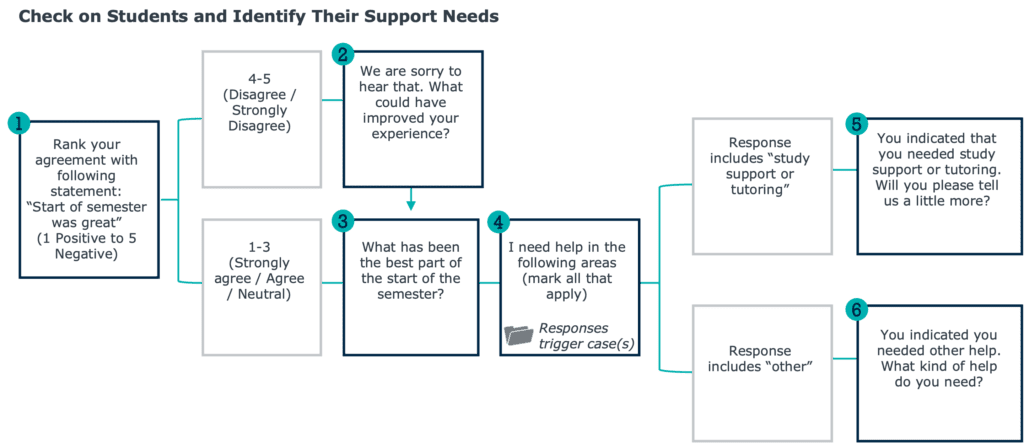
Each response automatically triggers the appropriate next step, such as sending the student information, opening a case, alerting a campus office, or prompting the student to schedule an appointment. In a recent semester, 774 students responded, and 353 requested supports. Those requests generated 509 cases because many students identified needs across multiple areas.
One of Utah Tech’s most surprising findings from the well-being survey was that social connection is a top area of requested support, with many students seeking help making friends and getting involved. The university initially responded by sharing information about events and clubs, then added more personal follow-up from peer coaches and resident assistants. For example, RAs might invite students living on campus to dinner or a residence hall activity, giving them an immediate opportunity to connect with their peers.
Our goal is to identify barriers before students even know they have them.
Dr. Helen Tate, Associate Provost for Academic Success
Week #4: Use faculty progress reports to intervene before recovery becomes harder
By week four, students have had time to settle into their classes, and Utah Tech shifts its attention to how they are doing academically. Through Navigate360, the university sends progress reports to faculty teaching targeted groups of students, including those enrolled in general education, first-year seminar, and developmental courses, as well as student-athletes.
Utah Tech chose week four because leaders believed that waiting until midterm could leave struggling students with too little time to recover. Some faculty initially worried that week four would be too early to identify academic risk, but the progress reports showed that instructors could already predict which students were likely to struggle.
Faculty can use the progress reports to raise six types of alerts and referrals:
- Missing or late assignments, with possible recommendation to consider dropping the course
- Attendance concerns, with a possible recommendation to consider dropping the course
- Referral to an academic adviser
- Referral to the Academic Performance Center
- Referral to the Math Tutoring Center
- Referral to the Writing Center
The team also learned that identifying risks did not guarantee that students would connect with support. When referrals alone did not encourage enough students to visit tutoring or writing support, Utah Tech created a warmer handoff between faculty and peer coaches:
- Faculty use progress reports to identify students who may be at risk.
- Alerts initiate follow-up from the appropriate resource
- The peer coach contacts the student and helps them schedule an appointment, visit the appropriate office, or understand the support available.
- Navigate360 dashboards track which cases were created, how staff followed up, and whether each case was closed.
In spring 2025, faculty completed 73.5% of progress reports for students in general education, first-year seminar, and developmental courses, along with 63.7% of reports for student-athletes. Their responses generated 534 alerts and referrals that could then be tracked and followed up on.
Tracking what happened after each alert also helped Utah Tech assess whether its interventions were working. Sharing those results with faculty and campus partners showed the value of their participation and helped leaders refine student support. Next, Utah Tech plans to use agent campaigns in Navigate360 to improve how students connect with resources after an alert is raised.
Week #10: Use early registration to encourage students to meet with advisors
As the semester approaches midterm, Utah Tech begins preparing students to register for the next term. Because advising is not required, the university needed a way to encourage students to meet with an adviser, confirm that their academic plans were on track, and resolve potential registration barriers early.
Utah Tech created an early-bird registration incentive for freshmen and sophomores. Students who meet with an adviser and have their course plan approved receive a special PIN that allows them to register about half a day before their classmates. This is a particularly strong incentive for the “Type A” students who want to stay ahead of the process and secure the classes they need.
Once those early registrants have enrolled, Utah Tech can focus on students who remain unregistered despite receiving standard enrollment campaigns. That group becomes the focus of the university’s fifth intervention.
Week #13 and beyond: Find unregistered students and assign the right outreach
Once the early-bird students have registered, Utah Tech turns its attention to eligible students who still have not selected classes. When the university began this work, leaders could not easily answer basic questions about how many degree-seeking students were eligible to register, who remained unregistered, or what might be preventing them from returning.
Utah Tech addressed this challenge by combining data from Edify and Navigate360 into a registration report that refreshes daily. Teams can break down the data in several ways, including:
- Class standing
- Registration hold type, including holds that may prevent registration
- GPA group, including the percentage of students below a 2.0 who remain unregistered
- College, department, major, or program
- Intent to return, based on a quick poll launched one week after registration fully opens
Teams also use the report to compare current registration patterns with the same point in prior years, including the percentage of eligible students who have not returned.
This visibility turns a list of roughly 2,000 unregistered students into smaller, more manageable groups. Department chairs and deans can view the data by major, helping each college identify students who may need support. Utah Tech then assigns outreach to the person or office best positioned to help. For example:
- Financial aid staff review students with $1,000 or more in outstanding balances to determine whether additional aid, payment plans, or other options could help them register.
- Peer coaches contact unregistered first-year students and ask what is preventing them from moving forward.
- An intent-to-return survey asks unregistered students whether they plan to come back, helping the university focus on students who want to return but face an unresolved barrier.
- Student Resource Center staff contact first-generation students who have not registered to identify barriers and connect them with appropriate support.
The registration report also helps Utah Tech identify students who might otherwise have been overlooked. One student with a 3.89 GPA was just one semester away from completing an associate degree but had not registered or responded to earlier re-enrollment outreach. The report helped Utah Tech recognize her situation as unusual, prompting her advisor to reach out directly.
The advisor learned that the student’s parents had not completed the FAFSA and connected her with financial aid staff, who helped the family resolve the issue and complete registration. During those conversations, staff also learned that the student was experiencing food insecurity and connected her with the campus food pantry. By using the report to spot an outlier and coordinate high-touch support, Utah Tech helped the student address multiple barriers and stay on track to complete her degree.
Utah Tech increased retention across student groups
Together, these semester-long interventions and support from faculty and staff across campus helped Utah Tech increase retention in just one year. Retention increased 3% for full-time, first-time freshmen, including a 4% increase among bachelor’s degree-seeking students and a 2% increase among associate degree-seeking students.
The strength of Utah Tech’s strategy comes from asking the right question at each point in the semester. Did the student arrive? What support do they need? How are they performing academically? Are they preparing for the next term? If they have not registered, what is standing in the way? Each answer helps the university identify the appropriate next step and connect the student with the person or resource best positioned to help.
To learn how Navigate360 can help your institution identify student needs earlier, coordinate support across campus, and improve retention, see Navigate360 in action and request a customized demo.

More Blogs

Turn institutional priorities into reasons to give

The “4S” challenges reshaping graduate and adult enrollment