5 takeaways from EAB’s Provost Experience Lab at OpenAI
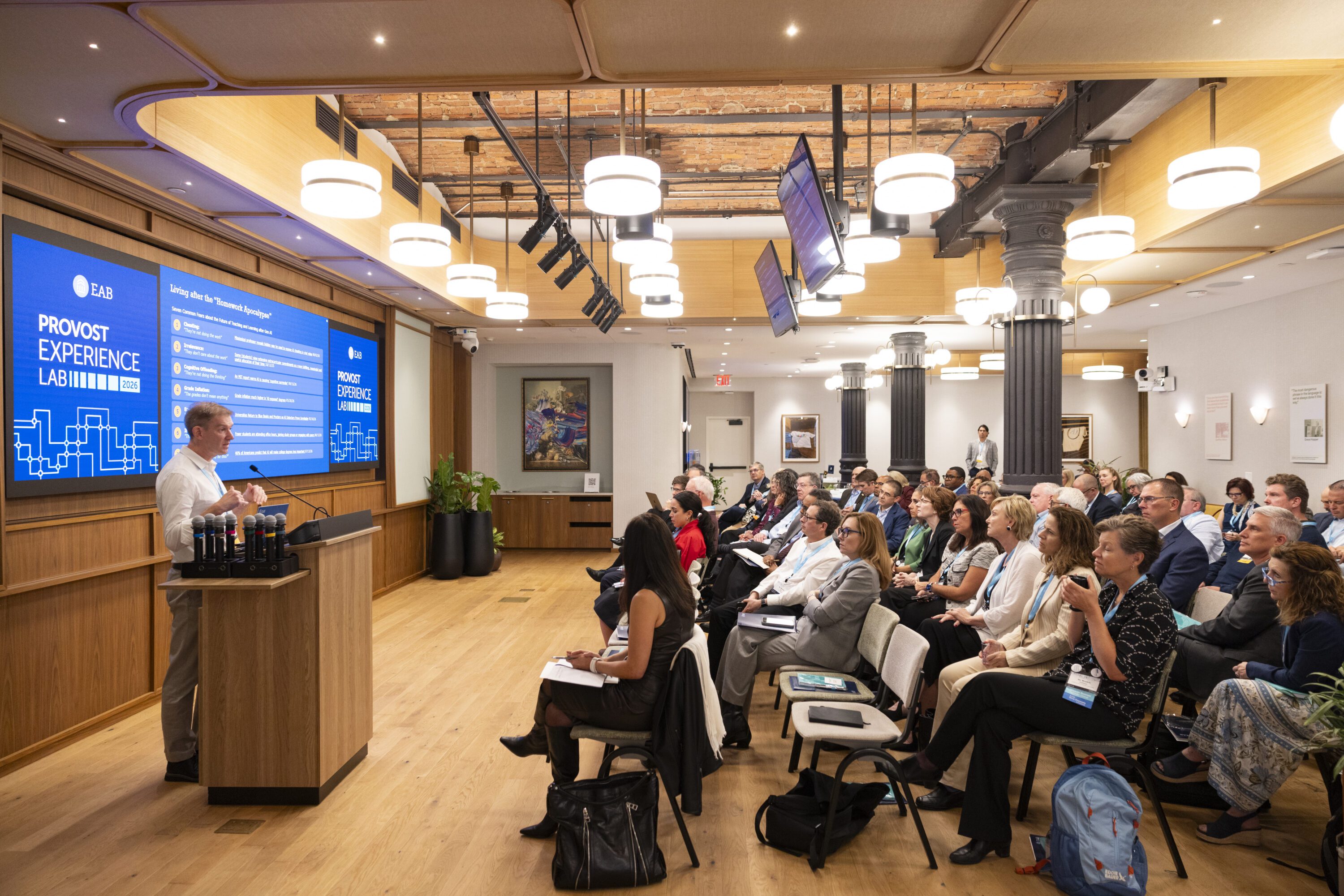
On October 1–2, provosts joined EAB at OpenAI’s New York office to consider a question that goes well beyond how students and faculty use AI: What should a college education prepare students to know and do when AI can perform more of the work we traditionally ask them to complete?
Over two days, participants experienced AI-enabled classroom activities, examined how early-career work is changing, and discussed what these shifts mean for academic leadership. The conversations pointed toward a larger opportunity for higher education: to rethink how students learn, how institutions assess that learning, and how graduates develop the judgment needed to succeed in an AI-enabled world.
For college and university leaders who couldn’t join us, here are five takeaways from the experience.
1. Start with what students need to learn, not what AI can do
It’s easy for a conversation about AI in the classroom to become a conversation about cheating. EAB encouraged participants to dig deeper and to consider the more important questions: Does a completed assignment show that a student has learned? Where does productive struggle happen, and how do we protect it? How will the work prepare students for life after graduation?
These questions shift the focus from policing AI use to designing better learning experiences. Students still need opportunities to build foundational knowledge and think independently. They also need to learn when AI can strengthen their work, which tasks are appropriate to delegate, and how to evaluate what the technology produces.
Julie Schell of the University of Texas at Austin reinforced this distinction through her discussion of AI fluency. Effective AI use requires judgment before a student ever enters a prompt: deciding what thinking to delegate to the technology and what responsibility to retain. It also requires diligence afterward to verify the output.
For faculty, the goal isn’t to choose between embracing AI and protecting learning. It’s to design activities that develop both independent thinking and the ability to work thoughtfully with AI.
-


Next step
Help faculty identify the cognitive work each assignment is intended to develop, then clarify when AI should support that work, when students should work independently, and how they will demonstrate their understanding.
2. Look beyond the finished assignment to see the thinking
If AI can produce a polished essay, solve a problem, or generate an analysis, the finished product alone may reveal little about what a student understands. That creates an opportunity to rethink assessment around the reasoning, decisions, and interactions that lead to an answer.
What might that look like in practice? Michigan State University’s David Souder shared how the Broad College of Business is using Breakout Learning discussion assessments to move beyond low-level multiple-choice questions. Rather than relying solely on whether students select the right answer, instructors can examine how they engage with ideas, respond to others, and demonstrate understanding through discussion.
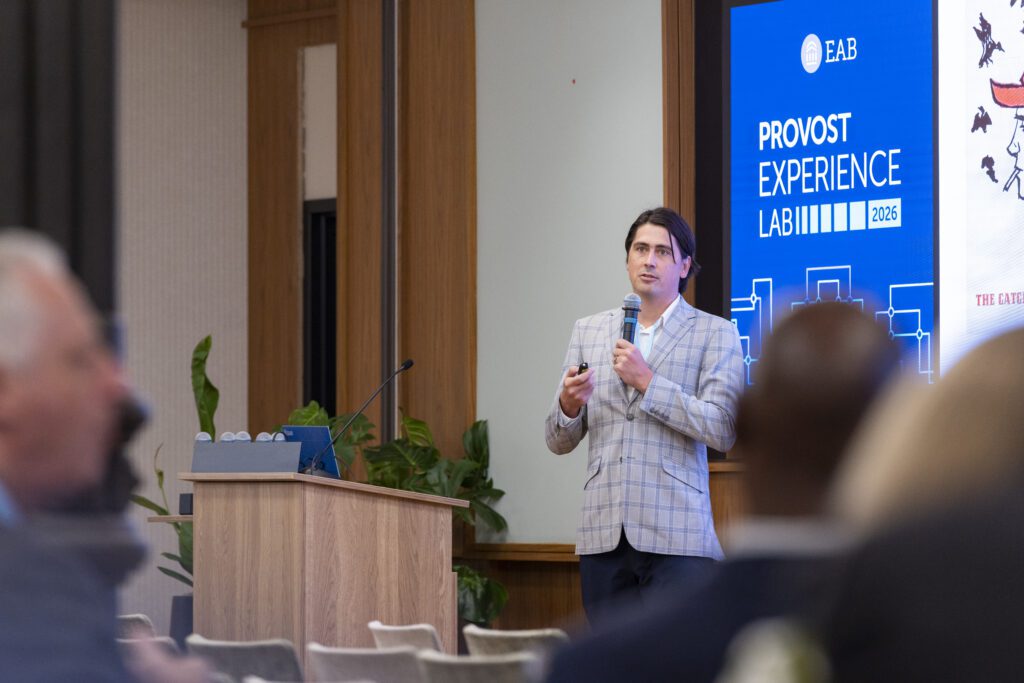
Mike Kentz of AI Friction Labs gave participants a chance to experience another approach. In an ethics simulation, provosts had to listen to an AI character, respond to her objections, and defend their position. Learners assessed their own performance, while the conversation transcript gave instructors specific moments to review and discuss.
The challenge for institutions is making these approaches feasible beyond individual classrooms. Faculty need assessment methods that reveal meaningful evidence of learning without creating an unsustainable grading burden. AI may help capture and organize that evidence, but instructors remain responsible for interpreting what it shows.
-
Next step
Identify an assignment where the final product offers limited evidence of student understanding. Consider whether discussion, simulation, reflection, or documented revision could provide a clearer picture of how students think and learn.
3. Help faculty turn AI guidance into classroom practice
Marc Watkins of the University of Mississippi showed how faculty can use AI to build activities that help students practice reading and writing. His examples included a sentence-level writing exercise, an annotation tool, and an immersive reading experience. In each case, AI helped create the activity while students still had work to do for themselves.
Helping more faculty try approaches like these takes ongoing support. Watkins highlighted faculty guides, communities of practice, and AI institutes as options. Provosts can start by giving instructors clear direction and time to experiment, along with opportunities to compare notes with colleagues. A single course redesign can give others a concrete example to build on.
For practical tools to support this work, explore EAB’s Construction Kit for Faculty AI Resources, which includes a faculty conversation guide, a classroom AI guidelines checklist, and a resource repository builder.
-
Next step
Give faculty opportunities to test a course activity, compare approaches with colleagues, and share what they learn about student engagement and understanding.
4. Prepare students for the messy work that AI can’t easily do
AI isn’t simply changing which jobs graduates will hold. It’s changing the work they will be expected to do within those jobs.
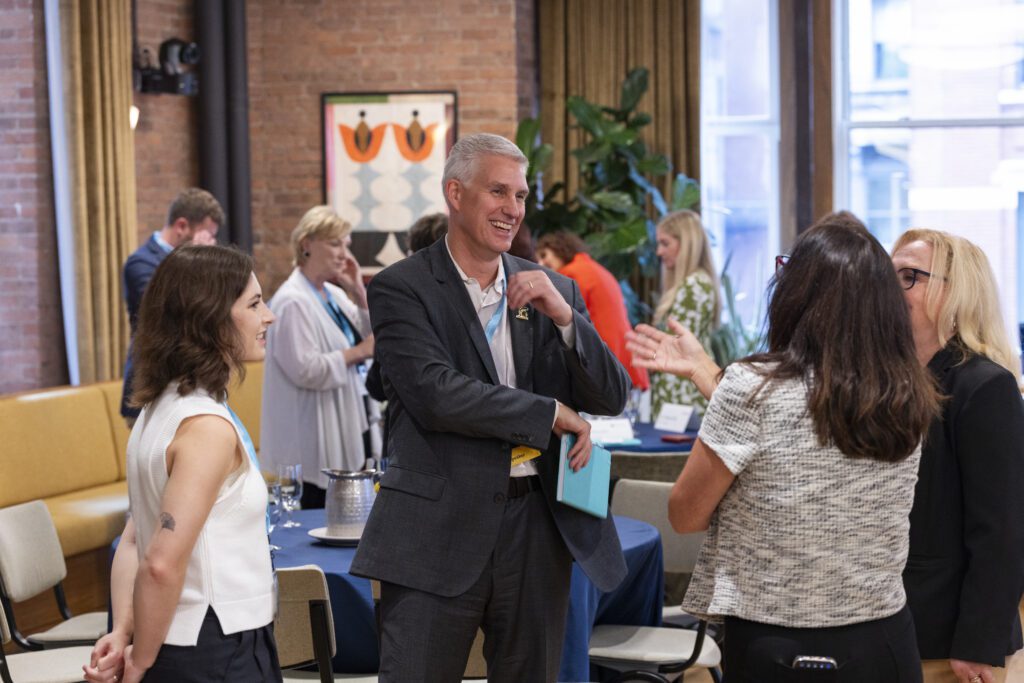
EAB examined how AI is reshaping tasks across occupations with Alex Martin Richmond, a labor economist at OpenAI. As technology takes on more predictable, repeatable work, the responsibilities that remain often require greater judgment, contextual understanding, and interpersonal skills.
Consider the difference between a typical college assignment and an early-career workplace assignment. In the classroom, students often receive a defined problem, clear instructions, a known audience, and a rubric that establishes what success looks like. At work, they may face competing stakeholder priorities, incomplete information, shifting deadlines, and no single right answer.
These are the characteristics of what researchers call messy jobs: work that is unpredictable, context-dependent, relational, and difficult to evaluate against fixed standards.
A nurse may use AI to summarize patient information but still needs to recognize a concerning change in a patient’s condition and communicate it effectively. A software developer may use AI to generate code but must understand the broader system, identify errors, and take responsibility when something fails.
Preparing graduates for this work requires more than teaching them to use AI tools. Students need enough foundational knowledge to recognize when an AI-generated answer is wrong, along with opportunities to practice making decisions when the right course of action is less obvious. For provosts, the question is whether these experiences are sufficiently embedded across academic programs or remain concentrated in a handful of courses.
EAB’s GenAI Curriculum Prioritization Assessment can help academic leaders identify programs where changes in the workplace make curriculum revisions most urgent.
-
Next step
Review where students practice making and defending decisions under realistic conditions, and consider how to make those experiences available across programs.
5. Turn individual AI experiments into institutional progress
The classroom examples demonstrated what is possible when faculty rethink teaching and assessment. But bringing those approaches to more students requires something different from provosts: a clear direction for institutional change.
Throughout EAB’s Provost Experience Lab, participants considered how to support faculty experimentation while creating a more consistent learning experience for students. Individual instructors can redesign assignments or introduce AI-enabled activities, but they cannot independently resolve questions about institutional expectations, professional development, curriculum priorities, or how student learning should be assessed.
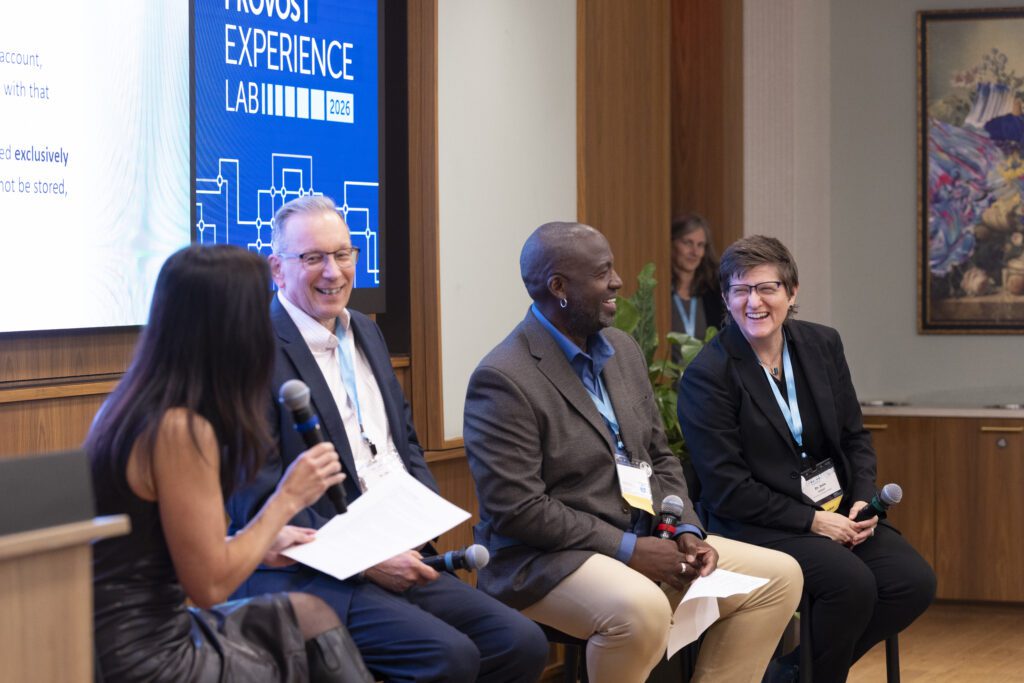
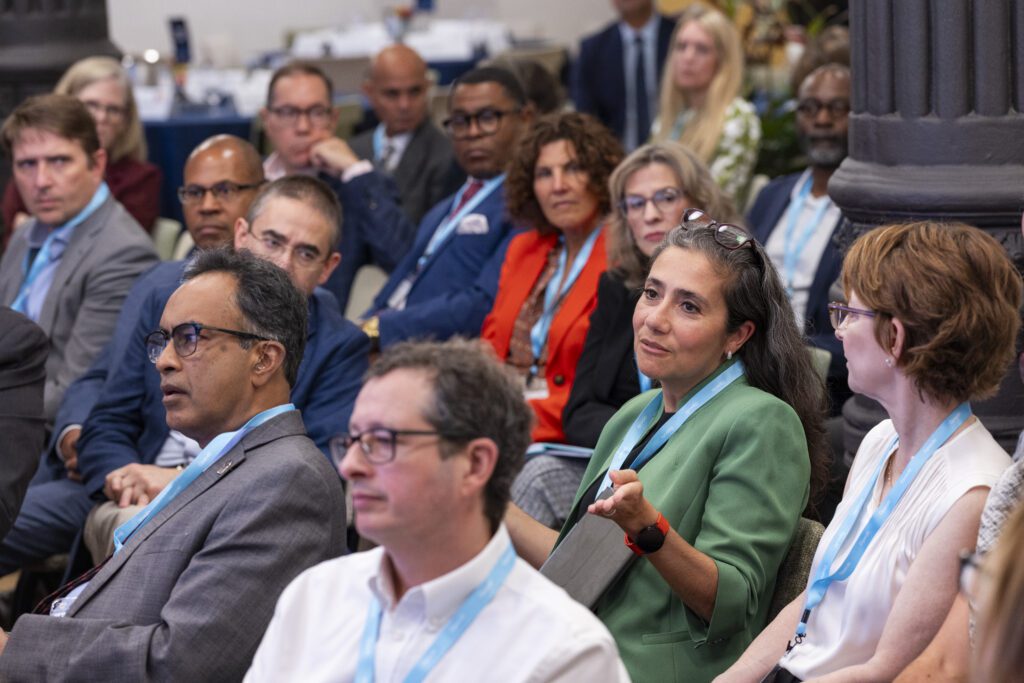
To bring the discussion back to campus, we asked provosts to look ahead to fall 2027. What did they want students and instructors to be able to say about teaching and learning? What stood in the way, and what could they do about it this academic year?
The goal isn’t to launch every initiative at once. It’s to establish a shared priority, identify what is preventing progress, and bring the right people together to act.
Provosts don’t need to prescribe how AI should be used in every classroom. They do need to help their institutions move beyond isolated experimentation toward a more coordinated approach to teaching, learning, and student preparation.
-
Next step
Choose one student or faculty outcome you want to achieve by fall 2027. Identify the most significant barrier to reaching it, then commit to a specific conversation or decision this academic year that will move the institution forward.
Expert guidance for your whole cabinet
If you are not a Strategic Advisory Services partner, fill out the form to learn more about how EAB can support your institutional goals, from smart AI adoption to long-term financial sustainability.

More Blogs

Higher ed isn’t ready for AI-scale cyberattacks

What we’re learning about AI governance in higher education