Empower high school counselors to strengthen your recruitment pipeline
High school counselors play one of the most influential (yet often underappreciated) roles in shaping higher ed enrollment outcomes. Every day, they guide students and families through applications, deadlines, and financial questions, bridging the gap between uncertainty and opportunity. When counselors trust and advocate for your institution, they can become one of your most effective recruitment channels and a continual source of qualified, right-fit applicants.
As a counselor for five years, I saw firsthand the difference counselors make in students’ lives. In my role at EAB, I am proud to have realized a long-standing goal of creating a Counselor Advisory Board for Appily, comprised of counselors from high schools and community-based organizations nationwide.
Recent conversations with members of Appily’s Counselor Advisory Board highlight what frontline advisors need most. Their insights, outlined below, highlight five ways counselors shape enrollment outcomes and how institutions can better support their work.
1. Counselors guide students through the noise
Students encounter no shortage of information during the college search, but volume does not equal clarity. Counselors help students interpret deadlines, statistics, and marketing messages, grounding the search in what truly matters for fit and opportunity.
To do that well, counselors rely on sources they trust. While institutional websites are an important starting point, counselors and students alike look for a credible second source to validate what they’re seeing and understand the real student experience. Appily was designed to serve that role. As one counselor explained,
“[Students feel] if you go to a college’s website, you’re only going to get really ‘pro-that-college’ information. If you’re going to a site that’s more objective, like Appily, you’re going to get facts.”
That distinction matters. Counselors help students discern which messages reflect genuine fit and opportunity, and when counselors have access to clear, unbiased data, they can deliver that guidance with confidence. Second sources like Appily complement, rather than compete with, your college website, helping students engage with greater trust early in the search.
2. Counselors help students expand their horizons
Many students begin their search with a narrow list of familiar institutions. Counselors broaden that perspective, introducing options that align with a student’s academic, personal, and financial goals, even when those schools were not initially on the radar. One Counselor Advisory Board member shared,
“We’re always looking for new ways to help a student figure out where they want to go… I want to make sure I’m giving kids a good depth and breadth of options.”
This work is about more than awareness. Counselors curate possibilities, ensuring students are not limited by misconceptions or incomplete information. Appily supports this effort by surfacing institutions that fit a student’s profile via the College Match feature, sometimes revealing strong matches the student may never have encountered otherwise.
When your institution appears in a counselor-facilitated discovery moment like this, it arrives with context and credibility, often leading to deeper exploration and more meaningful engagement.
3. Counselors bring clarity to a complex process
Applications, essays, test scores, financial aid forms, and college comparisons can quickly overwhelm students. Counselors break the process into manageable steps, help students prioritize, and keep them moving forward.
That clarity hinges on tools and resources that make exploration intuitive rather than intimidating. Appily’s solution is to allow students to create lists of saved colleges that meet their criteria. As one counselor noted,
“Appily’s [student] profiles take a minute to complete, and the student can save a list [of colleges they are interested in] right away.”
When students can organize their options, counselors can focus on meaningful guidance instead of troubleshooting technology or walking students through convoluted workflows. And when exploring your institution feels straightforward, students build confidence earlier in the journey, strengthening the path from inquiry to application.
4. Counselors help families navigate affordability and ROI
Cost remains one of the most stressful aspects of the college search. Sticker prices rarely reflect what students will actually pay, scholarship information can be difficult to compare, and conversations about value often carry fear of making the wrong decision.
Counselors help families distinguish between price and return on investment, identify realistic options, and avoid ruling out strong-fit institutions too early. Appily supports counselors in this work by showing scholarship estimates, cost information, and financial fit indicators directly alongside academic and cultural fit criteria. When this information is visible early in a student’s search, counselors can shift the conversation from anxiety to strategy, helping families understand which institutions offer attainable pathways and how various options compare. As one counselor put it:
“[Students] need money, and [Appily] marries down the costs via the college list.”
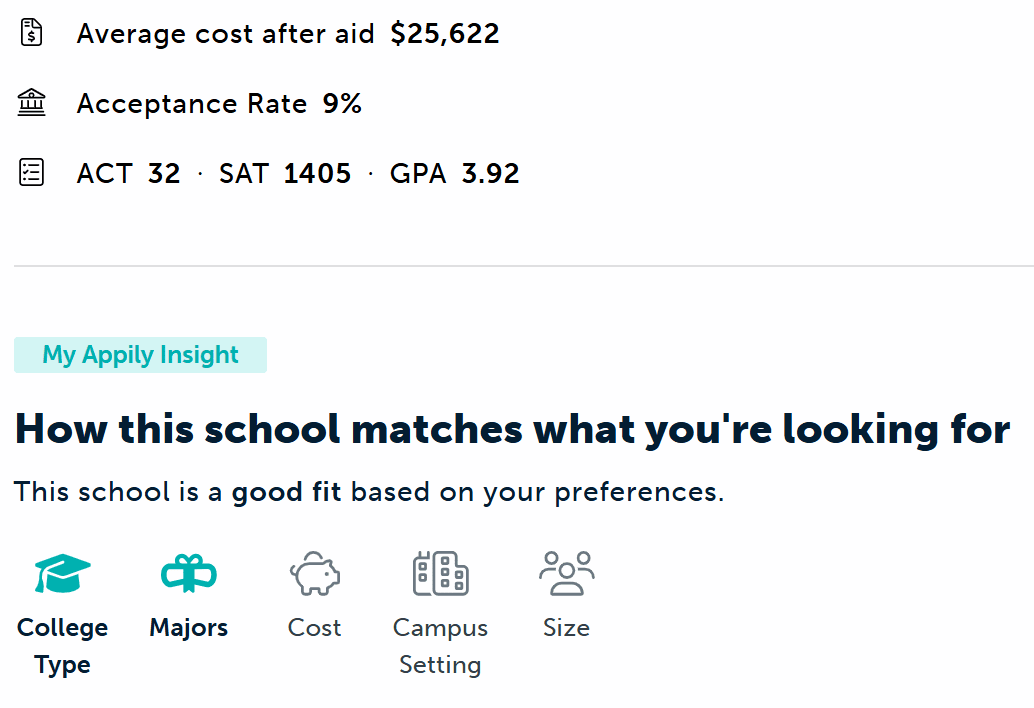
For colleges, this transparency strengthens your value narrative. When you can show that your institution may be more affordable than families assume or illustrate your return on investment clearly, counselors can help maintain momentum in the student’s decision-making process. As affordability aligns with interest, students engage more deeply and envision your campus as a realistic next step.
-


Reimagine the role your virtual tour plays in the college search process
Virtual tours don’t replace in-person visits in every case. Often, they serve as on-ramps. They give students a low-barrier way to get a feel for a school, decide whether it resonates with their goals, and determine whether an in-person visit is worth the time, cost, and logistics. For many students, especially those exploring colleges beyond their immediate region, a virtual tour is the first real moment a school becomes tangible.
Tools like Appily make it easier for counselors to connect students with these opportunities at exactly the right time. When virtual and in-person tour options are clearly presented alongside a student’s saved colleges, counselors can quickly help them take that next step while enthusiasm is high. And for institutions, these moments act as powerful drivers of further engagement. EAB analysis found that students who engage with an EAB virtual tour are 3.9x more likely to advance to an in-person visit.
In a competitive enrollment environment, small nudges matter. When counselors have seamless ways to guide students from curiosity to campus engagement, they accelerate the journey toward enrollment—and help students make informed, confident decisions.
The bottom line
Counselors sit at the heart of the college search, guiding students through one of the most complex and pivotal decisions of their lives. They interpret information, broaden horizons, simplify next steps, demystify affordability, and encourage students to meaningfully engage with campuses. When colleges recognize and support this work, they strengthen one of the most influential channels in their enrollment strategy. As Counselor Advisory Board member Sarah Macallum of Noble School shared,
“There is so much joy in this work. It can be really tough, but helping students prepare for what is next after they have worked so hard in their high school career is really rewarding.”
That joy carries responsibility. Colleges that invest in meeting counselors’ needs earn advocates who champion their campuses every day. For institutions looking to deepen their connection to the counseling community, partnering with solutions that prioritize counselor needs is a powerful place to start.
Build credibility where student decisions take shape
Students and counselors look for trusted, unbiased sources to navigate the college search. Appily positions your institution through counselor-trusted channels that strengthen confidence and drive meaningful engagement with right-fit students. Connect with us to explore how Appily fits into your enrollment strategy.

More Blogs

Marketing teams are stretched thin. Here’s what the data says to do next.

Five tips to recruit community college students for this fall (and beyond)