Five areas enrollment leaders are prioritizing in 2026
A read on your peers’ most pressing concerns
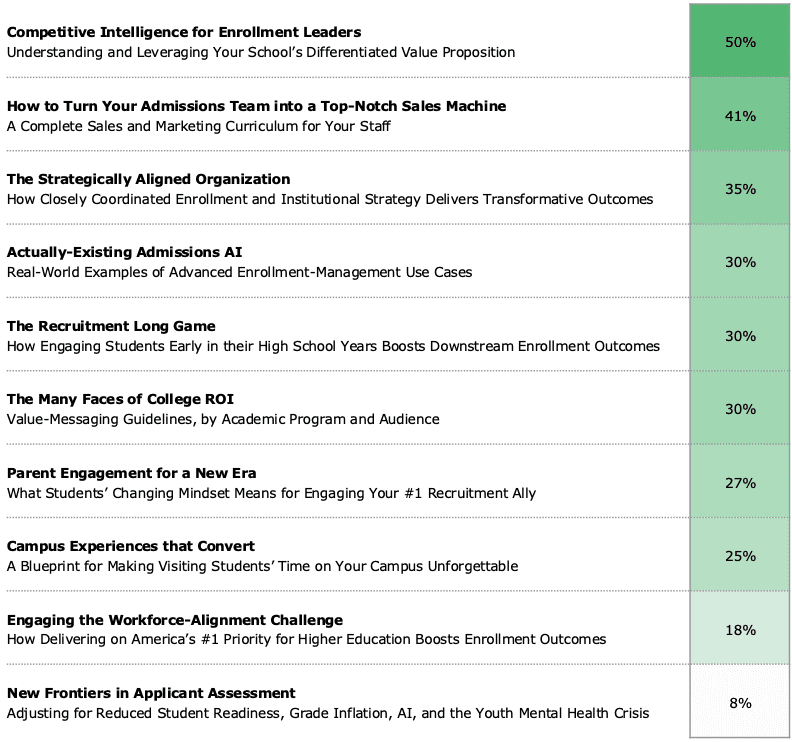
Each year, EAB’s enrollment management division conducts a survey of VPEMs and their teams to help set our research agenda for the coming months. This year we explored ten potential areas of inquiry, from competitive intelligence to enrollment AI. Below is some commentary on the five highest-ranking topics (those chosen by 30% or more of respondents). Included are observations about how the topics resonated with schools of varying types–large and small, public and private, more and less selective–and how interest varied by respondent title.
1. Competitive intelligence
Topping our poll, chosen by 50% of respondents, was “Competitive Intelligence for Enrollment Leaders; Understanding and Leveraging Your School’s Differentiated Value Proposition.”
The high level of interest in this topic comes as no surprise, given that schools are fighting over a shrinking pool of college-goers—a state of affairs that makes institutions’ ability to stand out more important than ever. The “value” part of the title also probably had something to do with its popularity, given the increasingly widespread feeling among the general public that college is not worth the cost (and our corresponding need to prove them wrong).
Segment-wise, public and private institutions both ranked the topic #1, it was especially popular with more-selective schools, and it was the top pick of both VP and non-VP respondents. Large and small schools both ranked this topic #1, though probably for different reasons. Large schools are facing more cross-regional competition, given students’ increasing willingness to travel greater distances for college, geographical variation in the growth of college-going populations, and the natural advantages some parts of the country have in attracting students (e.g., favorable climate). Smaller schools’ interest probably reflects a more general concern for competitiveness–due, for example, to the well-established trend of students increasingly favoring larger institutions.
2. Sales upskilling
The second-highest-scoring topic, chosen by 41% of respondents, was “How to Turn Your Admissions Team into a Top-Notch Sales Machine: a Complete Sales and Marketing Curriculum for Your Staff.”
Several factors likely account for the popularity of this topic. One has already been mentioned—intense competition over prospective students. Another is the high rate of turnover in the junior ranks of admissions teams, which creates a correspondingly heavy training burden. Yet another is ongoing growth in the size of admit pools, which is requiring us to scale and/or triage the kind of intensive personal engagement on which converting prospective enrollees depends—efforts on which enrollment leaders are eager for guidance.
While there was broad interest in this topic across institution types and respondent titles, it was least often cited by larger, more selective institutions—i.e., schools that tend to have greater draw with prospective students and may believe that they don’t have to work as hard to convert them.
3. Strategic alignment
The third-highest-scoring topic, chosen by 35% of respondents, was “The Strategically Aligned Organization: How Closely Coordinated Enrollment and Institutional Strategy Deliver Transformative Outcomes.”
The popularity of this topic likely reflects enrollment leaders’ growing conviction that their schools must have a differentiated value proposition in order to succeed—something that can only be worked out through strategic planning efforts at the highest level of their organizations. Other surveys we’ve done with VPEMs have shown them to be very interested in adjacent concerns such as brand strategy and ways of better aligning their institutions’ offerings with community needs.
This topic ranked highly with large schools but had considerably less traction with small and medium-sized institutions. It was also not popular with less selective schools. While this may be a sign that the latter group underestimates the potential of better strategy to boost their enrollment outcomes, it may also reflect the greater urgency that they give to more immediate, short-term fixes to their recruitment challenges. It could also be a manifestation of the resource constraints more often faced by smaller, less prestigious schools and an attendant lack of capacity for intensive strategic planning work.
4. AI
The fourth-highest-scoring topic, chosen by 30% of respondents, was “Actually-Existing Admissions AI: Real-World Examples of Advanced Enrollment-Management Use Cases.”
The popularity of this topic makes sense, given the ongoing ubiquity of AI in the news, in vendor pitches, in product releases, and everywhere else. Some of the interest in the topic is probably also attributable to the hype-busting aspect of it. Many enrollment leaders find themselves in the frustrating position of feeling they have to do something with AI but being overwhelmed and confused by the torrent of related information coming at them—information that can often be vague, inaccurate, or misleading.
The topic was considerably more popular with VP-level respondents, presumably because of the more direct role they play in acquiring related technologies and spurring adoption of AI (relative to their more junior counterparts). Its popularity was also greater with larger, more selective schools–possibly a reflection of more generous technology budgets at such institutions.
5. Early and sustained student recruitment
Tied with the AI topic in terms of popularity, having been chosen by 30% of respondents, was “The Recruitment Long Game: How Engaging Students Early in their High School Years Boosts Downstream Enrollment Outcomes.”
Like several of the other topics on the list, the popularity of this one likely stems from enrollment leaders’ keen sense of increasingly stiff competition for college-bound students; i.e., they are looking for anything that might give them an edge. It presumably also reflects the growing array of channels through which schools are reaching out to prospects and the overall increase in recruitment marketing activity that that represents. Some respondents are also likely aware of research showing that reaching out to prospective students earlier in their high school years increases their likelihood to apply and enroll.
Interest in the topic was comparable across several school segments, including publics and privates and more and less selective schools. Its popularity did, however, differ quite a bit by school size; while it was the third most popular topic for medium-sized schools, markedly fewer small and large institutions rated it highly. In the case of large schools, this may be due to a belief that their better name recognition and naturally greater ability to draw students makes intensive outreach less necessary. That view does, however, underrate the role that well-executed recruitment marketing can play in helping large institutions compete against other, comparably advantaged big institutions. Smaller schools, similarly, may think that their profile is already sufficiently high among students in their typically very local prospect pool—in which case, like large institutions, they are undervaluing the advantage that better engagement of prospects can confer on them in competition with local peers and with the non-four-year alternatives that are increasingly popular with the populations many of them have traditionally served.
What’s next
Thanks to those of you who participated in the survey; it does a lot to keep us focused on your most pressing concerns. Keep an eye out for related content from our team in the coming months, and please share with us any thoughts you may have about our research agenda, including ones concerning any topics from the full list of ten we vetted in the poll—see below.
The full list of ten topics vetted in the poll
Listed in descending order of popularity, with the percentage of respondents choosing each. Poll participants were instructed to choose their top three out of the ten topics.

More Blogs

Marketing teams are stretched thin. Here’s what the data says to do next.

Five tips to recruit community college students for this fall (and beyond)