Is your yield rate okay?
Yield rate—the percentage of a school’s admitted students who ultimately accept their offer of admission—is often used by higher education leaders as a measure of their school’s ability to prevail over other institutions and of their enrollment team’s effectiveness.
While yield rate does reflect these factors, it can be misleading if not understood in context. Considered on its own, a lower-than-average rate or one that is dropping over time might be interpreted as poor recruitment performance. In fact, such conditions may be entirely consistent with appropriate enrollment strategy and strong downstream outcomes.
Reduced yield is inevitable
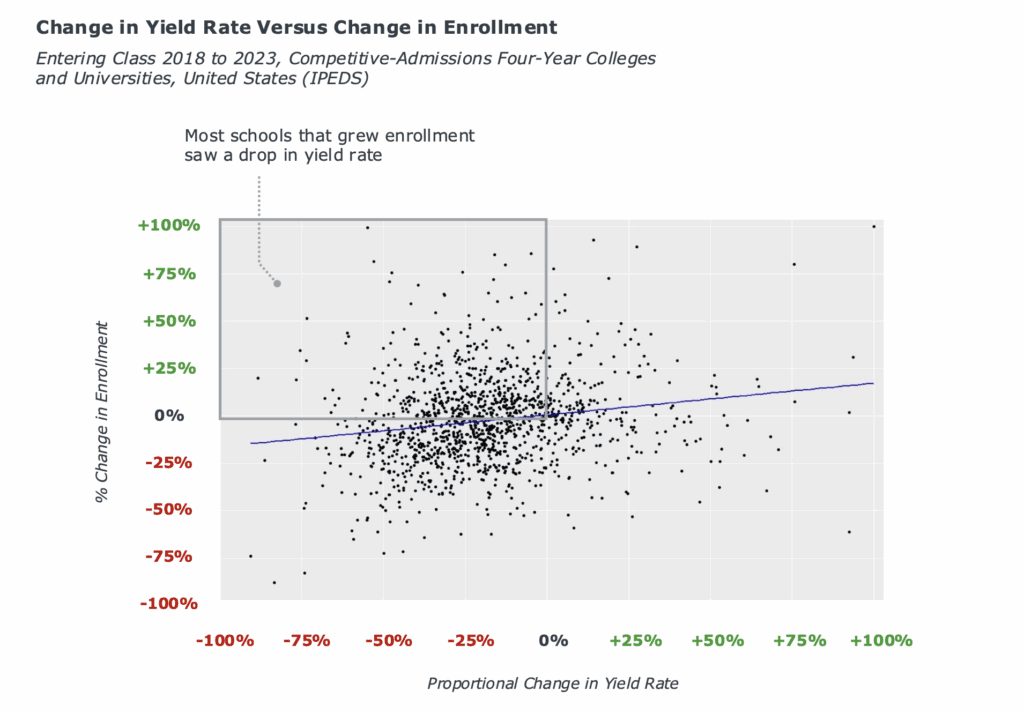
Increasing or even maintaining enrollment in today’s hypercompetitive higher education marketplace depends on outsized application growth—which generally drives outsized admit growth. Because the overall pool of college goers in the US is shrinking, and students are applying to more schools, most institutions have more ability to increase their admit population than they do to increase enrollment. And when admits grow more than enrollments, yield rate goes down. This is a mathematical inevitability. In other words, the very steps you need to take to protect enrollment are likely to decrease your yield rate.
How this dynamic has played out at the nation’s colleges and universities in recent years is illustrated by the chart below; growth in enrollment has, more often than not, been accompanied by declining yield rate.
A yield-management imperative
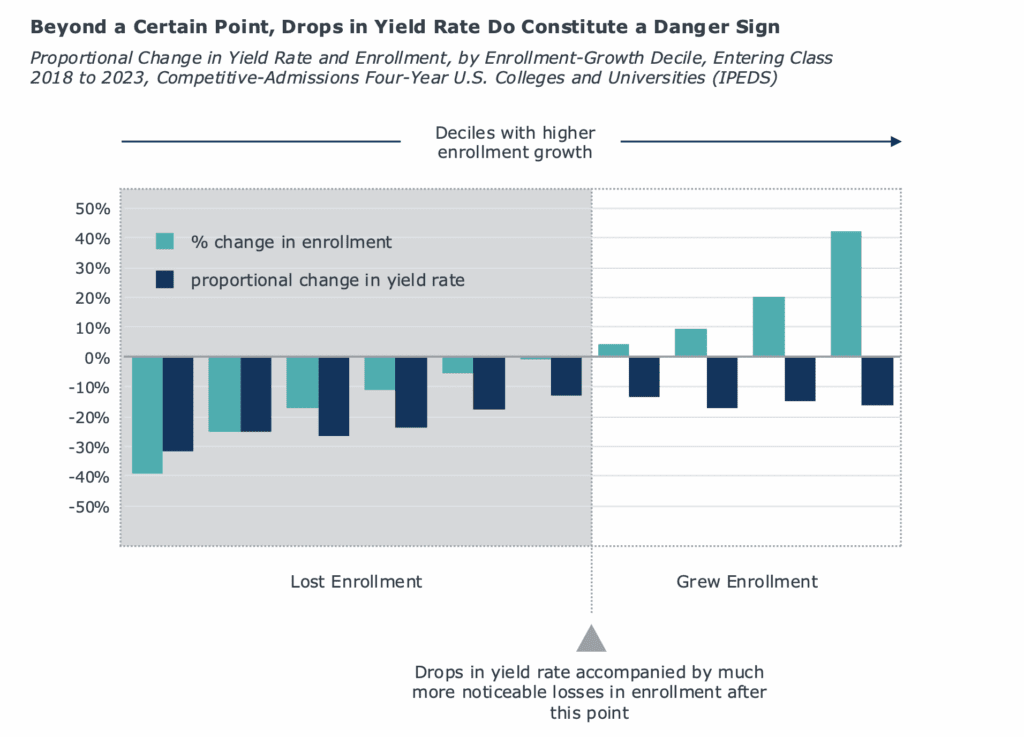
That doesn’t mean you shouldn’t be working to improve your yield performance! No school can afford to leave any enrollment potential on the table in today’s shrinking market. And that’s exactly what you’re doing if you’re not striving to convert as many admitted students as possible. Furthermore, as indicated in the chart below, there is a threshold beyond which drops in yield rate do have a significant negative impact on enrollment outcomes and therefore merit your urgent attention.
Steps enrollment leaders should take
Recognizing that improved yield performance will, for most enrollment leaders, be just one among several competing priorities, the first thing you’ll want to do is get a read on urgency. If you’ve seen a proportional drop in your rate of more than 20% in the past five years, that could be a sign that you’re in the danger zone—especially if your rate is dropping faster than your applications are increasing and if you’re losing enrollment. That is grounds for throwing yourself fully into the effort. If you’ve seen smaller drops in your yield rate and are enjoying robust application growth, you’ll not want to treat it as a crisis. But you should still ensure that you’re following proven yield-management best practices, in the spirit of basic due diligence. Whichever camp you fall in, our latest report on yield and melt management will provide you with a blueprint for progress.

More Blogs

Marketing teams are stretched thin. Here’s what the data says to do next.

Five tips to recruit community college students for this fall (and beyond)