Is University College Cork’s Market Attractive Index the answer to our diversification challenge?
Most universities know they need to diversify their international recruitment portfolio.
That imperative has only become more urgent. Traditional source markets are becoming less predictable, competition is expanding well beyond the traditional ‘Big Four’, and there is no single market waiting to replace the scale once provided by China. Moreover, many universities remain heavily reliant on international recruitment to support long-term financial sustainability. Diversification is no longer simply about growth; it is about resilience.
Yet knowing diversification is important and knowing how to achieve it are two very different things. Some universities told us their diversification strategy had not been revisited in years. Others admitted they had accumulated so many ‘priority’ markets that prioritisation had become nearly impossible. Many knew they needed to act; they just lacked a clear way to decide what came next.
We need to diversify away from our three major volume markets… we need to shore up smaller regions and have a more diverse base.
Head of International Recruitment
European University
What makes this particularly frustrating is that universities are not short on information. Recruitment teams have access to more market intelligence than ever before—from demographic forecasts and outbound mobility trends to visa data, economic indicators, and student demand signals. Yet more information rarely makes the decision any easier. Instead, leaders often find themselves choosing between two unsatisfying options: following the latest market buzz or gathering more data in the hope that clarity is just one more report away.
Neither approach makes diversification easier. Without a consistent way to compare opportunities, decisions become harder to justify, investment becomes harder to prioritise, and diversification remains an aspiration rather than a strategy. That is where University College Cork’s Market Attractiveness Index offers a compelling alternative.
How University College Cork turned data into decisions
University College Cork’s Tarik El Amoud, International Manager for College of Business, and Lenka Forrest, Head of Recruitment, approached diversification differently. Rather than evaluating markets on an ad hoc basis, the team developed a Market Attractiveness Index that allows both existing and emerging markets to be assessed through a consistent decision-making framework.
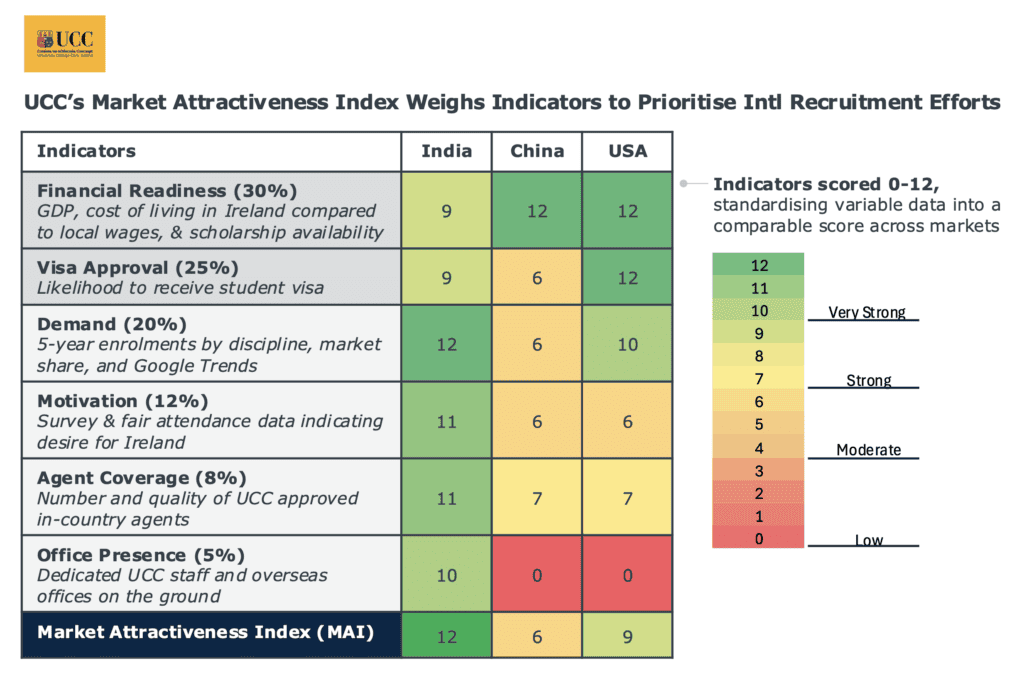
UCC’s Market Attractiveness Index Weighs Indicators to Prioritise Intl Recruitment Efforts
The model combines indicators, like financial readiness and student demand, into a single weighted score. Importantly, factors that have the greatest influence on enrolment conversion carry more weight than those that are merely informative.
The goal was not to predict the future or eliminate uncertainty. It was to create a shared process for evaluating opportunities and prioritising investment. Instead of relying on instinct, historical precedent, or whichever market is generating the most attention, teams can compare opportunities using a common framework.
That shift matters because diversification is not a one-time exercise. Markets evolve, university priorities change, and new opportunities emerge. UCC’s framework provides a way to reassess those opportunities over time while maintaining a consistent approach to decision-making.
The broader lesson is simple: successful diversification depends less on finding the perfect market and more on establishing a clear process for evaluating opportunities.
Build the decision framework before you pick the market
UCC’s Market Attractiveness Index demonstrates one way to bring greater discipline to market selection. But identifying promising markets is only half the challenge. Universities also need a clearer understanding of who their true competitors are—and how student decision-making is reshaping the competitive landscape.
EAB’s research explores both sides of that equation: building structured frameworks to evaluate emerging markets and helping institutions identify the competitor destinations that matter most. Together, these approaches enable recruitment teams to move beyond reactive diversification and make more confident, evidence-informed investment decisions.
Let’s Talk About Your Priorities
To find out how to build your university’s decisions framework, get in touch with us by filling out the form below.

More Blogs

Higher ed marketing is having a moment. Here’s why.

Should a student’s journey on campus be as challenging as Odysseus’ journey home?