Career readiness can’t wait until junior year
For today’s students, the distance between college and career has narrowed. Employers expect applied skills sooner. Students want clearer connections between coursework and work. And generative AI is changing the landscape of early-career roles in real time. Together, these shifts raise the stakes for career readiness and point to a clear conclusion: career exploration can no longer wait until junior or senior year.
Institutions have a role to play in helping students connect learning to opportunity earlier. For First-Year Experience (FYE) leaders, that shift creates both urgency and opportunity. The first year has always focused on belonging and momentum. Increasingly, it must also help students answer two foundational questions sooner: Why am I here? and Where could this lead?
The limits of the traditional career timeline
Underemployment among college graduates remains stubbornly high, with many alumni landing in roles that do not require a bachelor’s degree. Internships can reduce that risk, but access is uneven—and, critically, they often arrive too late to shape early academic decisions.
According to Strada’s national report, a stark number of recent graduates aren’t landing jobs that require a degree:
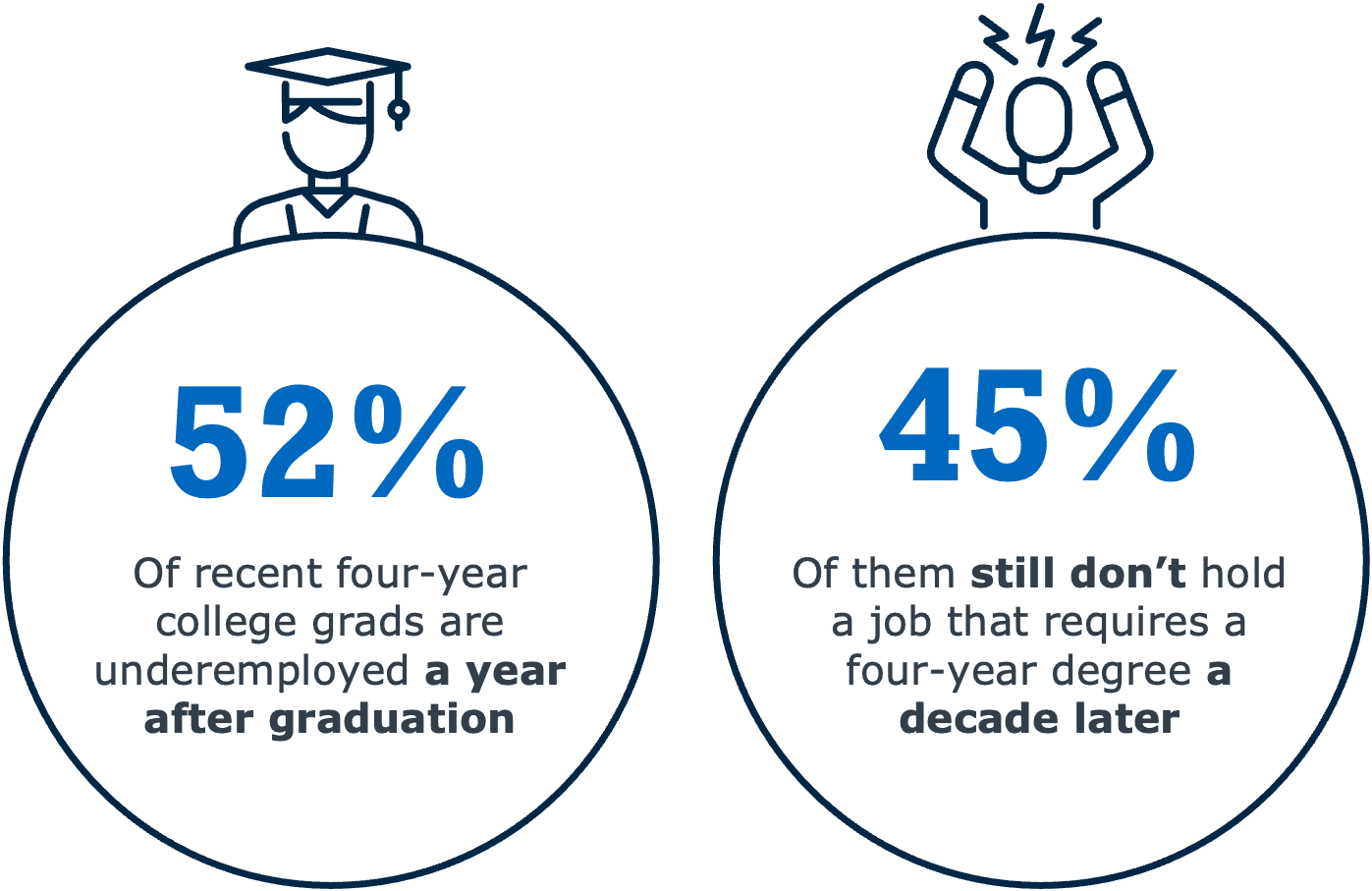
From an FYE perspective, the core issue is timing. Many institutions intentionally delay career conversations to avoid overwhelming new students. That instinct made sense when early academic choices were easier to revise and employer expectations were slower to materialize. It works far less well now.
By the time career planning becomes urgent, many students have already made consequential decisions about majors, programs, or transfer pathways—often without a clear picture of how those choices translate to work.
What first-year students actually experience
Most institutions encourage exploration, but the tools students encounter rarely provide meaningful insight. A typical first-year experience includes:
- A one-time interest inventory during orientation
- A list of majors paired with broad, generalized job outcomes
- Advising conversations that feel abstract without concrete examples of work
What’s missing is exposure to what professional work actually involves. Without that context, students struggle to connect coursework to opportunity. For FYE teams, this shows up in familiar ways: students questioning the relevance of required courses or having difficulty articulating goals during advising conversations.
Why early, low-risk career discovery works
Research consistently shows that early experiential learning—paired with structured reflection—improves motivation, persistence, and students’ ability to describe their skills. FYE programs already excel at this kind of learning.
Orientation programs, first-year seminars, learning communities, and co-curricular initiatives routinely engage students in applied projects, reflection, collaboration, and problem-solving. These experiences build confidence and transferable skills long before students think about internships or job searches.
The opportunity now is to extend that strong foundation toward early career discovery. Short, low-stakes experiences can connect the reflective, hands-on work FYE teams already lead with exposure to real careers—without adding undue burden for students or staff.
A practical model for the first year
Virtual, employer-designed simulations offer a way to make career exploration concrete early on. Used well, these experiences allow students to try out professional tasks, reflect on what they learned, and begin forming a more grounded sense of fit and interest.
Forage’s Career Explorer gives first-year students a safe, low-pressure way to explore careers through short job simulations designed by real employers. There’s no application process, no GPA threshold, and no cost.
For FYE teams, Career Explorer works because it:
- Requires no prior experience
- Fits easily into first-year seminars or orientation courses
- Emphasizes learning and reflection, not commitment
A realistic example: A first-year student completes a Forage simulation as part of a seminar assignment. They practice analyzing information, drafting a professional response, and making basic judgments. Through reflection, they begin to articulate what felt engaging and what didn’t. That experience becomes a concrete anchor for class discussions and advising conversations.
As detailed in EAB’s research, these simulations are most effective when paired with structured reflection and early advising touchpoints. Faculty-led studies show students who complete these simulations report clearer understanding of professional work and greater confidence in their skills, even early in their academic journey.
-


More insights
Explore EAB’s insight paper to learn how colleges can best use technology to help students build early-career momentum.
What This Looks Like in a First-Year Seminar
- Students complete the Forage Career Explorer simulation (30-40 minutes)
- Guided reflection on skills and interests
- Advising conversations grounded in experience, not speculation
Turn Exploration into Momentum with Journeys in Navigate360
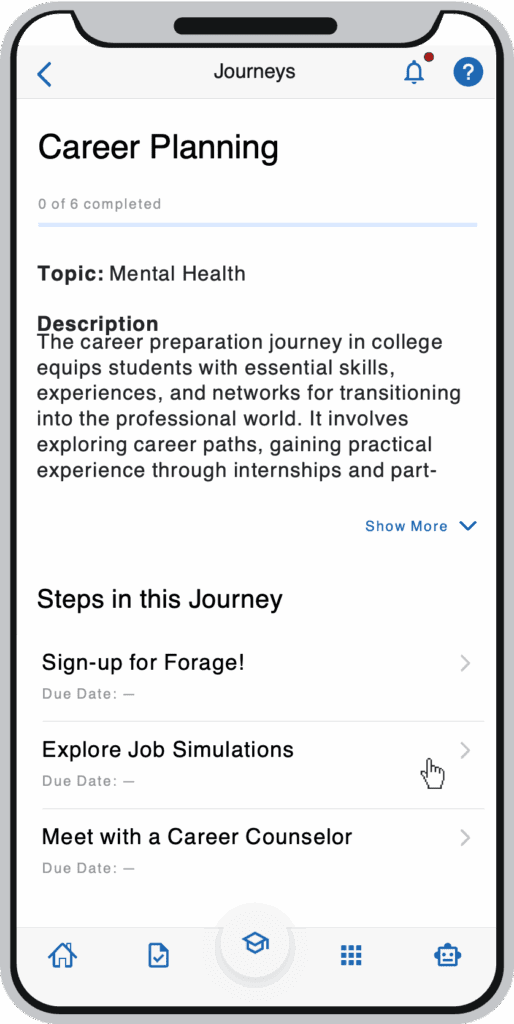
Early exposure matters, but structure makes it stick. Using Navigate360 Journeys, institutions can ensure career exploration is intentional and equitable rather than optional. Journeys organize steps and action items into a single guided pathway for students that staff can assign, monitor, and manage. So, students know what to do next, and teams can monitor progress across shared milestones.
The elephant in the room: AI is reshaping the entry level workforce
Generative AI is reshaping early-career work. Tasks that once defined entry-level roles—first-pass research, basic analysis, routine documentation—are increasingly automated. As those tasks disappear, students have fewer opportunities to learn by osmosis once they reach the workplace.
That shift makes early, institution-led practice more important, not less. Low-risk experiences in the first year give students time to explore, practice, and build confidence well before internships or job searches begin. Because these experiences are scalable and asynchronous, they also expand access for working students, commuters, and first-generation learners.
Start here: A checklist for FYE teams
Early career exploration does not require a wholesale redesign of the first year. Small, intentional steps embedded into existing structures can make a meaningful difference:
-

Anchor exploration where students already engage
First-year seminars, orientation courses, or learning communities.
-
Use low-risk experiences to spark curiosity
Short simulations or applied projects that students can complete independently.
-
Build in reflection, even briefly
Ask what surprised students and which skills they used.
-
Connect exploration to academic planning
Reference early experiences in conversations about majors, programs, or transfer pathways.
-
Pilot, then scale
Start with one course or cohort and expand based on what works.
A first-year success strategy
Career readiness is no longer a downstream outcome. It is a first-year success strategy. When students see how their education connects to opportunity early, they are more likely to persist, engage, and make intentional choices.
As new accountability frameworks increasingly tie institutional success to graduates’ economic outcomes, early career exploration is becoming a strategic imperative. For FYE leaders, it is also a natural extension of the work they already do best: helping students build purpose, confidence, and momentum from day one.

More Blogs

Student success as a revenue strategy in higher education

What matters to student success teams in 2026