What matters to student success teams in 2026
As a Strategic Leader, my role is to work closely with individual institutions to understand their unique goals and help them make progress toward what matters most. But one of my favorite ways to spot broader patterns is through the polling we conduct across our Navigate360 and Starfish partners ahead of each academic year to understand what’s top of mind for them.
That insight is especially valuable right now. Student success teams are juggling more complexity than ever, often with limited staff and resources. Understanding how your peer institutions are prioritizing, and where they’re feeling stuck, can make it easier to focus your efforts where they’ll have the greatest impact. Below are the high-level themes we heard in our 2025–26 academic year poll, along with practical ways to respond if these challenges feel familiar on your campus.
What student success teams are prioritizing in 2026
When leaders described their strategic goals for the year ahead, three themes dominated responses.
-


Mini retention milestones
Institutions remain squarely focused on retention, persistence, and graduation. But many teams also cited cohort-specific goals (first-year, transfer, historically marginalized populations) as well as progress-related outcomes like gateway course completion.
-

Expanding support networks
Leaders want a stronger student success ecosystem. They want support that feels proactive, coordinated, and data-informed rather than reactive and siloed. Leaders frequently pointed to belonging and community as core elements of a strong student success experience, particularly for first-year and historically marginalized students.
-

Aligning academics to post-grad success
Many institutions are connecting student success more explicitly to academic and career outcomes. The focus has shifted beyond course progression to include career readiness, job placement, and post-graduation success.
Click here to learn how technology prepares students for career success.
Across these themes, leaders are getting more specific about how they improve outcomes. Many are narrowing their focus to the moments—and the student cohorts—where timely, coordinated support is most likely to change trajectory, rather than applying the same approach across all students and stages.
The challenge for student success leaders
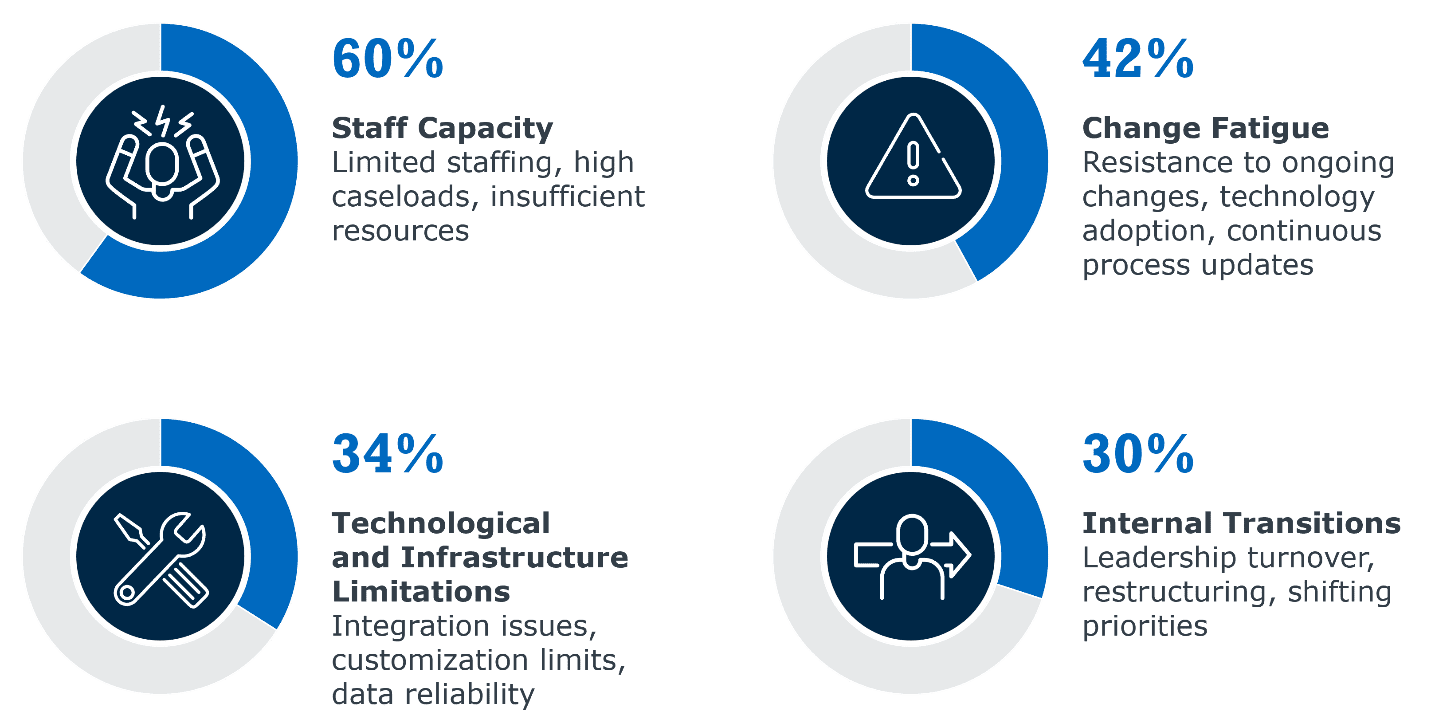
When we asked higher education leaders to identify barriers to achieving their strategic goals, these four challenges surfaced most often.
Using AI to reclaim time for high-impact student support
Capacity-saving automation and agentic AI have evolved from a “nice to have” to a necessity. In Navigate360, AI is intentionally designed around the real operating constraints of modern student success teams. Because it’s fully embedded into existing workflows, built-in guardrails ensure it’s safe to use—and there’s no extra technology to learn. With Navigate360’s agentic AI, every full-time user can reclaim 10+ hours per week, creating more capacity for high-impact, human conversations.
85% of Navigate360 partners use our AI features.
Four takeaways for student success teams to improve student outcomes in 2026
With staffing turnover and change fatigue still high, institutions are narrowing their focus. The shift is away from launching new programs and toward making their core retention efforts run more predictably: earlier signals, clearer ownership, fewer handoffs, and tighter measurement. In practice, that adaptation shows up in four moves that make student support easier to execute at scale.
1. Treat retention as a set of milestones, not just an annual outcome metric
Retention improves when campuses manage the term like a sequence of decision points. Many institutions are already moving in this direction by setting cohort-based goals and focusing on gateway course completion and other momentum milestones. The advantage is speed: milestones move faster than year-end rates, and they tell you where to intervene earlier.
-

Institutions act faster on cohort retention priorities
Learn how 40 Navigate360 partners operationalized cohort-focused retention priorities by defining a focus population, setting short- and long-term objectives, and running strategic advising campaigns at scale.
2. Don’t stop at early alerts, clearly define the “next step”
Most institutions already have early-alert signals. The differentiator is follow-through. Strong systems translate flags into consistent triage rules, clear ownership, and repeatable outreach that students actually receive. That’s how early alerts become earlier action, rather than more noise. For example, instead of an advisor simply receiving an alert that a student is failing a gateway math course and deciding on next steps on their own, a stronger system routes the case to the student’s assigned advisor, prompts a pre-built outreach message inviting the student to sign-up for tutoring, and then tracks whether the student attends and how long it takes the case to resolved.
3. Monitor implementation health to catch breakdowns early
When capacity is tight, leaders can’t wait for end-of-year retention data to learn what’s working. Our partners are digging deeper into retention and graduation outcomes with operational metrics like faculty response rates, service utilization, DFWI trends, and case closure. Those measures help teams see whether the strategy is working this term—and adjust before the year is over.
-
Faculty progress reports drive early intervention
When the University of Louisville saw faculty-submitted progress reports in Navigate360 were below 50%, they treated response rate as a leading indicator—not a nice-to-have. See how they raised submission to 78.5% in one year, contributing to a 5.5% increase in next-term persistence.
4. Expand coordination where it removes friction fastest
Institutions are also broadening “student success” beyond advising to the offices that routinely create student friction. A Coordinated Care Network works when teams share context, reduce duplicative handoffs, and close the loop across units. For many partners, that means bringing additional offices into the student success platform so referrals, information sharing, and follow-through stop depending on informal emails and individual memory.
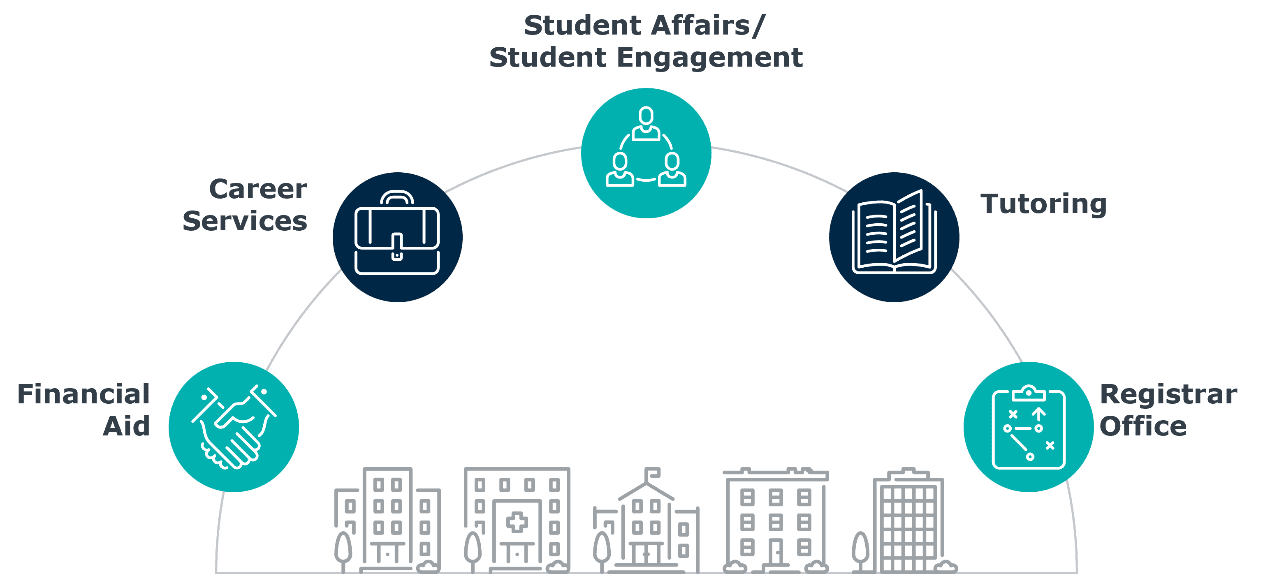
A practical starting point is where leaders most often cite near-term expansion: Financial Aid, Career Services, Student Affairs, Tutoring/Writing, and the Registrar. These areas tend to generate repeat student runaround—so tightening workflows here can have a huge impact on the way students experience care.
EAB partners have a head start
For Navigate360 and Starfish partners, your student success CRM positions you well to implement these strategic changes. It consolidates student data from multiple systems, including your LMS and SIS, into unified student profiles, creates consistent processes for early alerts and interventions, and leverages AI to help draft messages, summarize cases, and suggest next steps. Connect with your Strategic Leader to explore which additional strategies and capabilities could deliver the greatest impact at your institution.
What this moment requires from student success teams
This survey confirmed what many student success leaders have been feeling for a while: the work has outgrown the infrastructure supporting it. But rather than scaling back expectations, institutions are fundamentally rethinking how to achieve them. They’re focusing on earlier intervention, cleaner handoffs, and systems that don’t require constant manual effort to maintain. The strongest strategies for 2026 are the ones your team can actually sustain while still leaving room for the human work that matters most.

More Blogs

Student success as a revenue strategy in higher education

Career readiness can’t wait until junior year