What Blockbuster can teach enrollment leaders about AI-powered college search
When was the last time you went to Blockbuster to rent a movie? Unless you live in Bend, Oregon, home of the last Blockbuster since 2018, it’s probably been decades.
At its early-2000s peak, Blockbuster seemed as foundational and immutable as grocery stores, cars and highways. I’m old enough to remember when it dominated the movie-consumption experience in America. And yet, by 2013, it had virtually disappeared from the retail landscape.
Blockbuster missed out on the rise of the Internet and streaming, but not because its leaders didn’t notice the dot-com boom or didn’t understand the technological possibilities that the Web might bring. It was because their pre-Internet success made them believe that they had time to wait and see how the Internet transformation would play out.
Avoiding uncertainty paralysis
I’ve been thinking about Blockbuster a lot as conversations about AI and college search accelerate, because it’s a relevant and cautionary tale about how to deal with uncertainty and technology-driven change.
It’s tempting to treat AI as almost mystical: so complex and fast-moving that meaningful planning feels impossible.
But as computer scientist Melanie Mitchell recently told The New York Times, it’s a misconception to believe “that A.I. has ‘magic’ or ‘emergent’ abilities that are impossible to understand and predict.”
Many dimensions of the AI-powered future are hard to anticipate, to be sure, but the possibilities for how college search will evolve due to AI are not unlimited—which is why we pursued a scenario planning approach in our recent insight paper, College Search in the Age of AI. It is designed to help enrollment leaders begin to anticipate likely outcomes and assess their implications.
4 AI college search scenarios enrollment leaders should prepare for
We developed and analyzed four different scenarios through our research:
- AI-Everywhere College Search, in which AI assistants serve as the primary tool for researching, comparing, and applying to colleges, supplanting traditional websites and human intermediaries.
- AI-Limited College Search, where safety concerns and regulatory actions lead to wide-scale limitations on AI, resulting in restricted access for teens as they conduct their college search.
- AI-Accelerated College Opt-Out, in which automation reshapes early-career jobs, skepticism about the value of higher education grows, and students move toward college alternatives.
- AI-Saturated Flight to Authenticity, where students are fatigued by artificial and synthetic content, and so gravitate toward a more authentic college-search experience, opting for human-driven interactions wherever possible.
This was a strategy exercise, not a séance, so we’re making no promises about exactly how the future will unfold. In fact, it’s almost certain that tomorrow’s college-search environment will contain elements of all four scenarios.
How AI is already changing the college search process
Above all, the biggest trend to be mindful of is how quickly AI is becoming a primary tool for college search-related activities. In our most recent polling, 46% of college-bound high school students are using AI to gather information, compare options, and make decisions, often before they ever visit a college website or speak with an admissions counselor.
-


46%
of college-bound high school students are using AI to gather information, compare options, and make decisions
The world is changing fast, and the lesson of Blockbuster reminds us that in times of disruption, you shouldn’t just worry about betting on the wrong future—you should be equally worried about waiting too long and missing out on major changes in the market.
The good news is, the more we thought about it and talked to experts in AI, enrollment, marketing, and student behavior, we determined there are many actions that colleges can take today to position themselves for success. In fact, we came up with eight different implications that will be critical drivers of success in any future. Enrollment and marketing leaders should be evaluating and prioritizing these today, even as AI’s impact continues to unfold.
Plan for Continuous Adaptation
Leaders should build agile, cross-functional teams capable of ongoing experimentation, rapid learning, and response to emerging technologies and regulations.
Optimize for AI as an Audience
Colleges must ensure their digital content is accurate, structured, and machine-readable so AI systems consistently present them clearly and correctly to students.
Invest (More) in Brand Management
Enrollment leaders should actively monitor and shape how their institution is portrayed across the digital ecosystem—by AI agents as well as by human audiences.
Elevate Human Connection
Institutions should intentionally scale authentic, person-to-person interactions that build trust and affinity in an increasingly automated search environment.
Strengthen Parent and Counselor Relationships
Colleges must deepen engagement with parents and counselors, who will play an even more influential role when student communication is mediated by AI.
Shore Up Data Integrity
Schools need to implement stronger governance to keep program, cost, and outcome information accurate, current, and consistent across all public channels.
Anticipate Workforce and Value Shifts
Institutions should align programs, messaging, and partnerships with evolving workforce demands and student expectations for clear return on investment.
Evolve Recruitment Marketing Campaigns
Enrollment teams must update campaign strategies for an AI-filtered world, emphasizing clarity, personalization, and channels that reliably reach students.
8 enrollment strategies that work in any AI-driven future
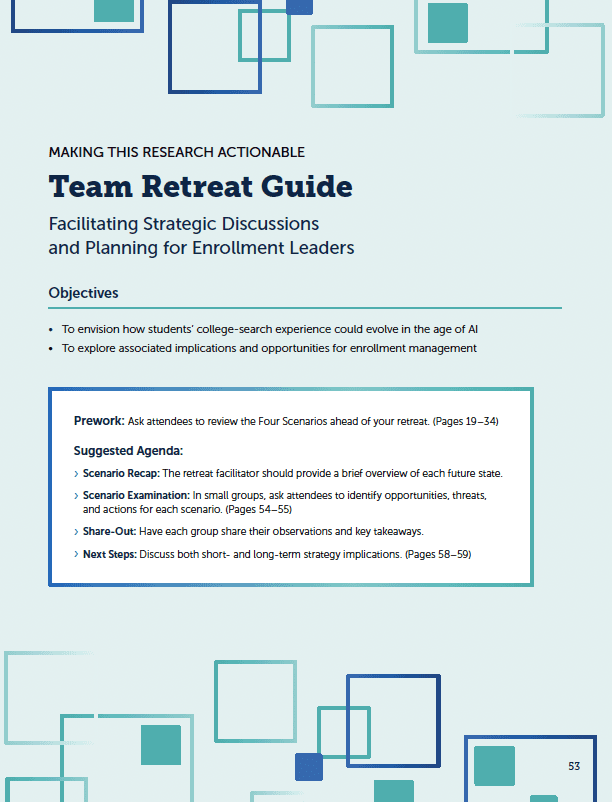
If you’re responsible for enrollment strategy, marketing, or institutional positioning, I’d encourage you to download the full insight paper and engage with it alongside your team. The paper even includes a Team Retreat Guide that you can use to guide your conversations.
In times of rapid and broad change, like what we’re living in today, there’s no way to predict the future for sure. But it is in your power to ensure your institution is best-prepared for success, in whatever version of the AI-powered future eventually arrives.

More Blogs

How mature is your AI search strategy?

4 steps to ensure your .edu remains the trusted source for students—and AI