The data behind leadership giving in higher education
To find success in today’s advancement landscape, leaders need to focus on strategies that support current fundraising goals while also building for the future. It’s not enough to focus only on annual giving participation, and it’s not sustainable to concentrate solely on major gifts. So where can teams find reliable growth that strengthens performance today while expanding the pipeline for tomorrow?
The answer already exists inside most advancement databases: leadership donors. Defined as donors who give between $1,000 and $24,999 in a single fiscal year, this segment represents one of the most important yet underutilized opportunities in advancement. At many institutions, leadership donors can account for as much as 40–50% of individual giving revenue.
Yet their potential often goes unrealized, as leadership donors are frequently folded into annual giving strategy rather than managed as a distinct segment with dedicated focus. But before you can build a stronger leadership giving strategy, you first need to know how to identify which donors are ready to grow. In this blog, I’ll explore the data signals that indicate when a donor is ready to grow their giving.
-


A strategic partner for leadership giving growth
Advancement Marketing Services combines data, strategy, and execution to help teams grow leadership donors and strengthen the future major gift pipeline.
The Signals Behind Leadership Giving
Through our work with Advancement Marketing Services partners, we analyze giving behavior across a broad range of institutions. When you examine donor growth over time, clear patterns begin to emerge. Donors who reach leadership levels tend to show three identifiable signals before their first four-figure gift.
1. Loyalty Reveals Commitment Over Time
One of the clearest indicators that a donor is ready for leadership giving is sustained giving over time. Donors who give across multiple years and whose cumulative giving continues to grow are far more likely to reach leadership levels than those who give sporadically. The relationship is steady and measurable, as the graphic above shows.
Often, loyalty is treated strictly as a retention metric. Teams focus on whether donors return each year, but the more meaningful insight lies in how lifetime years of giving and cumulative dollars work together. Certain combinations of longevity and total investment strongly correlate with leadership outcomes. By contrast, giving the same modest amount year after year, without growth, is not a strong signal on its own. What matters most is sustained investment that builds over time.
2. Growth Signals Increasing Capacity
In the years leading up to many donors’ first four-figure gift, their giving tends to increase gradually. Donors often raise their gift more than once before reaching leadership levels. In some cases, those increases exceed 50 percent of their original gift. That upward movement signals growing confidence, stronger alignment, and a willingness to invest more deeply.
These incremental year-over-year increases can easily be absorbed into overall revenue totals and overlooked at the individual level. A donor who moves from $100 to $250 may not stand out in a campaign recap. But when that increase becomes part of a consistent upward pattern, it serves as an early indicator that the donor may be ready for a leadership-level commitment.
-

How strong is your leadership pipeline?
Watch this on-demand session to explore the data patterns, benchmarks, and practical strategies that help institutions grow leadership donors with intention.
3. Engagement Indicates Deeper Investment
The Three Signals of Leadership Readiness
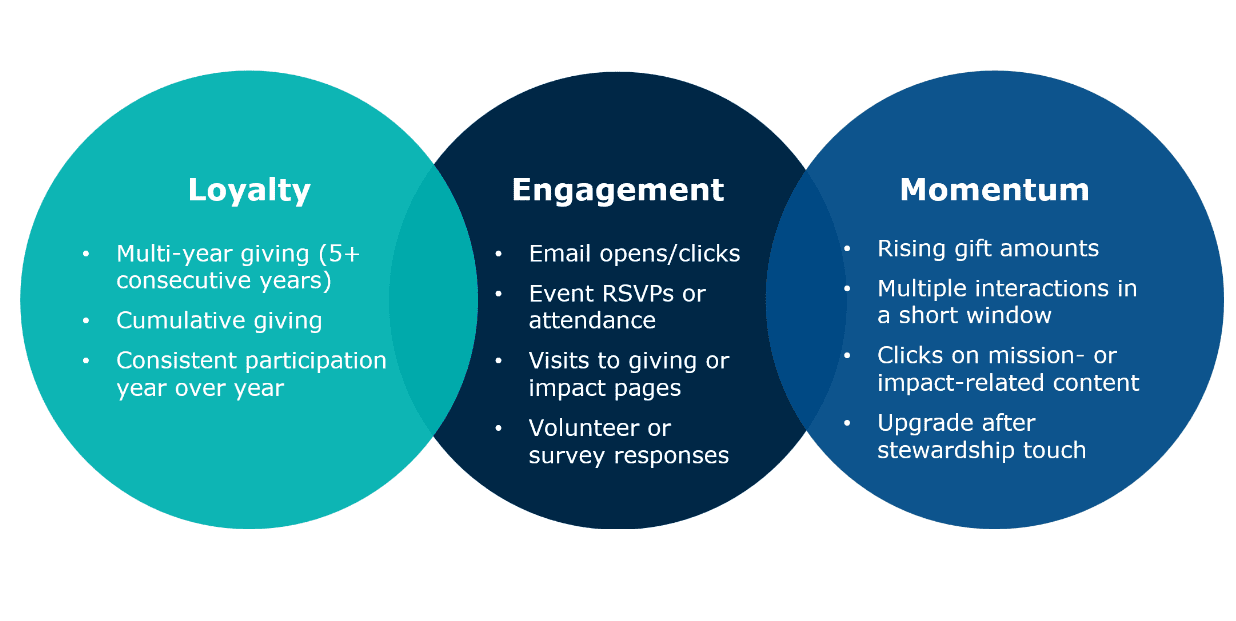
Leadership readiness becomes clearest when loyalty, engagement, and momentum rise together.
When a donor who has been steady in their giving begins engaging more actively with your content and programs, it often signals a shift in their relationship with the institution. Higher email open and click rates, event RSVPs, volunteer participation, social media interaction, or repeated visits to giving and impact pages suggest that a donor is paying closer attention to your priorities and outcomes.
Engagement alone does not guarantee a larger gift. But when increased interaction appears alongside consistent giving and upward momentum, it can indicate that a donor is becoming more invested. The challenge for many teams is access and integration. Engagement data often lives in marketing or event systems and is not easily analyzed alongside giving behavior. When those insights are reviewed together, it becomes much easier to identify donors who are not just maintaining support but deepening their connection.
Steps to Take Today
Leadership-ready donors already exist in most databases. The question is whether your team is structured to recognize them and respond intentionally. When a donor is giving consistently, increasing their investment, and engaging more actively, that is not a coincidence. It is a signal. Acting on it requires clarity, discipline, and ownership.
To begin this work, here are four places to start:
-

Assign clear ownership of the leadership segment.
Leadership donors often fall between annual giving and major gifts. When ownership is unclear, the segment defaults to broad appeals and inconsistent stewardship. Decide who is responsible for growing this group and define what success looks like.
-

Strengthen your data foundation.
You cannot identify leadership prospects with messy data. Make sure gifts are coded consistently, consecutive years are tracked accurately, and your team can easily pull the reports they need. If your data is hard to access or unreliable, fix that first.
-

Redefine how you qualify leadership prospects.
Add consecutive giving and multi-year upgrades into your qualification criteria. A donor with five or more years of steady support and consistent increases should be reviewed intentionally, even if they have not yet reached four figures.
-

Review upgrades and engagement on a regular basis.
Set a regular cadence to look at year-over-year increases, giving streaks, and meaningful engagement activity together. Patterns are easier to see when you look at them consistently rather than at year-end.
Related Resources
Assess Your Engagement Strategies Across Key Audiences (Toolkit)
Use this self-audit toolkit to evaluate how effectively you’re engaging alumni, parents, community members, and faculty and staff.
Rebuilding Advancement for Today’s Donor (On-Demand Webinar)
Explore how digital strategy and stronger use of data can help your team reach and grow today’s donors.
How to Grow Your Donor Pipeline in Today’s Climate (Blog)
Read three practical strategies to attract new supporters and strengthen mid-level and leadership giving.

More Blogs

Giving is up, but the donor base is shrinking. Here’s what to do.

How to prepare for a successful advancement CRM migration