Competitive intelligence for an era of hypercompetition
Stiff competition within higher education markets is nothing new. That said, it’s important to appreciate just how intense things have gotten lately, and why—an understanding that provides us with a basis for action.
A financial pressure cooker
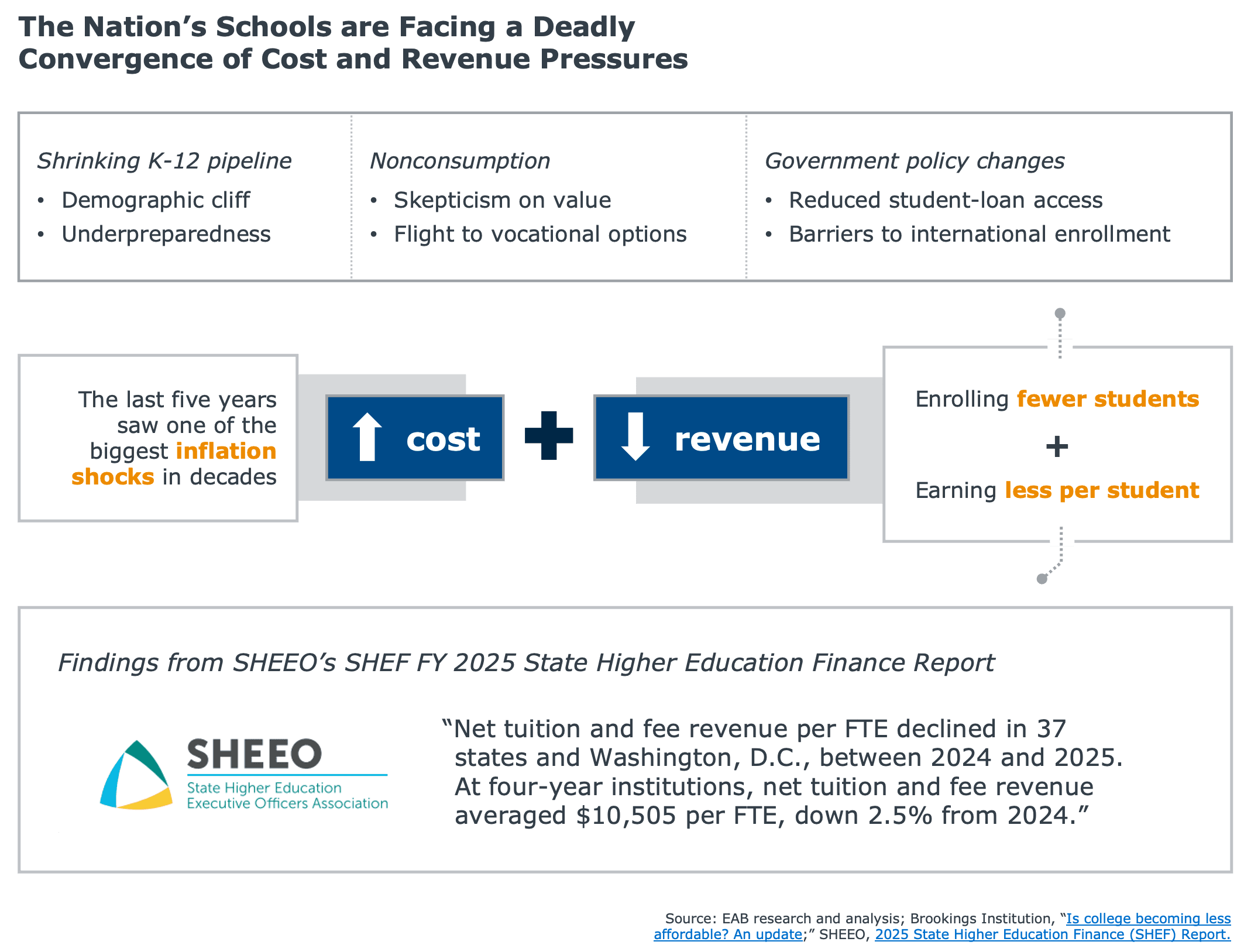
One key factor heating up competition is a historic convergence of cost increases and revenue decreases that is battering the finances of the nation’s colleges.
On the cost side of the equation, the last five years saw the biggest inflation shock in decades and, while rates have since come down, prices, for the most part, have not.
Meanwhile, multiple factors are causing schools to lose revenue. For example, federal policy changes have decreased research funding. They have also throttled international enrollment, and associated revenue, via restrictive immigration rules. On top of that, drops in domestic enrollment, due to the demographic cliff and increasing numbers of students opting out of college, are being felt by a growing set of schools nationwide. Finally, and perhaps most surprisingly, there is growing evidence that schools are actually earning less per student, in real (i.e., inflation-adjusted) terms, as tuition and fees have not kept pace with inflation.
VPEMs on the front lines
The situation outlined above has direct relevance for enrollment leaders. There is a widespread perception among college and university boards and cabinets that the quickest and “easiest” way for an institution to right itself financially is by growing enrollment. This has pushed the nation’s schools into ever more heated competition over prospective students—i.e., over badly needed tuition and fee revenue—an effort that puts enrollment leaders on the front lines.
New urgency for competitive intelligence
Among the several institutional capabilities that hypercompetition has given new importance, none is more critical than competitive intelligence. In past years, you might have gotten away with leaving it on the back burner. Not so now. You can’t hope to prevail in today’s environment without doing competitive intelligence and doing it well. It lies at the heart of both sound institutional strategy and tactical efficacy, which, in turn, determine your ability to win and keep market share.
Competitive intelligence enables sound institutional strategy and tactics
Impactful institutional strategy depends on understanding how things that matter most to students overlap with things that your institution is better at than anyone else. Not incidentally, that depends on having a detailed understanding of who you compete with and what their strengths and weaknesses are, individually and in aggregate. That insight comes from well-executed competitive intelligence.
The tactics through which you pursue your strategy, in turn, depend on a detailed and timely understanding of what your competitors are up to. Knowing how much they spend on marketing, for example, enables you to more effectively lobby for the funds you need to match their efforts. By way of another example, knowing that you’re losing students to a competitor whose block scheduling better accommodates students’ work commitments lets you neutralize the threat by matching that aspect of your competitor’s offering and/or altering messaging around scheduling flexibility at your institution.
Cutting the task down to size
One reason more institutional leaders have not made competitive intelligence a priority is the common (and justified) perception that it is complex and time-consuming work. Answering even basic questions—for example, which of your competitors is grabbing new market share most quickly—entails a range of labor-intensive tasks, including analytical design, data sourcing, information gathering, data processing and integration, analysis, and reporting.
That said, the right overarching framework and a few simple guidelines can make the task manageable.
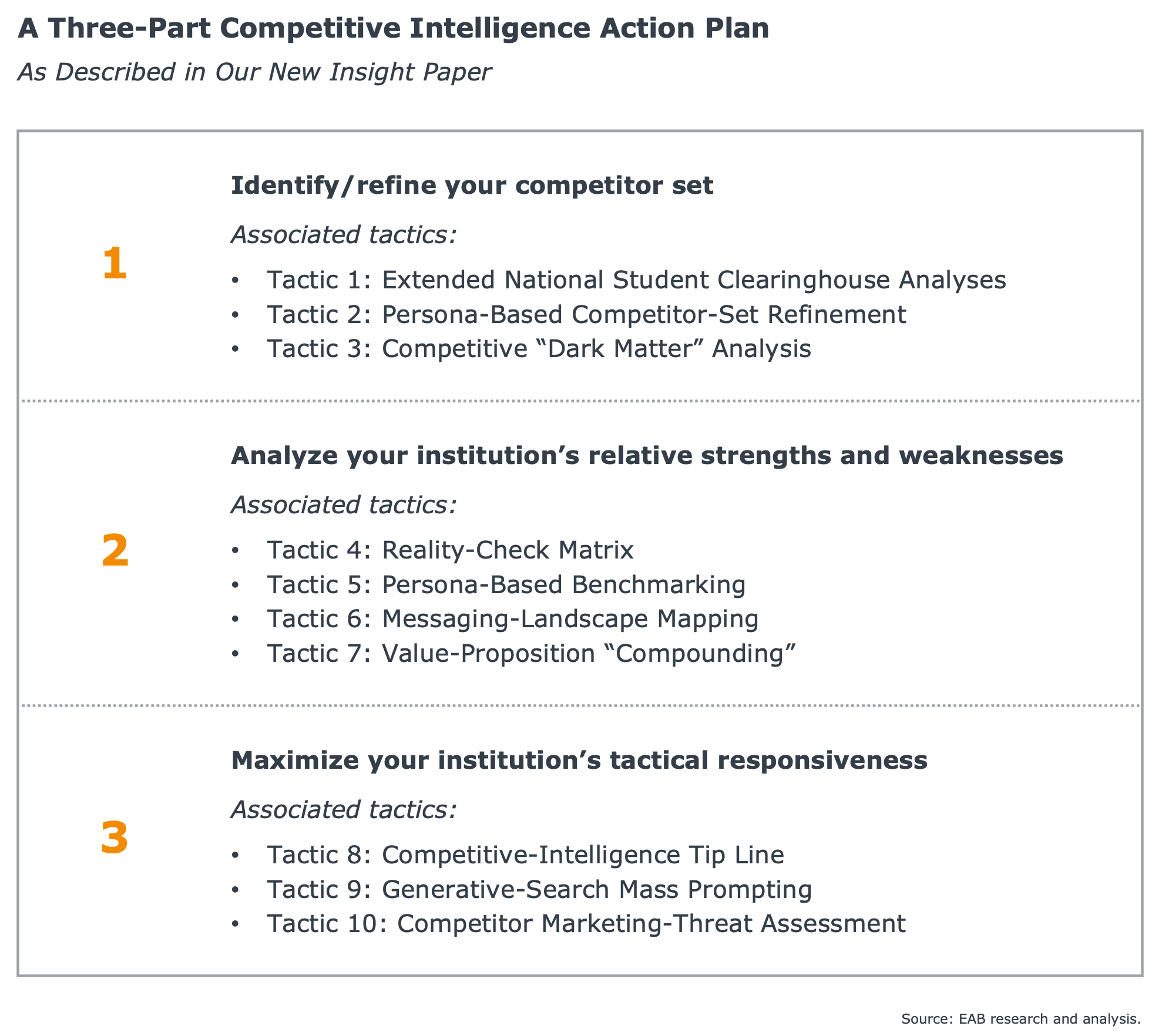
EAB’s recently published insight paper on competitive intelligence outlines a three-part action plan, comprising ten discrete tactics, the implementation of which will ensure that you have your bases covered while also keeping the demands placed on your team within reasonable limits. It additionally describes a handful of simple rules of thumb you can follow to ensure maximum return on the efforts you’re investing in competitive intelligence, for example:
- Focus on school characteristics that matter most to students
- Focus on data and analyses that are actionable
- Favor information that is easy to get
- Enlist the help of your campus community
- Make targeted use of expert third parties (consultants, etc.)
- Use AI
But probably the most important piece of advice on this score is to take that first step, no matter how insignificant it may seem—adding competitive intelligence as an agenda item for your cabinet meetings, for example. Acting, even in some small way, will quickly reveal manageable paths forward to fully developed and mature competitive-intelligence capabilities.

More Blogs

AI search is reshaping brand and enrollment strategy. Is your institution ready?

AI is impacting students’ college selections