Is your institution visible in AI search? Here are six questions to ask
“What are the best MBA programs on the West Coast?”
“What flexible options are available for working professionals at Bear University?”
“Compare research opportunities at Bear University and Woodley University.”
These are the kinds of questions prospective students are asking AI about your institution right now. Do you know how AI would answer them?
In our 2026 survey of 11,000+ Gen Z prospective students, 50% said they are using AI to explore college options (new report coming soon!). And based on conversations with our search experts (and my high school senior son and his friends), that number has only grown since then.
But while AI platforms are the fastest-growing college discovery channel for students, most institutions don’t have clear visibility into how their institution shows up in AI-generated answers—or whether they show up at all. Here are six questions marketing and enrollment leaders should ask to assess the strength of their AI search visibility (GEO) strategy.
What is AI search anyway?
AI search uses artificial intelligence to understand user intent and context, rather than just matching keywords. In AI search platforms like ChatGPT, Claude, and Google Overviews, users can ask a question and receive a direct, synthesized answer instead of a list of links like they would in traditional search engines like Google or Bing.
1. Are we showing up in AI platforms?
The first and most obvious question is: are you showing up in AI platforms? To get closer to an unbiased result, clear your cookies, delete your browsing history, and log out of accounts on AI platforms. I’d also recommend testing prompts related to your institution (such as “What’s the average debt for students at Bear University?” or “What kind of jobs can I get with an MBA from Bear U?”) in multiple AI platforms, as each platform operates differently.
Our GEO Intelligence Dashboard monitors an institution’s visibility across 12 AI models, from widely used assistants like ChatGPT and Gemini to embedded experiences like Google AI Overview and Meta AI, as well as emerging tools such as Mistral and Qwen. We worked closely with our Hybrid colleagues to build the dashboard specifically for higher ed, so every feature matches the ways prospective students search and move through the enrollment funnel.
It’s also important to monitor trends in your AI visibility over time. AI models and results change constantly, and visibility varies by prompt, platform, version, and timing. Tracking trends over time allows you to see how content and technical improvements on your site, plus any digital PR efforts, are impacting your visibility.
2. Are students finding us, or our competitors?
Any time a prospect searches for a program or institution like yours and your school doesn’t appear in AI answers, you risk being invisible to that prospect. And another school will appear in your place.
When you conduct searches as if you were a prospective student (“What’s student life like at Woodley U?”), which competitors are consistently appearing? Where are they outperforming?
Choose a handful of competitors to track in AI search results. In our dashboards, marketing and enrollment teams can quickly see their average competitor positioning score. They can also see their performance across both branded prompts (when a prospect asks about your institution by name) and non-branded prompts (questions like “best nursing program in New England”). For institutions in crowded markets, non-branded prompts represent a huge opportunity for student discovery.
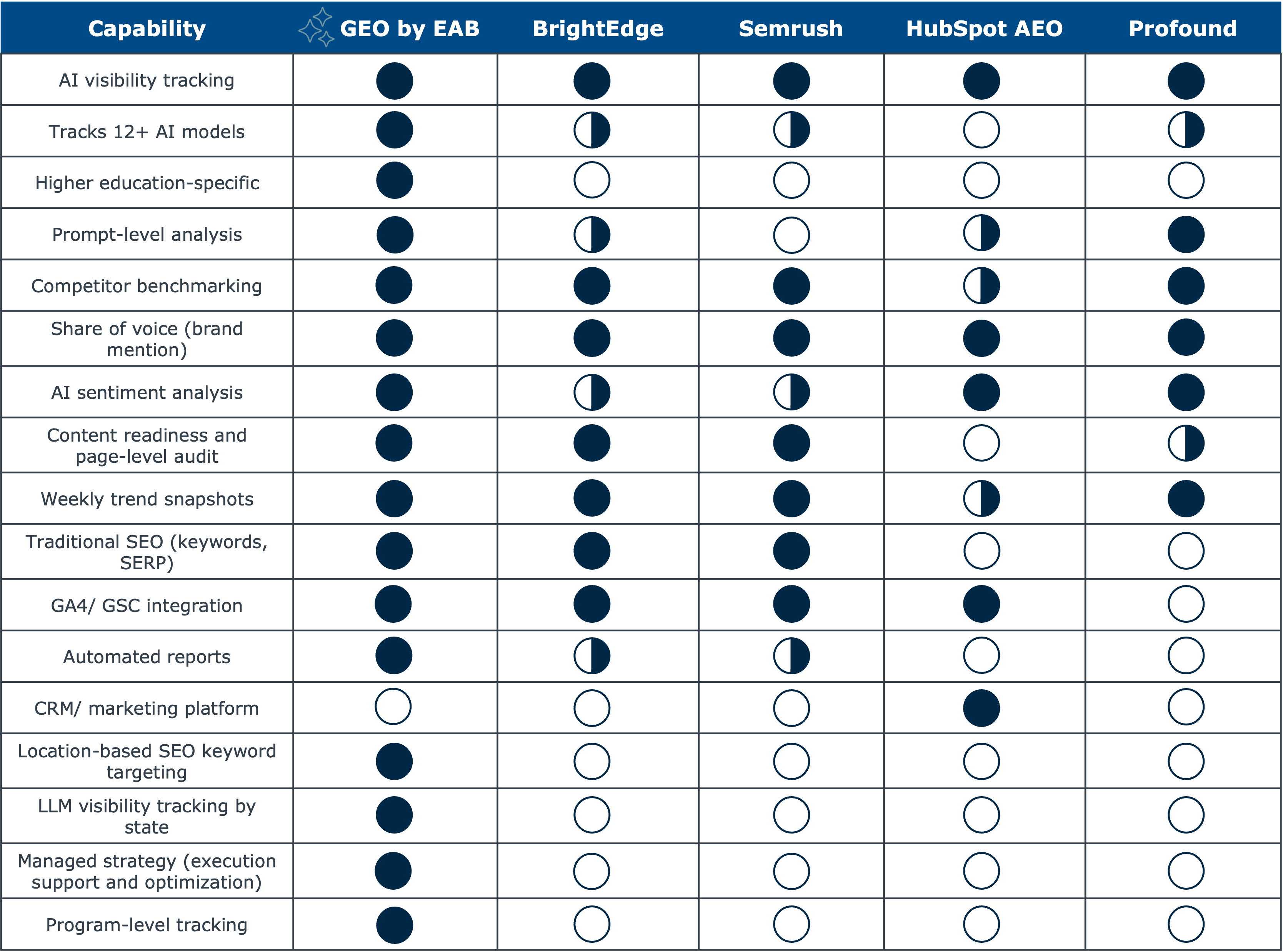
See how EAB GEO Intelligence stacks up to competitors
Explore EAB’s GEO Intelligence capabilities as compared to some of the top names in the industry.
Compare capabilities across AI search visibility platforms
3. What is AI actually saying about our school?
When it comes to AI search, not all press is good press; mentions in AI search results aren’t necessarily positive. AI responses may position your institution as a top choice. Or the AI may share neutral, outdated, inaccurate, or negative information about your school.
For example, that student using ChatGPT to search for the best MBA programs in your area might see inaccurate information about application requirements or cost if just one page on your .edu is outdated. Or the AI tool might recommend your competitor’s MBA over yours based on a comment or two on Reddit. And just like that, you don’t make a student’s shortlist.
Understanding sentiment—positive, neutral, or negative—is critical for protecting and shaping your brand in AI-driven discovery environments. And it’s equally critical to understand which sources influence that sentiment so you can update your website content accordingly.
4. Can AI understand our website?
The content on your website has long been critical to traditional search engine optimization. The same is true, and arguably even more true, for AI search visibility.
AI engines rely heavily on existing web content to generate answers, compare options, and recommend next steps. If your site is difficult to interpret, incomplete, outdated, overly promotional, or inconsistently structured, AI tools may be less likely to include your institution in their responses—or they may summarize your offerings inaccurately.
Make sure AI can read the content on your .edu
To improve visibility, your website should provide clear, detailed, and current answers to the questions students and families are already asking. That includes information about:
- Academic programs
- Admissions requirements
- Deadlines
- Tuition and aid
- Scholarships
- Student outcomes
- Career pathways
- Campus life
- Online options
- Transfer pathways
- Support services
These answers should be easy for both humans and machines to find. Use descriptive page titles, plain-language headings, FAQ-style content, structured program pages, schema markup where appropriate, and consistent language across related pages.
Schools should also look for gaps between what prospective students ask AI tools and what the website actually answers. For example, a student may ask, “What are the best affordable nursing programs near me?” or “Which colleges support first-generation students interested in engineering?” If your website only says, “We offer a world-class student experience,” AI may not have enough specific evidence to connect your institution to that query. Specificity is the new necessity.
5. Are we referenced as a source?
In AI search, credibility is often reinforced through citations, whether explicit (linked sources) or implicit (trusted domains informing model outputs). Institutions with stronger third-party validation—such as media mentions, partnerships, research visibility—are more likely to appear in AI-generated answers.
Schools should pay attention not only to whether they are mentioned, but also to who AI is using to support the answer. Is the response citing the institution’s own website, or is it relying on outdated directory pages, rankings sites, Reddit threads, or competitor content? The source mix matters because it can influence both accuracy and perception.
6. Is our SEO foundation supporting AI visibility?
SEO isn’t dead. The same core SEO practices still very much apply in AI search. If your pages aren’t ranking well in traditional search, they’re less likely to be picked up and referenced by AI models.
Continue to track metrics like number of keywords, average position for those keywords, page themes, site speed, and other signals of SEO health. Technical elements like page speed are also important for visibility in AI search in particular.
Our dashboards incorporate SEO performance as a core pillar of AI visibility. Partners can easily see how their SEO is scoring, how it has changed over time, and what improvements would have the greatest impact
Institutions that invested early in SEO in the early 2000s had an advantage in shaping if, when, and how students discovered them. Schools that deprioritized their website and SEO had to work harder to catch up. In 2026, AI search presents a similar moment for higher ed marketing and enrollment teams.
Prospective students are already forming opinions about your institution through AI-generated answers. Tracking these six areas is the first step toward understanding—and influencing—what they learn about your institution.
Let’s optimize your site for AI search together
To learn more or request a demo for your institution, please fill out this form.

More Blogs

How to evaluate a graduate enrollment CRM

Students no longer search like they used to