How to build an AI-ready digital strategy for student recruitment
Just a few years ago, students’ path to discovering your institution was relatively predictable. They Googled you, clicked on search results, landed on your website, requested information, and eventually applied.
Now, AI search has rewritten the rules again—this time by changing how students discover information, which institutions they see, and what they believe before they ever reach your website.
In my work with higher ed marketing leaders, I still often see digital strategies organized for yesterday’s student journey. But as more college discovery happens before the website, your digital strategy depends on whether your institution is discoverable, distinctive, and easy for both students and AI platforms to understand.
Below, I’ll share more about how AI-powered search has reshaped the student journey, and the four digital capabilities higher ed CMOs should prioritize to match it.
AI-powered discovery reshapes how students find—and use—your website
While previous digital journeys have always been designed for students, traditional search—and the role your website played in the process—still largely happened on your terms. Now, students start with themselves. They’re asking AI tools which colleges or programs fit their goals, where they can get in, and what they can afford. Each prompt helps them refine their preferences, compare options, and narrow their list before they ever reach an .edu website.
They increasingly trust those responses too: 56% of students say they’re more likely to trust an institution cited in an AI-generated summary.
By the time students reach your website, they’re validating what they found through AI-based discovery. That means if you fail to reinforce what they already discovered through AI, they’ll disengage or lose trust quickly. For example, if an AI-generated answer highlights your nursing program but your website buries the cost or admission details, a student may not move forward to learn more.
Beyond web traffic or even paid search performance, marketing success is about creating a digital ecosystem that feels connected from the first question a student asks to the moment they decide to inquire, apply, or enroll.
The four capabilities of an AI-ready ecosystem
Adapting to an AI-powered landscape requires connecting four key capabilities around the modern student journey: becoming discoverable, harnessing intent, deepening engagement, and amplifying visibility.
1. Become discoverable with AI search visibility
Discoverability begins with understanding how and where your institution appears in AI and traditional search. As the front door to student discovery expands beyond your .edu to AI search and other digital channels (some you control, many you don’t), every weak point in the digital journey carries more risk. Because AI platforms cite different sources, answers vary by model, and there is no universal search console, that visibility can be difficult to monitor consistently.
Visibility data alone isn’t enough. EAB combines higher ed-specific search strategy with insights from our proprietary GEO Intelligence dashboard to show where your institution appears across AI and traditional search, how AI platforms describe you, which competitors are gaining ground, and what to fix first. That gives CMOs and their teams a clearer view of search visibility and a practical path to strengthen brand representation, authority, and enrollment impact.
-


10x
increase in AI search visibility within six months (small private)
2. Harness intent with website modernization
AI search may shape a student’s first impression, but your website drives that student to engage.
To give students a reason to consider you further, your site needs three things working together:
- Enrollment-centered content structured for both human context and AI readability
- User pathways built around how prospective students evaluate options
- Storytelling that makes your institution’s brand and value distinct
The technical foundation matters just as much, from site structure and accessibility to schema, CMS modules, and performance.
For many small web marketing teams, this task can feel like a tall order. That’s why having the right external support is so important. My team has helped marketing teams of all shapes and sizes modernize web content, structure, and design based on where they are today and what their teams can support—from discovery and planning to targeted content enhancements to full design and development.
-

192%
average increase in engagement rate for partners
3. Deepen engagement with .edu digital experiences
Once students decide to engage with your institution, the next step is helping them feel connected. Digital experiences can give students a reason to raise their hand, return, and continue moving forward in their journey.
Integrating tools such as immersive tour experiences and chat agents allow you to personalize the web experience and help students express interest without interrupting exploration. And in the AI era, this is more critical than ever: AI-referred traffic is 4.4x more likely to convert because visitors arrive at your site more informed and ready to take action.
-

49%
average inquiry-to-application rate for EAB Virtual Tours
4. Amplify visibility with targeted paid media
Paid media shouldn’t compete with your organic or AI search strategy. It should extend your reach, reinforce your brand, and draw right-fit students back to the digital experiences designed to convert their interest.
Today’s prospects may encounter your institution through any number of touchpoints before they ever reach your .edu. When those touchpoints tell a consistent story, paid media reinforces what makes your institution distinctive and gives students a reason to take the next step.
Through targeted, multi-channel media campaigns, you can amplify your story from first impression through engagement. As campaigns run, continue optimizing for stronger visibility, engagement, and enrollment outcomes over time.
-

+250K
student applications generated through Hybrid’s paid media campaigns
A quick check: Is your digital strategy built for today’s student journey?
Bring your marketing, enrollment, web, content, and technology leaders together and ask:
- Where are prospective students first discovering our institution today?
- What impression are students getting before they reach our website?
- Does our website validate and deepen what they may have already learned through AI-generated answers?
- Are our AI search, website, digital experience, and paid media investments working toward one student journey?
- Where is digital fragmentation creating friction, missed engagement, or inconsistent brand representation?
Where the answers reveal gaps, resist the urge to address each one with another stand-alone initiative. Start by mapping how your existing investments should work together around the modern student journey.
An AI-ready digital ecosystem drives results from discovery to enrollment
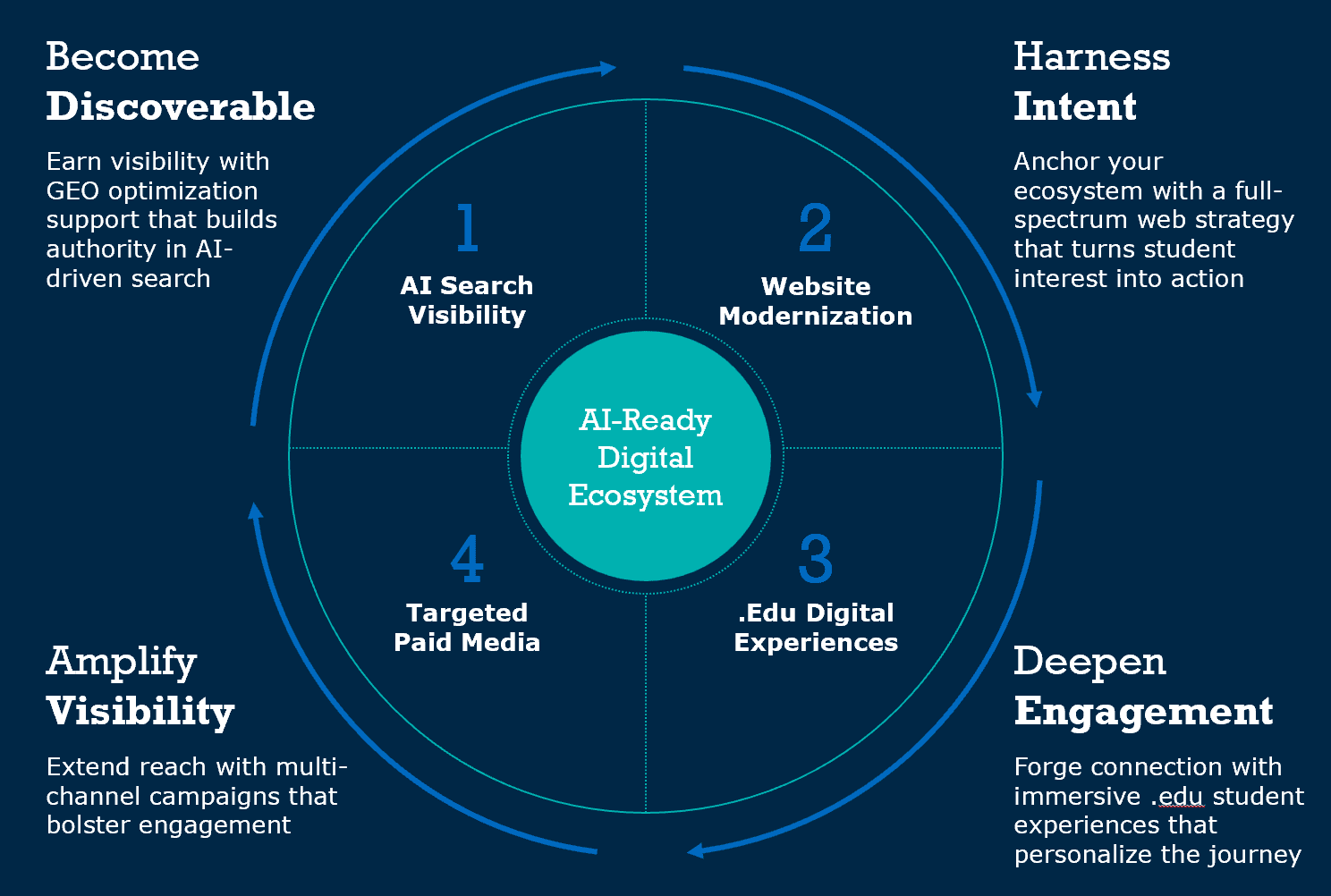
The four capabilities outlined above are strongest when they work together and connect to your enrollment and institutional goals.
Of course, most marketing leaders already understand why a connected approach matters. The hard part is deciding what to fix first, staying on top of evolving trends, and balancing competing priorities, limited staff, and a sprawling list of platforms.
My team’s goal at EAB is to serve as an extension of your team, helping you prioritize the work with the greatest enrollment impact, build momentum, and create a long-term roadmap to compete in an AI-powered enrollment landscape.
And if you’re not sure where to begin, contact my team. We’d love to partner with you.
Turn Your Digital Presence into a Connected, AI-Ready Ecosystem
Connect with our experts to explore how EAB can help you build an AI-ready digital ecosystem, reach more students, and drive measurable enrollment growth.

More Blogs

AI search is reshaping brand and enrollment strategy. Is your institution ready?

AI is impacting students’ college selections