Demographics shape the enrollment landscape, but strategy determines success
The ‘demographic cliff’ is here but, as we showed in a previous blog post, it is hitting unevenly across the country. The West, Midwest, and Northeast are seeing steeper-than-expected declines, while the Southeast and Southwest are holding steady or even still gaining ground. Fortunately, the story doesn’t end there. New data on enrollment trends show that schools across some states are outperforming their demographic circumstances. Understanding where and why enrollment trends diverge from demographic ones can help enrollment leaders tailor strategies that fit their region’s market dynamics.
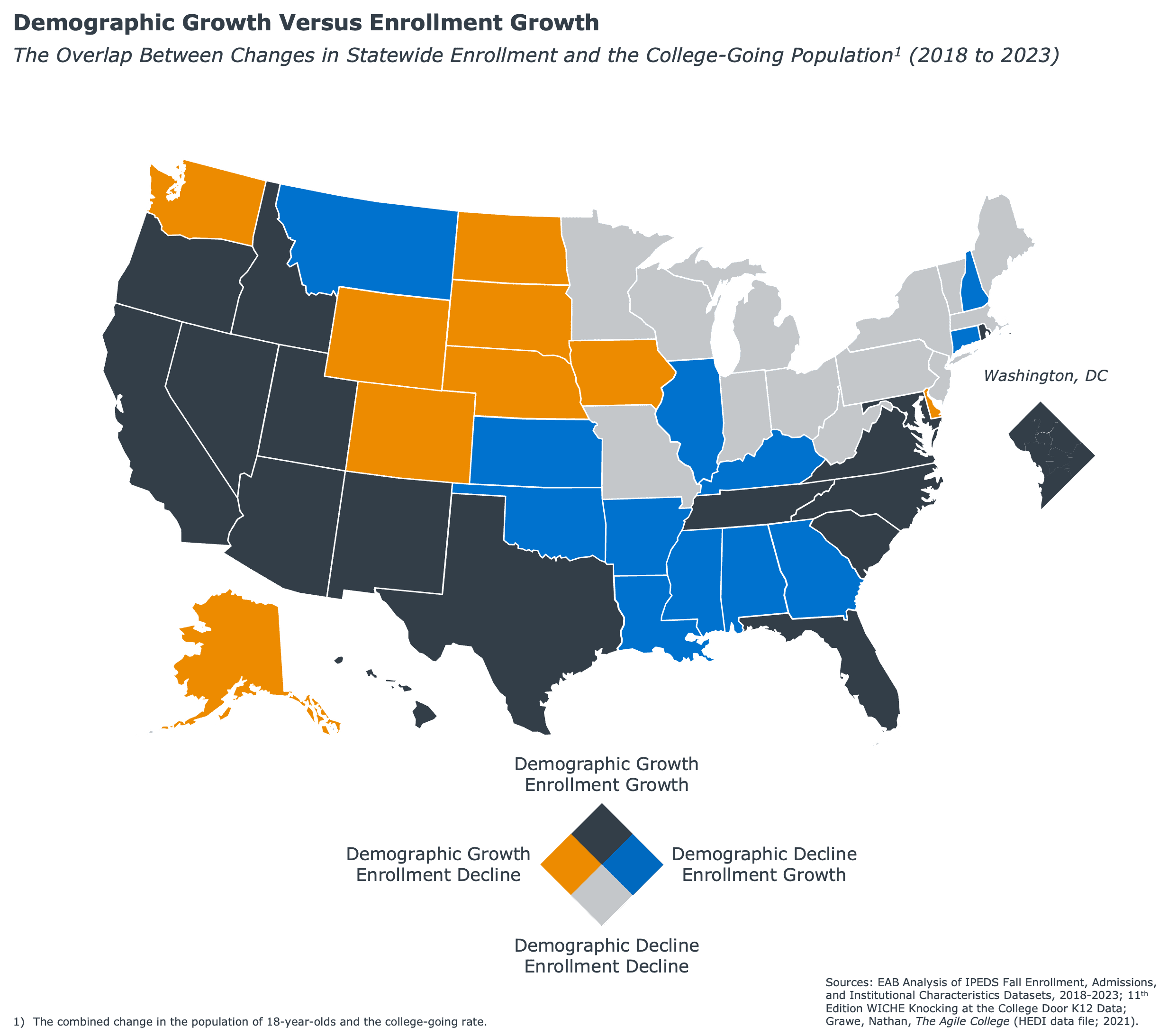
To gain some insight into this phenomenon, the map below plots how closely enrollment trends have mirrored demographic change in each state from 2018 to 2023. States shaded in black saw both demographic and enrollment growth, while those in gray experienced declines on both fronts. Orange and blue mark the outliers: states where enrollment trends moved in the opposite direction of change in the college-going population.
Demographics set the stage for enrollment success
In most of the country, enrollment moved in tandem with population trends, with the direction of enrollment change across schools matching the direction of demographic change in 59% of states from fall 2018 to 2023 (i.e., the states in black and gray). That overlap underscores what enrollment leaders already know: the size and composition of the local student population still exert enormous influence on institutional performance.
We see this alignment most clearly in the gray states of the Midwest and Northeast, where shrinking pools of 18-year-olds and declining college-going rates have translated directly into lower first-year enrollment. By contrast, the states in black across much of the Southeast, Southwest, and West experienced increases in both the number of college-going students and the share of high school graduates choosing college. That combination has supported sustained enrollment growth across institutions in those states.
Demographics aren’t destiny
The remaining 41% of states (i.e., those in orange and blue) tell a more complicated story. Schools across several states, particularly in the Southeast, grew enrollment despite declines in the college-going populations there (i.e., states in blue). Others, such as Washington and Colorado in the West or Iowa and the Dakotas in the Midwest, lost students even as their college-going populations grew (i.e., states in orange). Both of these divergent trends point to enrollment forces beyond demography, many of which are within your control, such as institutional strategy and competitive positioning. For example, states where enrollment outpaced demographic decline often include institutions that paired generous merit-aid offers with aggressive regional recruitment, especially in southern states.
Other forces influencing enrollment, however, are harder to change. In our research into why students pick the schools they do, we found that (holding other factors constant) students are more attracted to colleges in warmer regions. In fact, that institutional trait is quite high in overall importance among students across the country (see below). That fact helps explain why institutions across some states in the Southeast and Southwest drew students from farther afield, while schools across many states in the Midwest and West lost enrollment despite growing college-going populations. Even so, climate alone doesn’t determine whether institutions succeed.
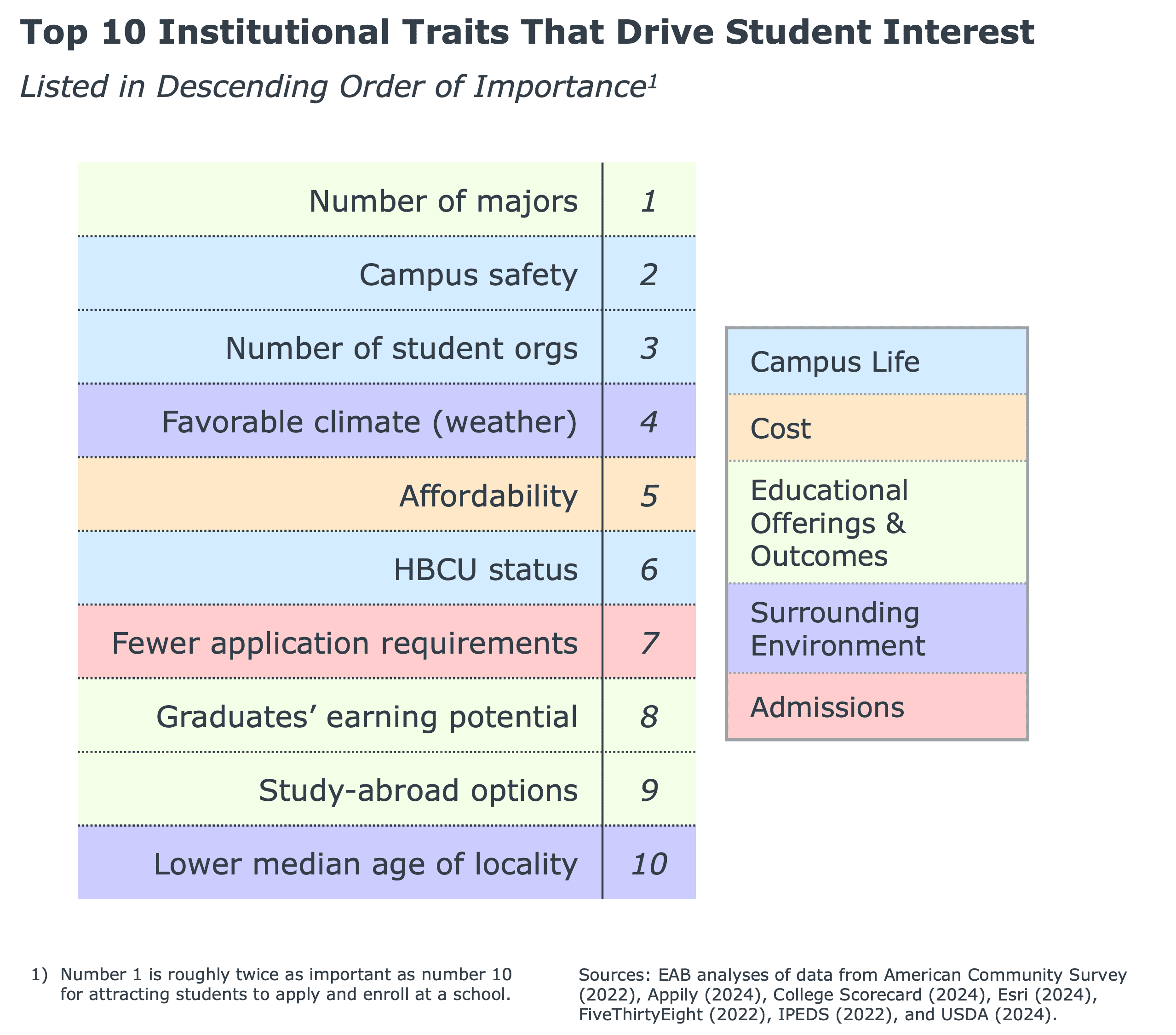
In fact, climate isn’t destiny any more than demographics are. Our institutional persona research shows that even schools in less temperate climates can outperform competitors when they clearly convey what makes them exceptional. For example, colleges in colder regions have succeeded despite the perception gap by leaning into other strengths, such as by highlighting the quality of their academics, the energy of campus life, or even by highlighting distinctive winter activities that turn what is often viewed as a drawback into a strength. In other words, regional context shapes demand, but institutional strategy—and how effectively that strategy is communicated—determines who thrives within it.
Implications for Enrollment Leaders
You can think about your campus as landing in one of four enrollment–demographic market types:
1. Declining population and declining enrollment
The average school in this market is facing both market contraction and competitive pressure. The playbook is about defending (and expanding) market share: differentiate value, build cross-regional pipelines, and strengthen retention.
(e.g., many states in the Midwest and Northeast; in gray)
2. Declining population but growing enrollment
Most schools in this market are outperforming their demographics. The priority now is to protect that momentum: tighten yield, highlight the experience that’s drawing students, and anticipate increased competition for the out-of-state and out-of-region students who are currently driving their enrollment growth.
(e.g., several Southeastern states; in blue)
3. Growing population but declining enrollment
This market has potential, but most schools are losing share. Diagnose the drivers (e.g., out-migration, affordability concerns, or competitive positioning) and adjust strategy to reclaim lost ground.
(e.g., many Western and Midwestern states; in orange)
4. Growing population and growing enrollment
These states face the fewest structural headwinds today, but they are also the most attractive targets for institutions recruiting from shrinking regions. And because regional population advantages begin to flatten by 2030, now is the time to build the brand strength and student experience that will carry the institution through the next phase of demographic change.
(e.g., parts of the Southeast, Southwest, and West; in black)
No matter your category, the central insight holds: demographics shape the landscape, but strategy determines enrollment performance. Knowing which category you operate in—and why—is essential for planning the next several years.
This analysis draws from EAB’s College Search Trends Across Space and Time: 2025 Edition, which explores how demographics, application trends, and student migration patterns are reshaping the enrollment landscape.
-


Ready to learn more?
Download the full paper or watch the on-demand webinar to explore what these demographic shifts mean for your institution’s market strategy.

More Blogs

Marketing teams are stretched thin. Here’s what the data says to do next.

Five tips to recruit community college students for this fall (and beyond)