What we’ve learned from testing earlier yield engagement
Every year, spooky season seems to arrive a little earlier. Halloween candy appears while it is still 90 degrees outside, and the plastic skeletons are waiting in the garden center before anyone has packed away the pool floats.
A similar seasonal mashup is happening on college campuses. Some institutions are already admitting students in October, and others are preparing for early-action decisions later this year. As those admission decisions go out, students start comparing cost, academics, campus life, housing, and distance from home. Much of that decision-making happens out of view, while counselors have limited capacity to follow every clue. So what can institutions learn from this?
Over roughly three years of experiments and pilots, EAB has tested new approaches to admitted-student engagement. That work included a yield nurture pilot with a cohort of 16 Enroll360 partner institutions and drew on insights from the more than 200 tests our broader enrollment marketing team conducts each year.
Understanding what motivates students to enroll has never been more important. These three lessons can help enrollment teams manage yield more effectively.
1. Start yield conversations sooner
Students may not deposit until spring, but they start forming opinions much earlier. The weeks immediately after admission are often the best opportunity to learn what’s influencing their decision.
In our yield nurture pilot, institutions began communicating with admitted students as early as October. Messages focused on the topics students care about most: academics, affordability, financial aid, campus life, visits, and housing.
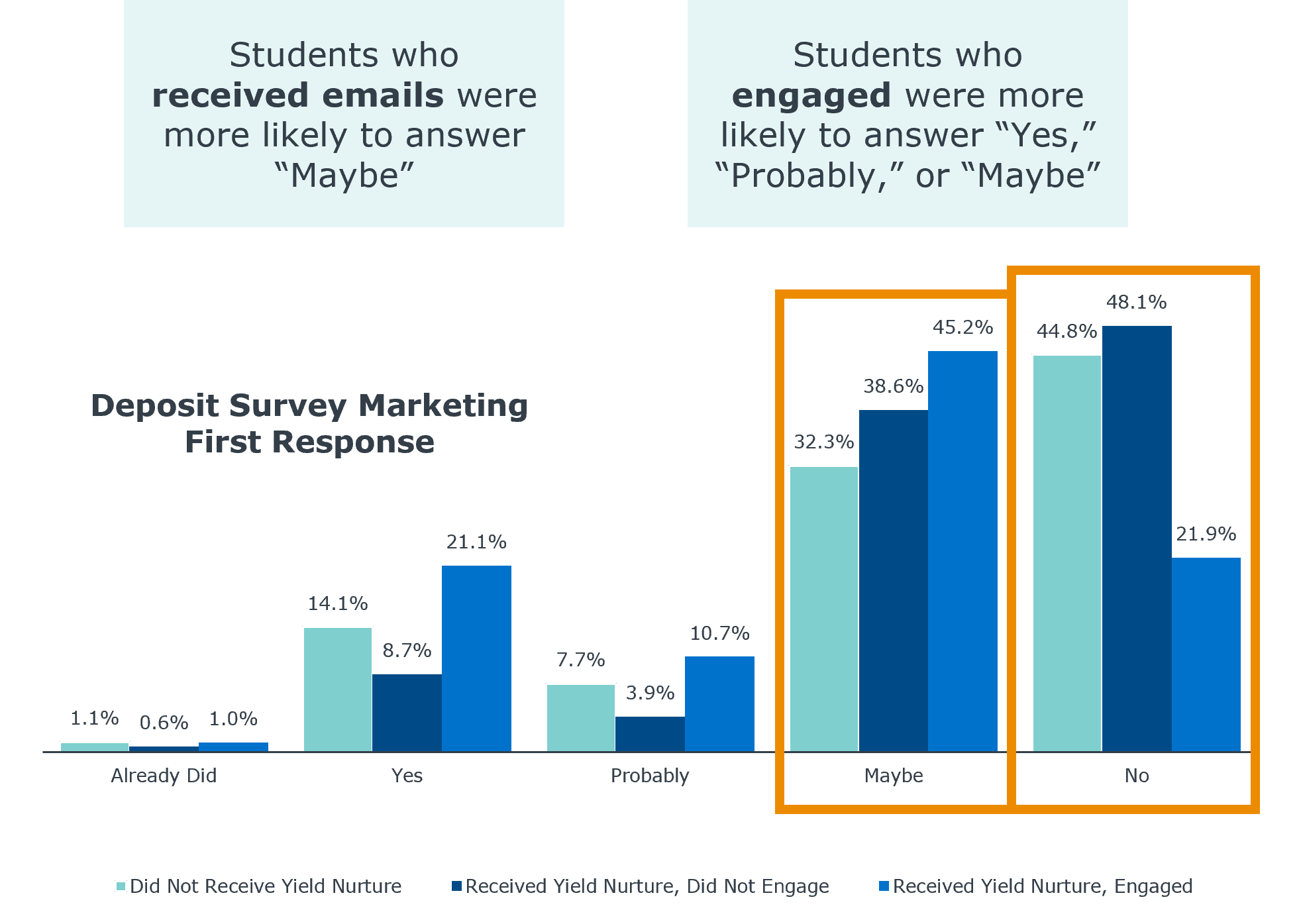
That outreach did more than keep the institution top of mind; it gave students opportunities to communicate their intentions. Students who engaged with nurture content were more likely to indicate they were still considering the institution, often selecting “maybe” when asked about their enrollment plans.That matters because a “maybe” is actionable. It identifies students whose decision is still in play and creates an opportunity to understand what could move them closer to enrollment.
2. Create more opportunities for students to respond
Traditional engagement metrics only go so far. Opens and clicks show students are interested, but they don’t explain what’s driving their decisions—conversation-based outreach can.
In one pilot, an SMS agent asked admitted students whether they planned to enroll. Students who responded “maybe” were invited to share what information they needed to make their decision. Their questions ranged from academics and housing to financial aid and scholarships, while more complex concerns could be routed directly to an admissions counselor.
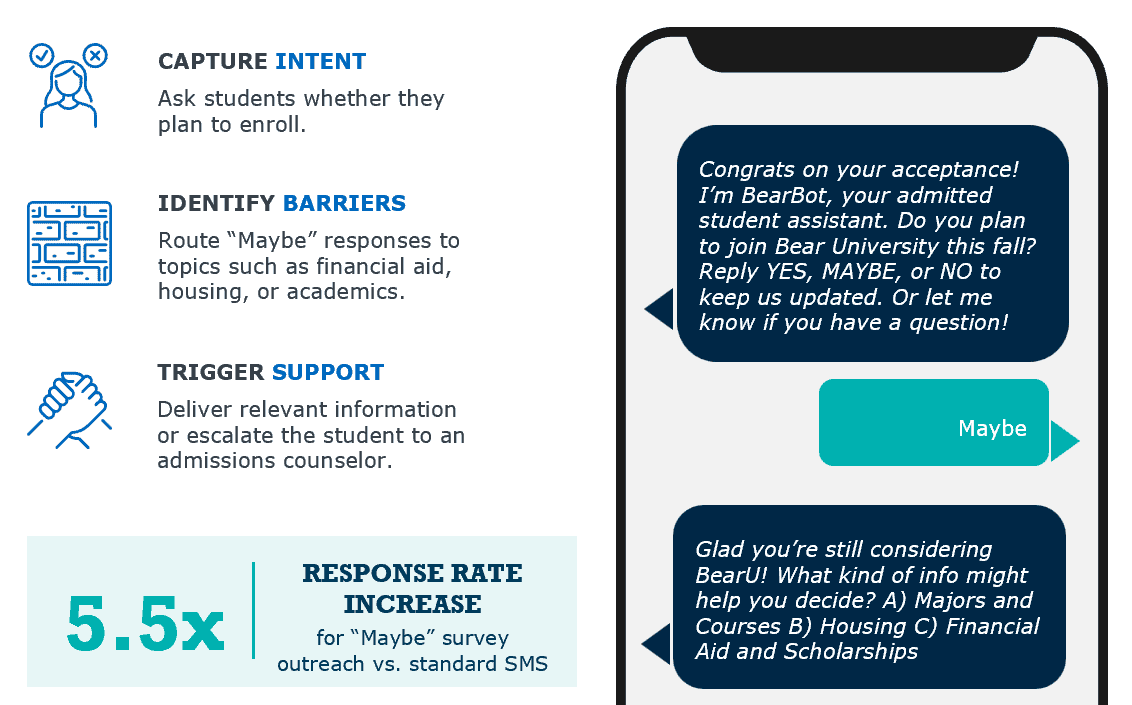
The result was a response rate 5.5 times higher than standard SMS outreach for students who were undecided. Tools like these help institutions identify questions, concerns, or barriers earlier so staff can focus their time where it will have the greatest impact.
3. Use those signals to focus spring outreach
Collecting more information only helps if it changes what happens next.
Our testing found that relatively simple forms of personalization were often the safest. Factors such as distance from campus, geography, stated interests, and web activity helped make communications more relevant to the student’s situation.
We also found that the questions students ask change throughout the cycle. Early on, they’re focused on scholarships, academics, housing, and campus life. As deposit deadlines approach, attention shifts to orientation, registration, portal access, and other enrollment logistics.
That makes timing just as important as personalization. The most effective outreach reflects both where a student is in the decision process and what they need to know next.
What enrollment leaders should do this fall
For enrollment leaders, this research provides three useful lessons for the fall:
- Start admitted-student nurture earlier.
- Give students a simple way to ask questions or express uncertainty.
- Use the responses you’ve collected at scale via automated outreach to prioritize high-touch counselor outreach.
Those lessons are informing six enhancements to Enroll360’s Yield solution for the class of 2027, including earlier nurture, more targeted personalization, SMS and web agents, expanded SMS opt-in collection, and deposit-focused communications.
The biggest opportunity for your team is visibility. The earlier students begin sharing what they’re thinking, the earlier enrollment teams can identify who is still persuadable, what concerns are emerging, and where counselor outreach is most likely to make a difference.
That raises an important question for this cycle: how early are you learning what admitted students need, and what happens once you do?
Want to compare your current yield strategy against what we’re seeing across the market?
Schedule a conversation with an EAB Enrollment Partnership expert.

More Blogs

How to talk about college cost before families bring it to the holiday table

The enrollment game has changed. What still works?
