Enrollment yield best practices
Ask most enrollment office staffers when yield season begins, and they’ll likely say that it kicks off as soon as students start receiving your offers of admission. And while they’d certainly be right, that answer is increasingly out of step with the realities of today’s hypercompetitive recruitment environment. The reason is that it fails to acknowledge the big impact that effective pre-admit engagement of students has on admitted students’ likelihood to pick your institution.
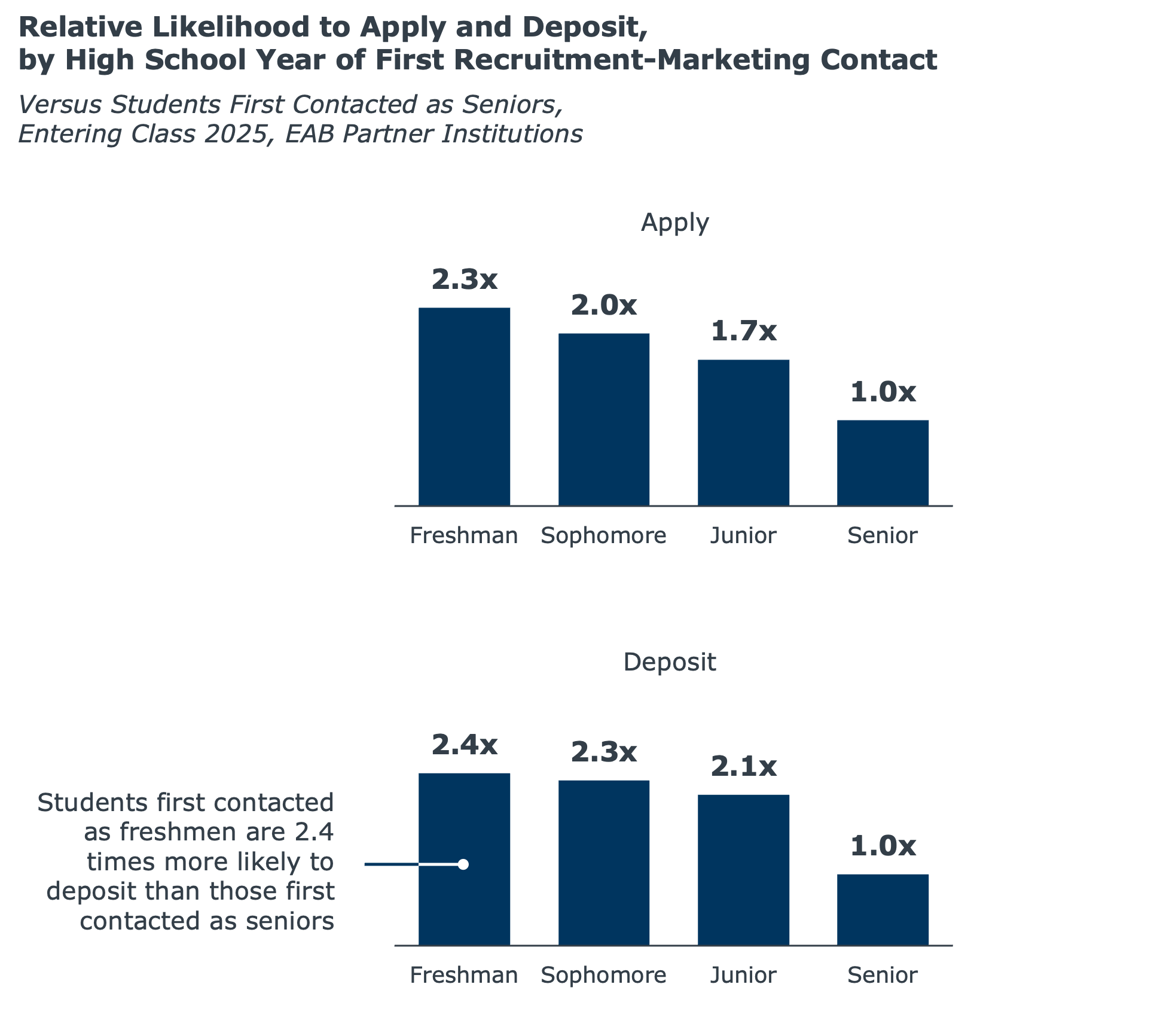
Probably the best evidence I’ve seen of that comes from EAB’s own data. The many hundreds of schools that we partner with on recruitment marketing vary a lot in terms of their preferred way of doing things. Crucially for the question at hand, that includes how early in a student’s high school career they initiate outreach; while some wait until senior year, others are already establishing contact with potential college goers while they are still high school freshmen.
-


For higher education institutions looking to advance their enrollment yield management strategy, it starts earlier than most expect and requires a coordinated approach across the entire recruitment funnel.
What is admissions yield management?
Enrollment yield management is the strategic practice of influencing admitted-student enrollment decisions by shaping engagement across the entire recruitment funnel. It combines recruitment marketing, personalized communications, and data-driven targeting to maximize the percentage of admitted students who choose your institution and to minimize summer melt (the loss of students who deposited but do not ultimately enroll). Below, we outline the admissions yield best practices enrollment leaders should prioritize across both before and after admission.
Earlier outreach makes a difference
Now for that data I mentioned. As you can see in the charts below, the earlier a school initiates recruitment outreach to students, the more likely students are to apply and deposit. And it’s no trivial difference—earlier outreach more than doubles the likelihood of admitted students converting. In other words, recruitment-marketing works, and the longer you do it the more impact it has.
Post-admit strategy still matters
Of course, none of this means that you can just put your feet up once students are admitted. What’s true for the pre-admit phase is doubly so for yield season proper; namely, the more successful you are in engaging admitted students, the greater the likelihood that they will commit to your institution and enroll.
The difference, of course, is one of time; in the post-admit phase you have months, not years, to boost students’ affinity for you, and that means pursuing them with greater intensity. I don’t need to tell you how hard it is to do that well. To support your efforts, my team has put together a compendium of best practices for enhanced yield performance and melt prevention, available for download here. Best practices explored in the paper include:
- Embedding high-impact value messaging into post-admit and post-deposit communications
- Using data analytics to focus highly intensive and personalized outreach on parts of your admit pool where it will have the greatest impact
- Using chatbots and related forms of generative AI to scale highly personalized engagement
- Deploying a broadly scoped program of parent-engagement initiatives, aimed at winning the support of these all-important influencers and enablers of students
What enrollment leaders can do next
At the end of the day, you’ll want to make sure you’re overperforming on both imperatives described above. Top universties optimize their enrollment marketing funnel by doing both well, which means cultivating relationships with students early in their high school years and pursuing them with maximal intensity once they’ve been admitted. I know that may sound like a lot. But in today’s hypercompetitive markets it can be the difference between making your class and not.

More Blogs

Students no longer search like they used to

AI search is reshaping brand and enrollment strategy. Is your institution ready?