You may be benchmarking against the wrong institutions
You probably have a good sense of who your competitors are. But do you know which institutions students are choosing instead of yours?
Students don’t make enrollment decisions based solely on selectivity, geography, or institutional type. In many cases, they’re comparing schools that look quite different on paper but appeal to them for similar reasons. That means your most important competitors may not be the institutions you benchmark against today.
A national directory of college and university institutional personas
As explained in past blog posts (see here and here), EAB has developed a granular, student-centered taxonomy of U.S. colleges and universities that places each of the nation’s schools into one of nine “institutional personas.”
I’m excited to share that we recently made an important addition to our related resource center—a directory that identifies the institutional persona of every four-year college and university in the nation, focusing on schools with competitive admissions processes.
The directory enables you to immediately identify your school’s persona (and those of your competitors), eliminating any associated guesswork and unlocking the many valuable tools included in the Personas System.
-


Download our Persona Directory to see who you’re actually competing against.
A quantitatively grounded look at what attracts students
EAB’s personas research and resulting framework used large national datasets to examine which aspects of schools most influence where students ultimately choose to enroll—characteristics we call “attractors.” These attractors, in turn, enabled us to perform a cluster analysis, sorting the nation’s schools into nine groups of like institutions.
Identifying your true competitor set
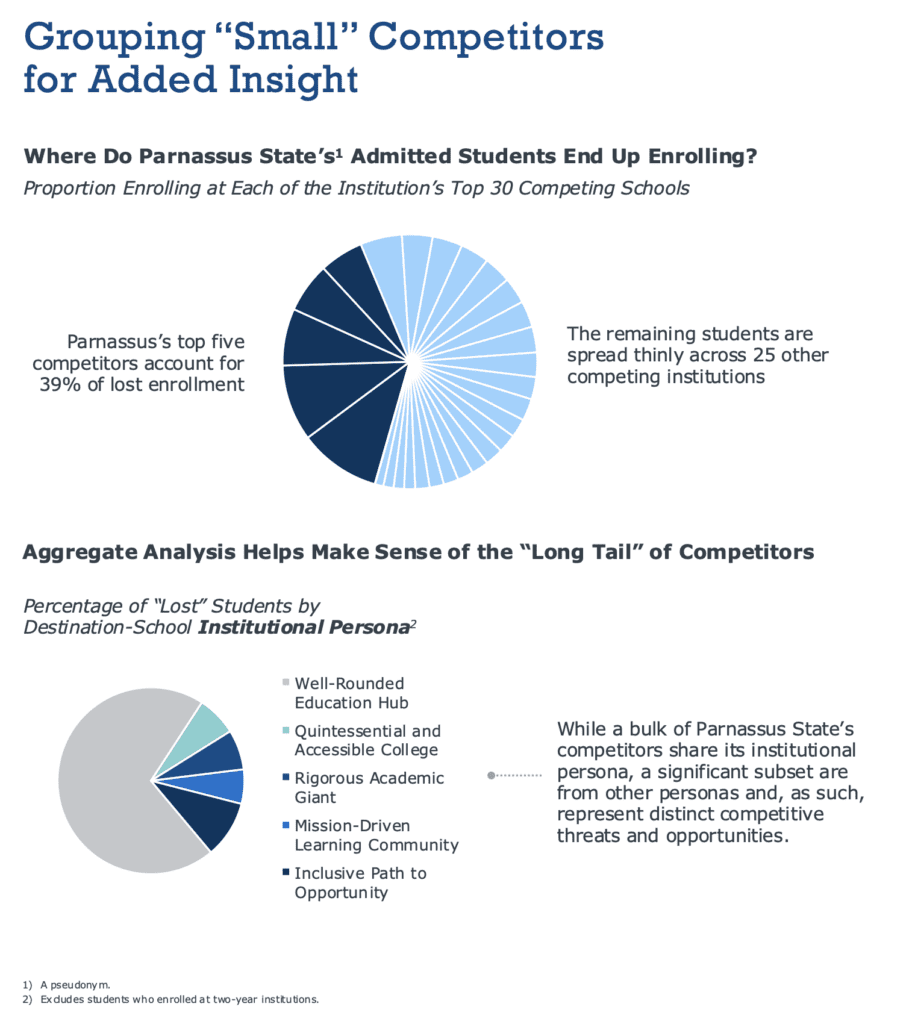
The personas framework enables you to do several important things. First, it allows you to more precisely define your competitor set. It does so by discerning, within that group of schools with whom you overlap on admits, institutions that most resemble you – i.e., ones that appeal to similar types of students, for similar reasons. These are your most direct competitors. It also identifies schools who may pose a competitive threat with respect to your traditional market or who might be serving students who represent potential sources of new enrollment for you. An example of a related analysis you might do is illustrated below.
Persona benchmarking
The Personas framework also gives you a better read on your institution’s strengths and weaknesses relative to your competitors, via a set of benchmarks we’ve created for each persona.
The benchmarks have two key characteristics. First of all, they focus on aspects of schools that we know, from our quantitative analyses, to have the greatest influence on students’ ultimate selection of school (the “attractors” mentioned above). Secondly, the granularity of the personas framework enables true apples to apples comparisons between your institution and your competitors, to a degree unattainable via earlier systems of classification.
Getting started
Getting started with the Personas System is easy.
A good first step is to look up your institution in the directory on our resource center. Knowing your persona will unlock a series of next steps, including those described above. Among the resources we’ve created to help you along the way is a standalone insight paper that provides additional details on each persona, including benchmarks and frameworks you can use to perform analyses of your competitive positioning.
From there, I encourage you to also explore our new insight paper, “Competitive Intelligence for Enrollment Leaders,” which offers practical guidance on understanding your market position, including ways of using the Personas System to that end.
EAB Enroll360 partners can also have us come onsite to facilitate workshops, aimed at translating persona-based insights into competitive strategy, including brand positioning. If that sounds valuable for your team, connect with your Strategic Leader or Partner Success Manager to learn more.

More Blogs

AI is impacting students’ college selections

The enrollment recovery masks sharp divides