3 things university chatbots tell us about student behavior
In a recent post, What are students asking university chatbots?, we looked at what students were asking university chatbots to get a better understanding of which students needed extra support, where to invest resources, and how to improve communications.
This post examines a different question: What can we learn about student behavior based on how students are using AI chatbots?
Understanding when students seek help, how their questions unfold, and what kind of support they expect provides new visibility into student behavior. To explore this, EAB analyzed 10,000 student conversations with Navigate360’s AI Assistant. Below are three insights that student success leaders should consider as they prepare for the semester ahead.
These insights were drawn from the sentiment analysis capabilities built into Navigate360’s AI Assistant for Students. If you’re a Navigate360 partner, you can use the same feature to analyze student interactions from your campus.
1. Students need a single “front door” to support
Students experience your institution as one entity, regardless of enrollment size and campus structure, and they expect support to operate that way. But most campuses are built the opposite way, siloed by office, function, and system. This leaves students frustrated and bouncing around between teams when their issue spans multiple departments.
AI chatbots provide a single point of entry where students can ask a question without needing to understand your campus structure. For student success leaders, this reframes the role of student-facing chatbots. It’s not just a tool for answering common questions; it also helps students access the support they need. 31% of students who used the AI Assistant asked multiple questions during the same interaction, highlighting how often one inquiry leads to another. In one instance, a student asked a question about being put on academic notice that flowed into a conversation about housing options. The AI Assistant was able to instantly pivot and point the student to the right support within a single conversation.
Click here to see the conversation unfold
Student
i am on notice, what does that mean
AI Assistant
Being on “academic notice” at [institution] means your academic performance has fallen
below the university’s required standards…
→ explains probation and required actions
Student
Thanks. I am overwhelmed right now.
Agent
I’m sorry to hear that you’re feeling overwhelmed…
→ shifts tone and connects to counseling, advising, and support services
Student
looking for a new place to live, my apartment is expensive and my family lives too far
Agent
If you are experiencing housing issues, [institution] offers resources that may help you find affordable housing solutions…
→ introduces housing navigator and assistance programs
Any student-facing chatbot needs to be connected to the broader campus support ecosystem. Student success CRMs like Navigate360 help institutions create a single front door for support by centralizing resources and taking on the work of routing students to the right information, offices, and services. Rather than figuring out where to go for help, students get a seamless path to the support they need.
Learn more about “One Front Door” onboarding from EAB’s podcast: listen here.
2. Students want help with enrollment decisions
Many conversations with the AI Assistant were directly related to decisions impacting enrollment or retention. 35% of student questions were directly related to advising, registration, and scheduling.
The most common examples of enrollment and retention-related questions include:
- How do I schedule my classes?
- When can I register?
- How do I add or drop a class?
- Will withdrawing from a course affect my financial aid?
- Will a late drop result in a “W” on my transcript?
- Who should I contact about transferring?
These early choices can have consequences that aren’t always visible in the moment, especially to first-generation students and others navigating higher ed for the first time. The AI Assistant provided an easy way for students to explore their options without pressure to commit to anything. And when students have the information they need, they’re less likely to make mistakes that put their progress or enrollment at risk.
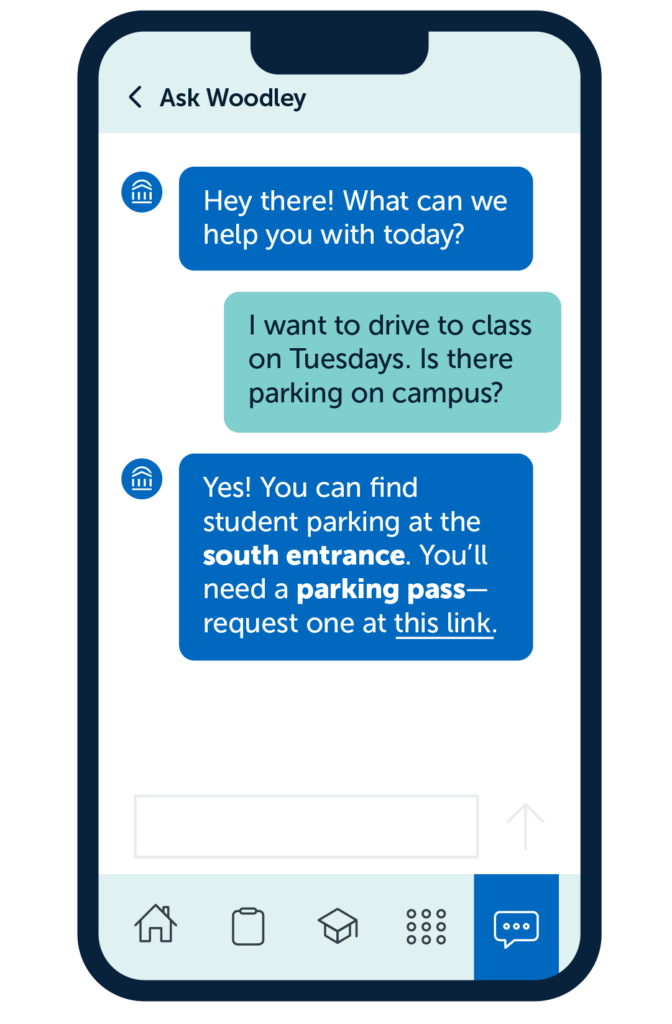
Once students decide what to do, the path forward needs to be effortless. If the task has too many steps, they’re less likely to follow through. For example, if a student asks who they should talk to about course planning, they should be able to schedule that meeting with their advisor directly from the same conversation. And when they connect with that advisor, the context from their previous chatbot conversation should carry over. Staff should know what the student asked, what they are worried about, and what guidance they already received, so the conversation starts with clarity instead of repetition.
The belief that students should only have to tell their story once is central to Navigate360, and that carries over into our AI Assistant for Students. The goal is to help students move from question to action as quickly as possible—whether that means booking an appointment, connecting with the right office, or giving staff the context they need to provide informed support.
3. Students’ lives aren’t confined to typical business hours
Students are often working through tasks before work, during a commute, or after putting children to bed. The usage data reflects that reality: 82% of students used the AI agent when traditional offices were closed or less likely to be fully staffed:
- 70% used it Monday through Friday outside business hours
- 10% used it on weekends.
This, paired with the fact that 27% of student questions posed to the AI Assistant were quick questions and clarifications tells us that students are not always looking for a full conversation; they need one missing detail so they can keep making progress at a time that works for them. Points of confusion in these moments can stall progress for students with very limited time. If a student can’t confirm a deadline or find the right form, they’re more likely to abandon their next step and fall off track.
Students must be able to trust the answers coming from your chatbot. Outdated or wrong information could result in a busy student making a poor decision and erode their trust in your institution. Keeping your chatbot current isn’t just a technical detail, it’s a student success priority. Navigate360’s AI Assistant for Students handles this automatically by checking the school-designated sources it is connected to, like websites, policies, and uploaded documents. When those sources change, the assistant refreshes its answers from the updated content instead of using old information. So, students get reliable guidance and your staff isn’t stuck playing content editor on top of everything else they’re already managing.
University chatbots can remove barriers to student progress
By proactively removing barriers, institutions can help more students stay on their path to success. Student-facing chatbots are increasingly becoming a meaningful part of that. Beyond answering questions, they show us where students are struggling, when they need help, and where support needs better coordination. This helps students—and provides real-time insight into student behavior that helps the leaders who serve them.
Learn how Navigate360’s AI Assistant bridges the gap between insight and action
Schedule a demo to see how our partner institutions are giving students clearer answers, faster support, and more connected guidance across the student journey.

More Blogs

How to keep human connection at the center of your campus AI strategy

How to improve student success in short-term credential programs