AI visibility is critical when competing for student enrollments
Where and how does your institution appear in AI-driven search?
If your answer is “I’m not sure,” now’s the time to assess where you stand. Generative AI is rapidly reshaping how students get information online. EAB’s fall 2025 student survey found that 46% of Gen Z now use tools like ChatGPT during the college search (up from 26% this spring) and often rely on AI summaries instead of clicking through to .edu sites.
AI tools rely heavily on content from third-party sites, which include everything from college search platforms to Reddit. This means that as zero-click behavior grows, your institution’s AI visibility* becomes synonymous with your brand authority. In my work as a Content Strategist with EAB’s Digital Agency, I’ve seen firsthand how the right content strategy enables partners to safeguard their brand and remain the trusted source of information about their institution.
Read on for the top strategies I recommend to help partners stay competitive and in control of their brand presence in AI-powered search.
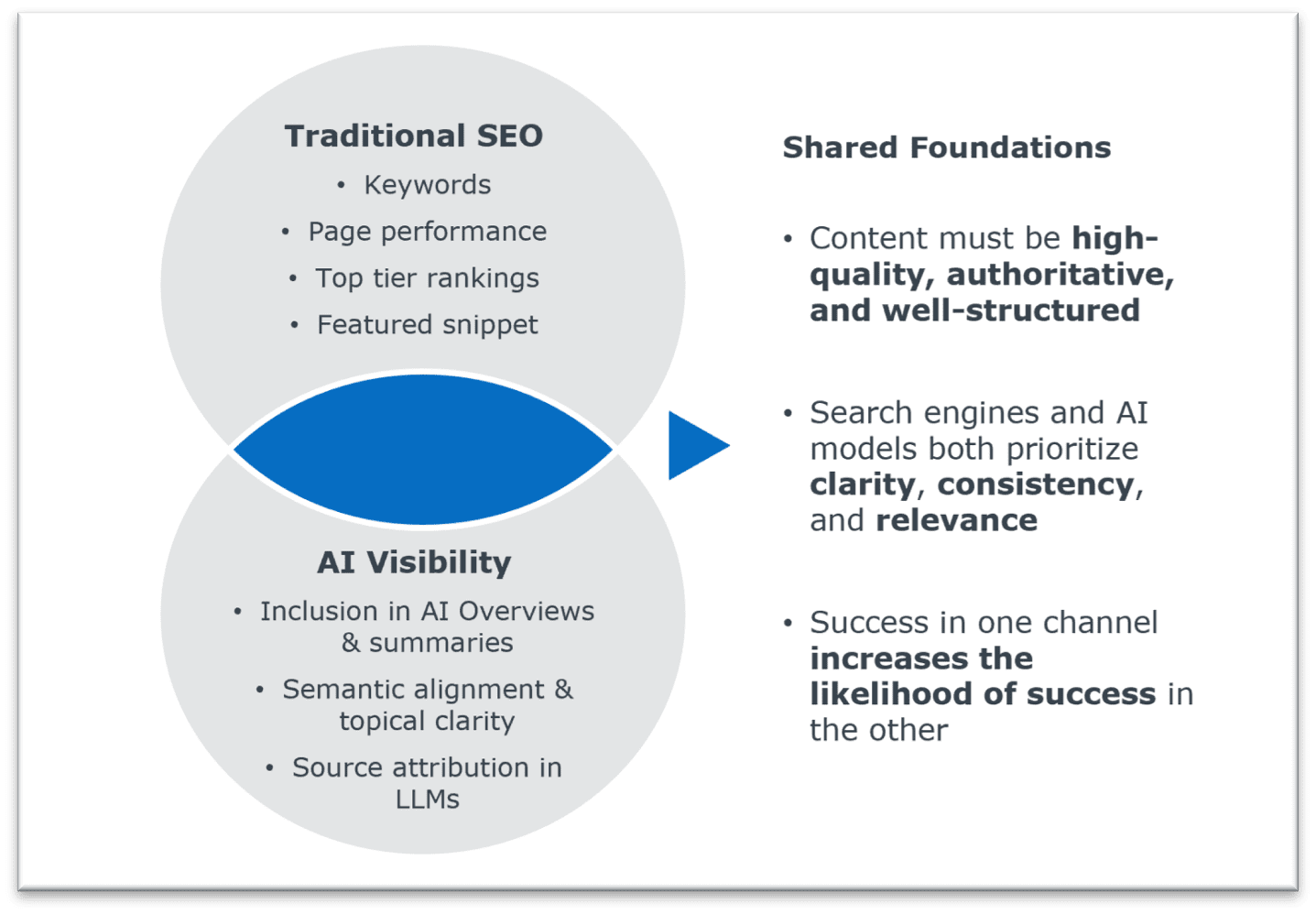
*What do we mean by “AI visibility,” and how is it different than traditional SEO?
AI visibility is how prominently your brand and content appear in AI-generated answers, summaries, and other AI-driven search experiences. True visibility hinges on accuracy and credibility, not just rankings or keywords. And while the two differ, strong SEO foundations and strong AI visibility practices now work together to determine how your institution shows up in search.
Understand Your .edu’s AI Visibility With Our Search Visibility Audit
1. Use E-E-A-T to guide your content
We don’t yet know the full mechanics behind how generative search determines which content to prioritize. But we do know that Google’s AI Overviews rely on four key trust signals—experience, expertise, authoritativeness, and trustworthiness, or E-E-A-T—to surface information that’s genuinely useful. These signals matter even more for what Google calls Your Money Your Life (YMYL) content, which covers medical, financial, and educational information, because these are areas where people are making important decisions with meaningful impacts on their lives. And because .edu websites fall squarely within YMYL content, these trust signals play a big role in how your institution shows up in AI-driven search.
Let’s break down E-E-A-T and the kinds of content you can create to instill trust in your .edu site:
-


Experience: Does your content show first-hand, real-world insight?
This is the kind of content that brings your institution’s value to life through real stories from your campus community. Think student testimonials, faculty spotlights, and authentic photos or videos of life on campus.
-

Expertise: Does your content demonstrate knowledge or credentials?
On your .edu, this often means highlighting program accreditation, faculty credentials, research published by faculty or students, and clear information about curriculum.
-

Authoritativeness: Does your content have external recognition or reputation?
Your .edu domain already gives you a head start here. You can further strengthen your authority with rankings or recognition from notable publications, industry partnerships, and alumni success stories that connect former students to well-known employers or institutions.
-

Trustworthiness: Does your content convey transparency, safety, and reliability?
These are the basics that help families feel confident in your institution, like clear contact information, transparent cost details, up-to-date privacy and accessibility statements, and an ADA-compliant site.
When these trust signals work together, they help establish your .edu site as a credible, reliable source of information in an AI-driven search landscape.
2. Turn keywords into conversations
Where users once typed in a few keywords and clicked through a list of links, they’re now asking full, specific, natural-language questions and getting AI-generated answers directly. Instead of a discrete search term like “Bear University tuition,” a student might ask, “How much will it cost me to go to Bear University for four years?”
You can adapt to this shift in search behavior with the content on your site. Think about your web content as though you were having a conversation with a prospective student. You already know the first questions they’ll ask about enrollment-critical topics like admissions, academics, or financial aid. Now consider the follow-up questions that naturally come next. After they learn what it costs to attend your institution for four years, they might immediately wonder about available scholarships, the percentage of students who receive aid, or the financial aid application deadline.
Start by building content around a central question, then make sure the smaller, related questions are answered clearly and concisely. That structure gives AI what it needs to keep relying on your site instead of drifting to third-party sources. It’s a deeper, more proactive way to think about search intent, and it helps your content resonate more meaningfully with your users.
3. Don’t overlook the SEO basics
With all the energy around AI visibility, traditional SEO can easily slip out of focus. It’s important to remember that on-page search optimized content strategies like structured H-tags and headers, meta descriptions, and actionable linked copy remain just as important to help users of all kinds parse your content. Clear, structured content centered around user intent is the foundation of accessibility—not just for users, but for search engines and LLMs alike.
Be found and trusted in the new search landscape
How you show up in AI-driven search shapes not only how well you compete for students, but how your institution is perceived. You and your team are the ultimate authority on your brand, but poorly optimized content can keep AI tools from recognizing your .edu as the most trusted source.
Start by conducting a search visibility audit to see where you stand. With the right content strategy tools, your content becomes more visible to LLMs and more accessible to prospective students—strengthening your competitive edge in an AI-driven search environment.
Ready to improve your .edu’s AI visibility?
To speak with an expert or request a demo, please submit this form.

More Blogs

Higher ed marketing is having a moment. Here’s why.

The enrollment game has changed. What still works?
