The hard truth about admit, yield, and discount rates
There’s a tension at the heart of enrollment management that enrollment leaders understand well, but many of their stakeholders often do not. Improving every rate at the same time is extraordinarily difficult.
In theory, the goal of enrollment management is straightforward: Build enrollment that generates sufficient net tuition revenue to support the mission and operations of the institution without compromising academic quality. In practice, the reality is that most enrollment leaders are expected to simultaneously improve admit rate, yield rate, and discount rate…not to mention any number of other metrics.
To put some data behind this challenge, I looked at longitudinal trends related to each of these rates across institutional segments. The results help illustrate just how difficult this is, and they provide important context for conversations with cabinets and boards.
Only 4% of institutions can do it all at once.
The data shows just how rarely institutions are able to thread the needle of simultaneously improving all the major rates at once.
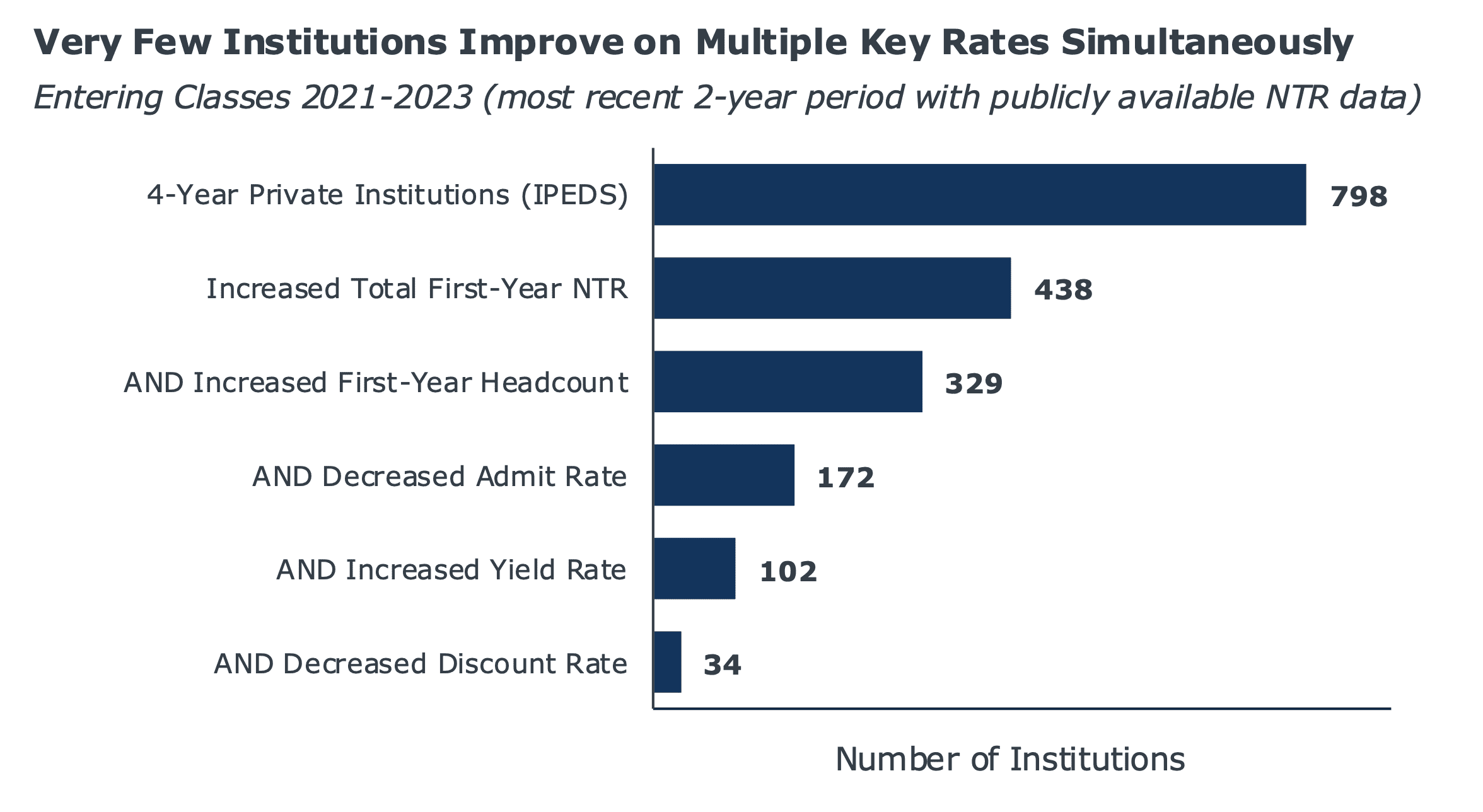
Between Entering Classes 2021 and 2023, 798 private four-year institutions reported net tuition revenue (NTR) data to IPEDS. Of those, 438 increased NTR, but only 34 were able to also increase headcount, decrease admit rate, increase yield rate, and decrease discount rate—that’s just 4% of schools.
While this analysis focuses on private institutions, the same underlying dynamics apply more broadly. Admit, yield, and discount rates are best understood as by-products of your enrollment strategy, but they are often treated as goals in their own right. This is due in part to outside entities, such as bond rating agencies, who view them as proxies for institutional stability and desirability. When these rates become goals, rather than by-products, the result can be counterproductive.
To understand why, it helps to look at each metric individually.
Admit rate is easiest to change, but not without tradeoffs
Any school can lower its admit rate by admitting fewer students. But push too far in pursuit of selectivity, and you risk constraining enrollment growth and putting NTR at risk.
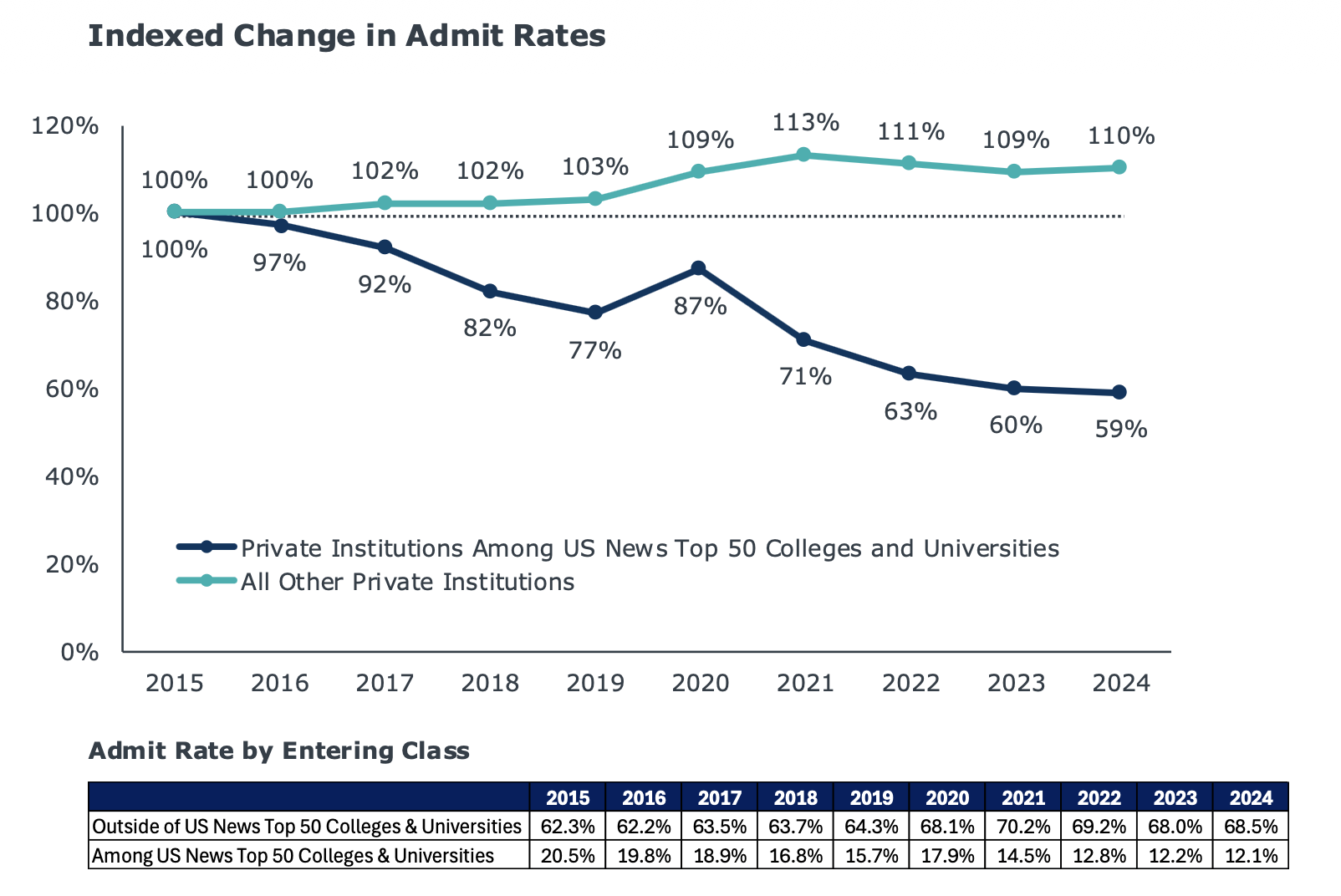
The graph below compares the change in admit rates in the past 10 years among elite institutions to the field of all other private institutions. (Note that I’ve used U.S. News Top 50 Colleges and Top 50 Universities merely as a way to define a cohort, not as a comment on the value of rankings.) While the average admit rate across elite institutions has decreased significantly, among the other 90% of private institutions, admit rate has increased over time.
-


The takeaway
While the most selective institutions have driven down admit rates, most schools have had to increase admit rates to sustain enrollment. Rather than focusing on lowering admit rates, the majority of institutions are better served by looking upstream at how they generate and shape demand.
Higher yield doesn’t mean stronger demand
A similar tension emerges when you look at yield rate. The challenge with yield rate is that the students who want you most—and therefore yield at the highest rates—are often the students you may want least. Meanwhile, the students you most want typically have more options and yield at lower rates.
As such, one surefire way to increase yield would be to simply stop pursuing your most coveted students, which would, of course, be counterproductive. Compounding the issue, meaningful enrollment growth typically requires significant application and admit growth. As admits expand, the denominator in the yield calculation increases—making it even harder to raise yield. In many cases, a declining yield rate is simply the math of enrollment growth.
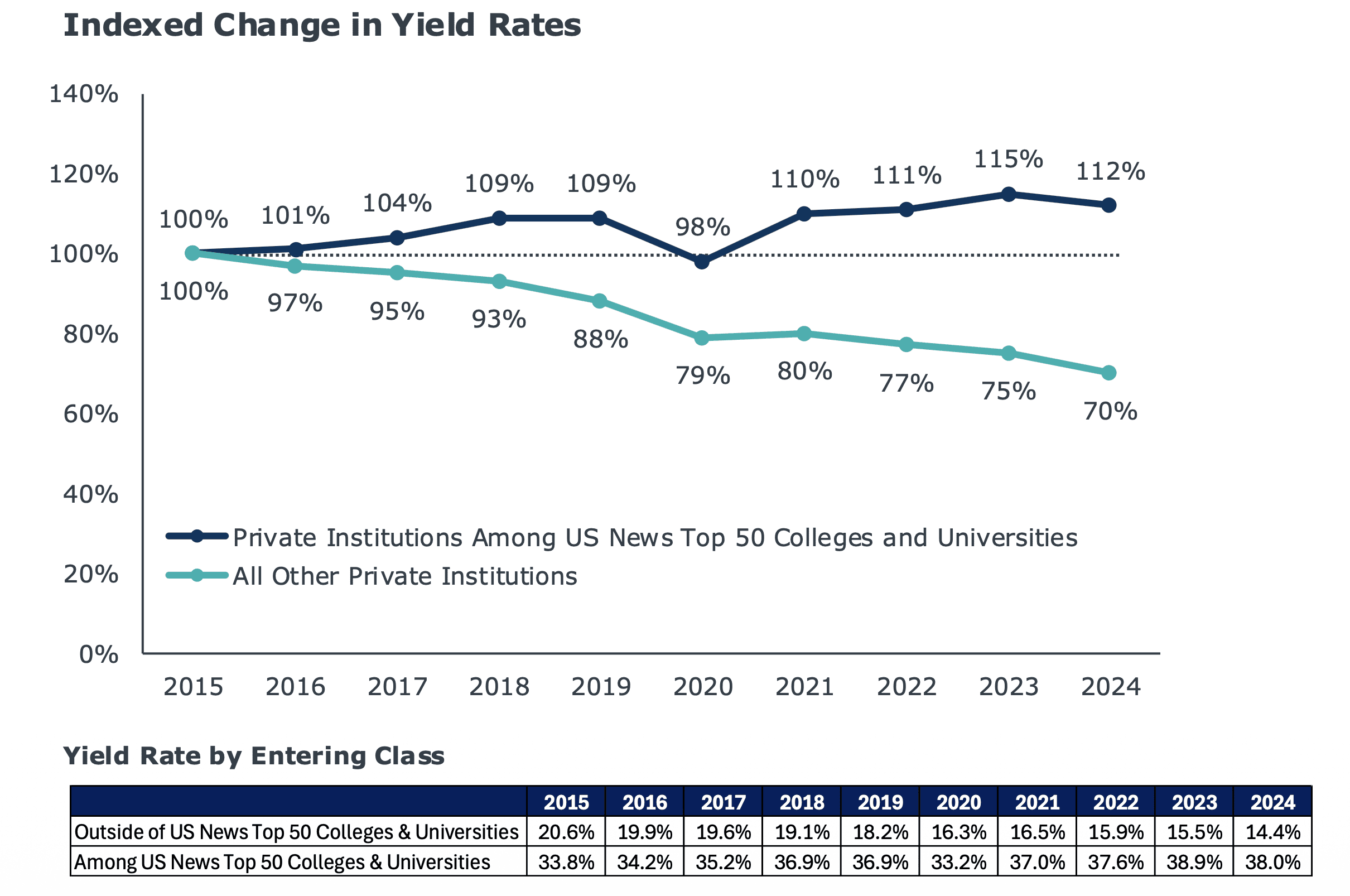
Again, elite institutions have been able to drive gains in yield, but for the other 90% of institutions, yield rate has declined consistently over time. It’s important to note also that among elite institutions, on average, more than 38% of enrolled students were reported as admitted through some type of early decision program, making it easier to drive down admit rates and increase yield rates.
-
The takeaway
Efforts to grow enrollment and shape the class often put downward pressure on yield. This is why benchmarking yield in isolation can be misleading without a clearer view of student mix, growth strategy, and market position. Yield also depends on how well institutions are targeting and engaging the students they most want to enroll.
Rising discount rates aren’t inherently a red flag
Finally, let’s look to discount rate. To an outside observer, an increasing discount rate appears very alarming. In practice, the story is more nuanced.
Schools increase tuition to generate incremental net tuition revenue from returning students. In turn, a marginal increase in discount rate helps blunt the impact for new incoming students. As long as the relative lift in discount rate does not exceed the relative increase in tuition, an increase in discount rate does not mean a decrease in net tuition revenue.
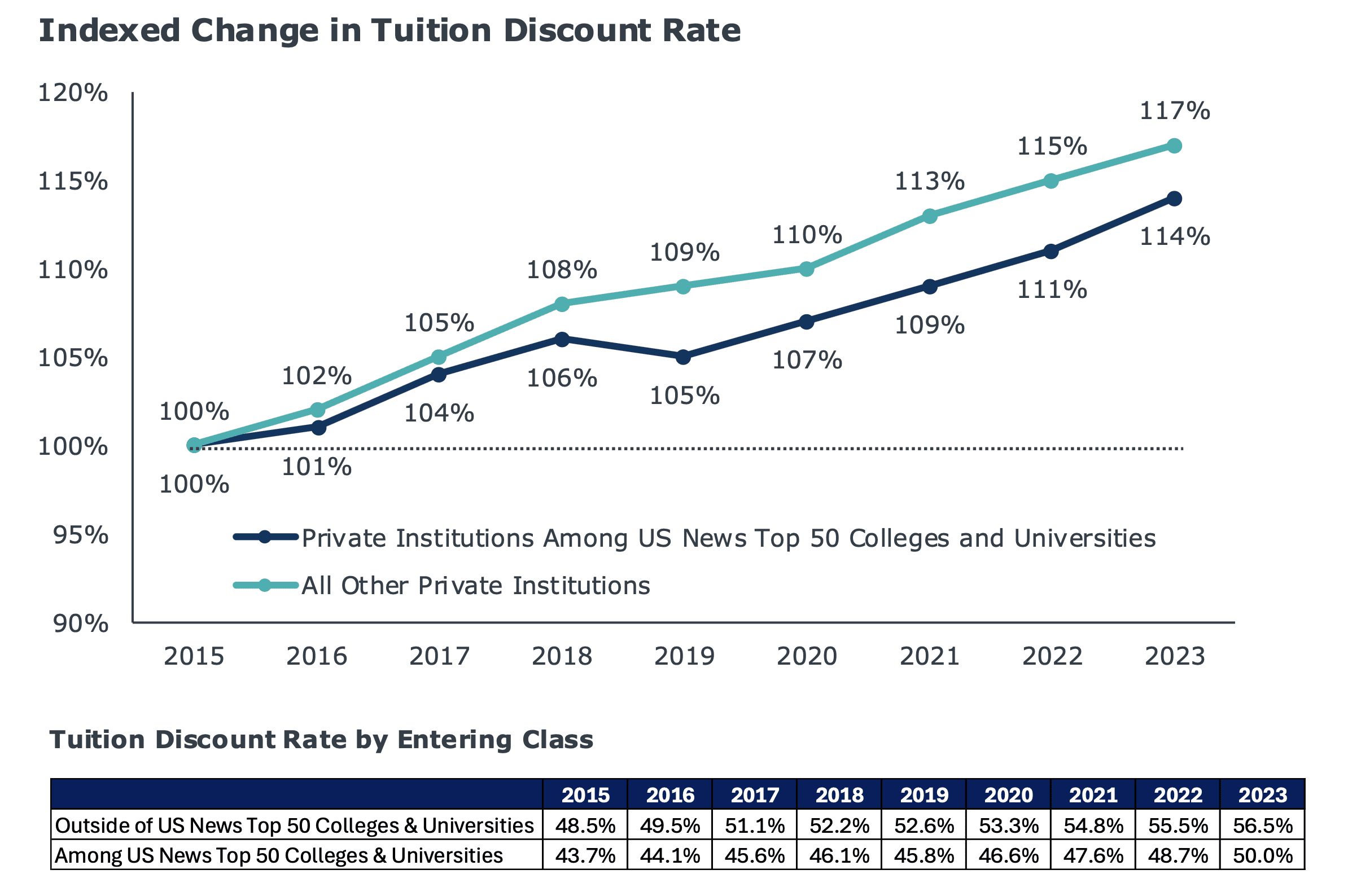
If aid packages become too lean in pursuit of a lower discount rate, some students simply won’t enroll—and you risk losing the entire tuition stream. And in today’s challenging market, you don’t have to miss by much to miss by a lot. As you can see in the chart below, even elite institutions are not immune to increases in discount rate as tuition rises over time.
-
The takeaway
Modest increases in discount rate are necessary to sustain enrollment and revenue in a competitive market. Financial aid optimization modeling can help institutions test pricing and discount scenarios to balance access, class shape, and net tuition revenue.
Rethinking how we measure and inflect enrollment success
All of this is not to say that admit, yield, and discount rates don’t matter. Rather, in pursuing them, enrollment leaders need to help others understand the underlying dynamics of the rates and the gravitational forces that govern them.
Enrollment management is fundamentally about trade-offs. The institutions that succeed over time stay focused on the true objective, sustainable net tuition revenue aligned with mission, and treat interim rates as signals to interpret, not goals to chase.
Doing that well requires more than tracking individual metrics. It requires a more integrated view of enrollment strategy, one that brings together market insight, marketing and recruitment strategy, analytics, and financial modeling to drive better outcomes in an increasingly complex environment.

More Blogs

The enrollment game has changed. What still works?

How mature is your AI search strategy?