How CBOs can prepare for higher ed’s less stable future
Higher education is facing increased financial pressure and deteriorating outlooks from major rating agencies such as Fitch and Moody’s. These are not temporary disruptions, but a new operating reality: Moody’s 2026 outlook, for example, projects expense growth outpacing revenues (4.4% vs. 2.5-3.5%) for the foreseeable future.
This spring, EAB convened over 50 chief business officers (CBOs) to discuss what these pressures mean for higher education and the actions leaders must take to address them. Conversations spanned four sessions covering the financial state of the sector, the future of financial planning, making meaningful change within shared governance, and preparing for a future workforce with fewer people. Throughout the sessions, one theme was clear: past strategies are insufficient to meet the challenges ahead. Read on for four takeaways from these discussions.
1. Revenue and cost pressures are simultaneously compressing universities
EAB’s financial overview of the sector set the foundation for the meeting, emphasizing that higher education’s business model is increasingly fragile and that many institutions are struggling to respond to changing conditions.
Primary revenue sources (e.g., tuition and fees and government allocations) are under strain. At the same time, cost rigidity sets a real budget ceiling, with labor comprising 56% of all expenses. The consequences of this synchronized compression are already apparent, with one in three U.S. institutions posting a structural deficit in FY2024.
Revenue and cost pressures: a simultaneous squeeze
Revenue
- Tuition and fees: Demographic decline; global volatility; ROI skepticism.
- Government funding: Federal policy pressures (especially research), weakened state budgets.
- Private grants and contracts: Dependent on federal flows; shifting priorities post-election.
Costs
- Instruction: Salary growth outpacing revenue; static workload and delivery models.
- Financial aid: Borrowing caps; shifting loan eligibility; access concerns.
- Research and public service: High-cost infrastructure; new compliance mandates, federal cuts.
Changes to federal student loan programs were flagged by CBOs as a top concern, with discussion focused on the differential impact of new borrowing caps depending on an institution’s enrollment demographics and mix. Several leaders are already modeling the impact of various enrollment and revenue scenarios. One CBO shared the proactive steps they are taking to work with local banks to ensure students have access to the funds they need to continue their education.
-


Explore the full picture of revenue and cost pressures
Register for EAB’s Financial State of the Sector webinar on June 18 for a clear view of higher education’s most pressing financial challenges.
2. Long-term financial planning helps institutions respond to volatility
While universities must think in decades, their budgets are often planned only a few semesters ahead. Institutions with multi-year financial plans are much better positioned to absorb shocks and respond quickly when conditions shift, maintaining a focus on strategic priorities while navigating uncertainty and change.
Institutions that ground forecasting in realistic assumptions, plan across multiple years rather than just the next budget cycle, and free finance teams to conduct strategic analysis rather than transactional reporting can see volatility coming and respond before a crisis hits.
Three marks of an effective multi-year financial plan
-

Iterative
A plan that builds on previous versions and is updated as conditions change
-

Aligned
The financial plan directly or indirectly supports strategic priorities
-

Integrated
A comprehensive view that brings together all revenue and cost drivers
While some CBOs expressed frustration with how to obtain value from planning horizons beyond three years, conversations quickly turned to how aligning financial timelines with broader institutional planning cycles—like strategic plans—strengthens the ability to deliver on priorities. Several shared that their institutions are actively building out 3-, 5-, and 10-year plans updated alongside the annual budget, treating long-range planning not as a forecasting exercise but as a management tool.
Overall, there was agreement that leaders don’t need a perfect model; they need a plan that gets updated regularly as conditions change, giving the board and cabinet clearer direction.
-

Interested in improving financial planning at your institution?
Reach out to your Strategic Leader or [email protected] to bring an in-depth financial planning research presentation to your team.
3. Shared governance requires stronger decision resolve
We started day two of our roundtables with an intentionally provocative question for CBOs: Is shared governance a design flaw in higher ed? While opinions in the room differed over the fundamentals of shared governance, all agreed that it’s often misapplied. When institutions engage in consensus-based decision-making where it is not required, progress stalls.
To overcome this challenge, institutions need to strengthen decision resolve: the ability to make the right call, quickly enough, with the right people in the room. Institutions with strong decision resolve do four things differently:
- Build constructive conflict structures that secure group commitment rather than passive consensus
- Install tripwires that auto-trigger decisions when market signals hit a threshold
- Enact transparent decision rules that assign ownership for final calls
- Implement clearly scoped mandates with defined timeframes so committees deliver
The conversation immediately surfaced the tension CBOs face with shared governance, with nearly everyone in attendance providing examples from their own institutions. A key insight was that time is the scarcest resource a leader has, and most governance structures consume far more of it than necessary. One CBO noted how time-consuming board management can be, but that instituting clearer decision roles and providing a dedicated financial education session for members has streamlined operations and sped up decision-making.
-

Ready to build the infrastructure to better navigate change?
Get started with EAB’s Stakeholder Assessment Toolkit for Change Management.
4. As labor challenges intensify, institutions must build capacity from within
Higher education leaders are acutely aware of the impact of the demographic cliff on enrollment, but they often overlook the parallel effect on the workforce. The pool of available talent is shrinking, with the U.S. estimated to face a worker deficit of 6 million by 2028. At the same time, higher education struggles to compete for workers with the private sector, where employees see average salary increases of $10,000 or more. Addressing these dynamics requires a multifaceted talent strategy.
Four levers for building workforce capacity
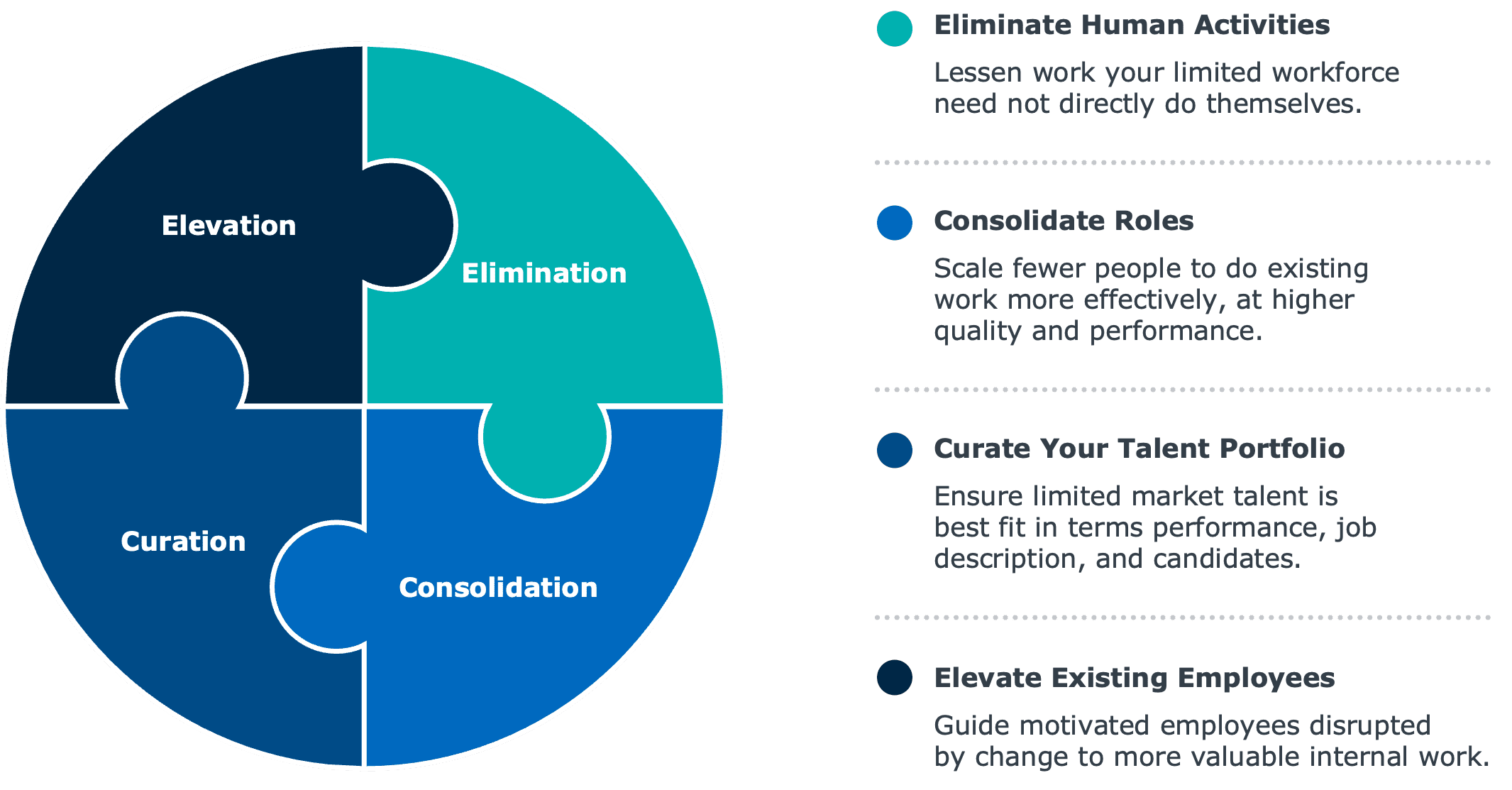
Discussion of workforce challenges hit close to home for nearly every CBO at our roundtables, with most attendees noting a struggle to fill critical vacancies in recent years. As one CBO put it, the skills institutions will need in five years are not the skills they have today. Institutions are finding creative solutions to talent gaps, with one CBO sharing that they moved dining services staff into apprenticeships to build a pipeline of locksmiths to replace retirees.
-

Build a more resilient talent strategy
EAB’s Employee Recruitment and Retention Resource Center compiles research, tools, and services to help leaders improve hiring practices and boost employee engagement.
Prepare now for a less certain future
The CBOs who gathered at our spring 2026 roundtables are navigating one of the most uncertain periods in higher education in decades. Revenue is harder to predict while costs keep rising, and the decisions that matter most are often the hardest to move through shared governance quickly. These sessions offered a clearer picture of what the path forward requires. Ultimately, the institutions that find traction will be those that stop waiting for conditions to stabilize and start proactively preparing for a less certain future.
Get expert guidance on administrative and operations goals
Fill out the form to learn how Strategic Advisory Services supports CBOs with financial planning, navigating shared governance, and workforce challenges.

More Blogs

How one university used AI to build trust in financial scenario planning

Why higher ed administrative transformation stalls at scale