The reduced-credit degree landscape is growing—here’s what higher ed leaders need to know before launching a 90-credit degree
As students increasingly question the bachelor’s degree’s value, reduced-credit bachelor’s degrees are emerging as a compelling alternative to the traditional 120-credit design. Yet many stakeholders worry these offerings will devalue education and harm revenue. We believe reduced-credit degrees are here to stay, and sooner or later leaders will need to decide whether to launch their own programs.
To inform leaders’ decision-making, this blog explains the current reduced-credit landscape and describes what successful program design requires.
The evolution of the reduced-credit landscape
Following the first reduced-credit program launch in 2024, program announcements grew steadily, then almost exponentially as all major accreditors now permit them. State legislatures are also calling for reduced-credit degrees to demonstrate investment in low-cost education. We expect reduced-credit program numbers to grow as institutions race to launch degrees before competitors.
Reduced credit is the next in a series of higher ed innovations, including massive open online courses (MOOCs), competency-based education (CBE), accelerated programs, and alternative credentials. Like its predecessors, it creates new ways to access education and deliver outcomes for a diversifying student population.
In 2026, program announcements are accelerating as an increasingly diverse set of institutions enter the reduced-credit landscape.
Active vs. Proposed Reduced-Credit Bachelor’s Programs Over Time with Future Forecast
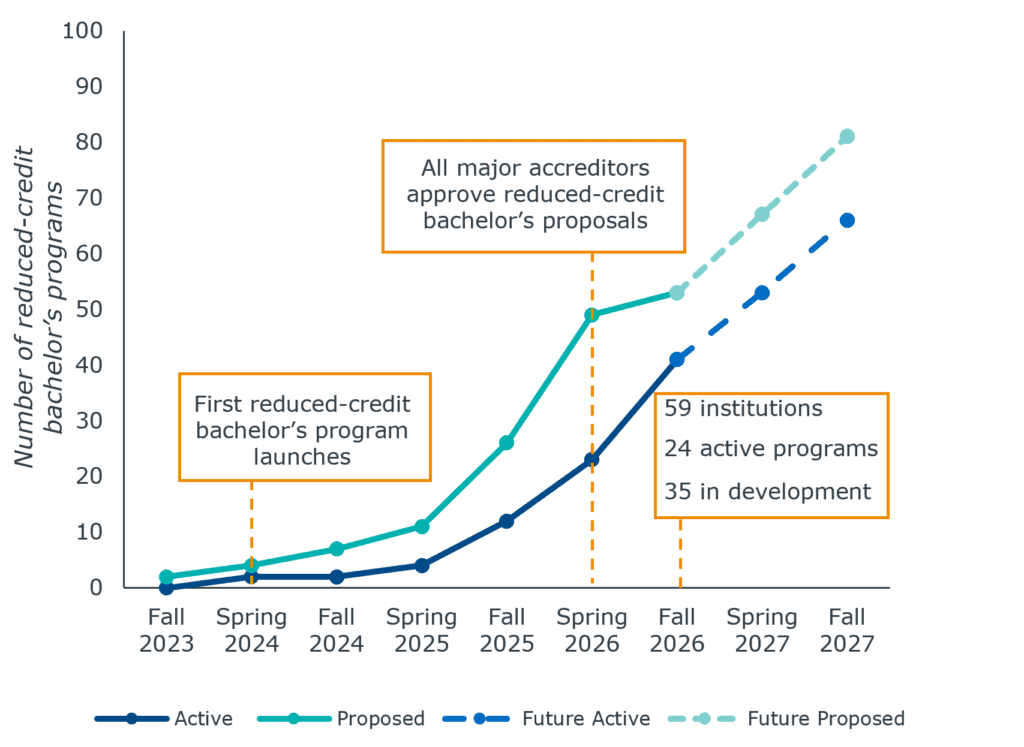
The landscape is becoming mainstream as state pressures, shrinking enrollment pools, and changing value propositions make reduced credit appealing to a variety of institutions such as state flagships and selective privates. Regardless of their status or reason for launching a program, institutions cannot afford to treat reduced credit as an experiment and must choose programs that improve student outcomes.
Reduced-credit degrees can work—but not for every program or audience
We crafted four questions to assess whether a reduced-credit program will succeed and connect students to a strong labor market. Leaders should not just ask, “Can we reduce this degree to three years?” Instead, they should ask:
- Which students would benefit from a shorter pathway?
- What problem is the reduced-credit model solving for them?
- Does the potential market size warrant institutional investment?
- Does reducing credits preserve the academic and professional value students need?
Which degrees fit a reduced-credit model?
Comparing projected job growth, underemployment, and unemployment across common reduced-credit disciplines shows that not all programs meet these criteria.
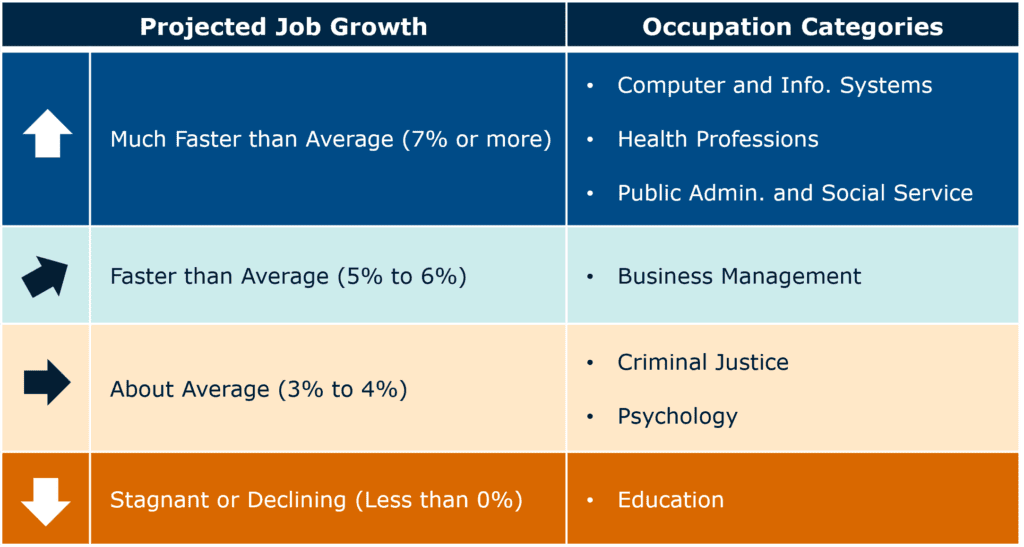
Only a few reduced-credit degrees lead to strong career outcomes. Programs with weaker outcomes face smaller markets, fewer employment opportunities, and lower demand.
Why program selection matters
Weakest signal: Criminal Justice
- Only two of nine aligned occupations typically require a bachelor’s degree for entry.
- Most aligned occupations require only a high school diploma.
- Four of nine occupations are projected to have declining employment opportunities
- Recent criminal justice graduates experience particularly high underemployment.
Implication: Institutions risk creating a shorter bachelor’s degree for a labor market that often does not require a bachelor’s degree in the first place.
Weaker signal: Psychology
- Four of six aligned occupations typically require a master’s or doctoral degree for entry.
- In those occupations, 15% or fewer workers hold a bachelor’s degree as their highest level of education.
- Occupational growth is relatively strong, but recent psychology graduates experience above-average unemployment and underemployment.
Implication: Reducing the time and credits required for the bachelor’s degree does not solve the larger challenge that many psychology career pathways require graduate education.
Stronger signal: Business Administration
- 21 of 23 aligned occupations are projected to experience average or faster-than-average growth through 2034.
- A bachelor’s degree is the typical entry-level credential for 20 of 23 occupations.
- 21 occupations have above-average shares of workers whose highest credential is a bachelor’s degree.
- Recent graduates experience higher underemployment but below-average unemployment.
Implication: The breadth of bachelor’s-level career pathways makes business a potentially strong fit, although institutions should consider variation in outcomes by occupation.
Strongest signal: Information Technology
- Eight of nine aligned occupations are projected to grow faster than average.
- A bachelor’s degree is the typical entry-level credential for eight of nine aligned occupations.
- In every aligned occupation, at least 36% of workers hold a bachelor’s degree as their highest level of education, compared with a 25% overall average.
- Recent graduates have experienced rising unemployment, but underemployment remains comparatively lower.
Implication: Strong occupational demand and clear bachelor’s-level requirements create a stronger case for a streamlined bachelor’s pathway.
Four personas for identifying strong reduced-credit opportunities
-


Graduate School Pathway Seekers
Those seeking a fast, affordable path to a career that requires a bachelor’s and post-bachelor’s degree
-

Career-Focused Undergraduates
Those seeking fast, affordable degrees for a career that requires a bachelor’s degree
-

Adult Learners with Some Credit but No Degree
Stop-outs, community college transfer students, and military – with an associate’s degree and/or certificate or 60+ credits
-

Open-Enrollment College Students
Undergraduate students seeking low-cost generalist education
Once leaders choose a persona, they can select a program designed to serve that population. For more on the personas, aligned programs, and real-world examples, register for our webinar on designing effective reduced-credit bachelor’s degrees.

More Blogs