AI inboxes are the next test for your enrollment marketing strategy
My Gmail AI Inbox just activated, and for a moment I was convinced the “Email Marketing Apocalypse” had come at last. If Google’s innovation takes hold, future audiences may never see the subject lines, copy, imagery, and designs that today’s marketers labor over.
That is an unsettling prospect for teams that rely on email to drive action, from applications and FAFSA completion to event registration and deposits.
So, we set out to understand what this shift could mean for our Enroll360 partners. What we found points to a practical question for enrollment teams: how should email strategy evolve when AI becomes part of the audience experience?
AI inboxes add another layer to an already complex channel
For years, the inbox has functioned as a crowded holding place. Some messages earned attention, while others were either skimmed or shoved to the “doom piles” of our spam and trash folders.
AI inboxes work differently; they are designed to help users make sense of crowded inboxes by summarizing messages, identifying key points, and suggesting next steps.
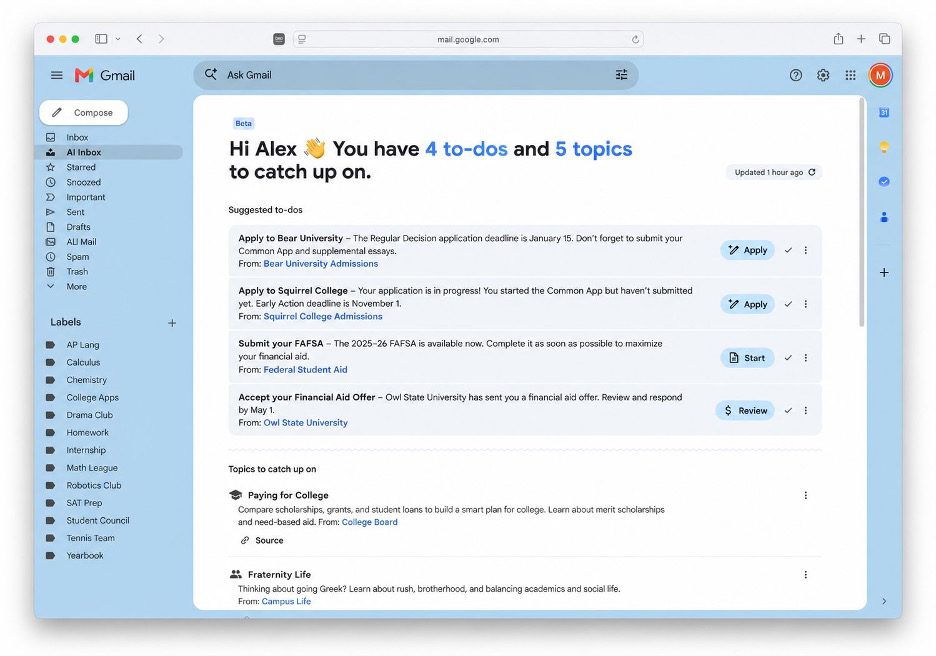
A hypothetical student Gmail AI inbox
Students don’t always engage with recruitment messages in linear or easily trackable ways. In a recent report on AI inboxes from Validity—an email deliverability platform—we learn why this shift matters: 55% of consumers now make decisions based on AI-generated email summaries alone, meaning marketers can no longer assume their full message will be opened, read, or interpreted as intended.
A prospective student can now ask their inbox what college-related tasks they need to complete this week. A parent could rely on an email summary to understand a financial aid deadline. An admitted student may see a prompt about housing, orientation, or FAFSA completion without reading the full campaign email that prompted it.
That makes the inbox less like a place and more like an active interpreter. It may decide—autonomously—what to highlight, what to condense, and what belongs on a user’s task list.
What our AI inbox testing showed
Our Enroll360 team spent much of the spring running structured experiments on AI email mediation across Gmail and Apple Mail. We wanted to understand what AI summaries, subject-line rewrites, thread condensation, and inbox prioritization could mean for the campaigns we run on behalf of colleges and universities.
The results were surprisingly reassuring.
In many ways, AI tools are like people: they are not especially eager to do extra homework. They reward clarity, concision, and directness, and they are more likely to surface the right takeaway when the most important information is easy to find.
In our testing, the emails that fared best with AI mediation tended to have the same qualities we already recommend for strong student and family communication. Those emails:
- made the audience clear
- put the most important action near the top
- included specific dates and deadlines in the body copy
- relied on plain language
- did not ask the recipient to decode the message before understanding what to do next
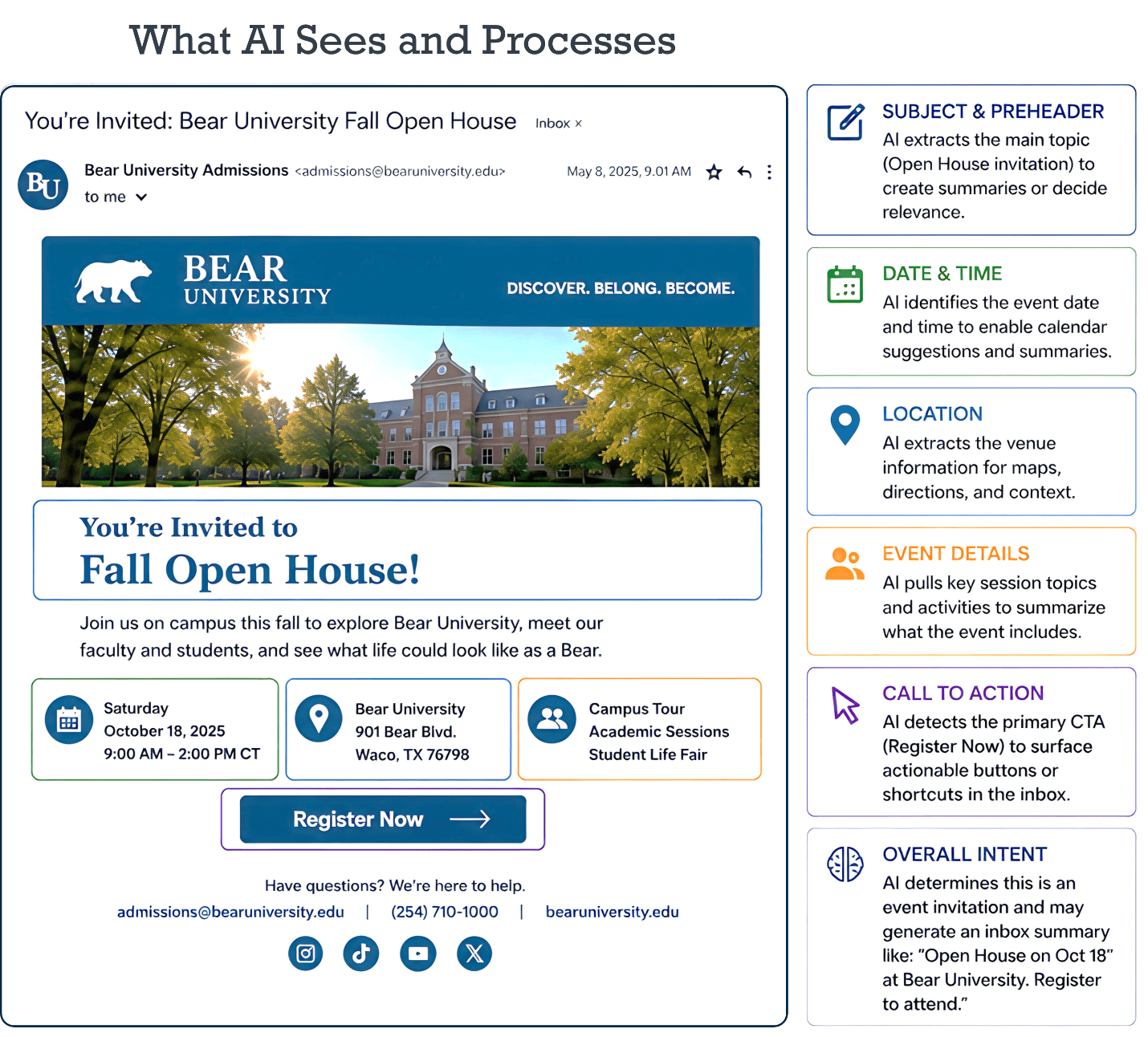
What AI sees and processes from college emails
The emails that created more risk also had common traits. These emails:
- buried the CTA
- used design to carry essential information
- included multiple competing actions
- assumed the reader would open an attachment
- used vague language when a specific deadline or instruction would have been more useful
If AI summarizers do not like your emails, the people you’re sending them to probably won’t either. That reinforces the value of the work many enrollment teams already do to make communications more relevant, readable, and action-oriented.
AI-readiness starts with the fundamentals
The encouraging part is that colleges do not need to rebuild their email strategies from scratch. Many of the practices that make emails more useful to students and families today also make emails easier for AI tools to summarize and prioritize.
Enrollment marketers should focus on fundamentals that serve both the human reader and the AI assistant helping them manage the inbox:
- Put the most important action in the first few lines.
- Use specific dates, deadlines, and instructions.
- Keep one primary CTA whenever possible.
- Avoid hiding essential information in images, PDFs, or attachments.
- Make links descriptive and action-oriented.
- Use plain language for complex enrollment, financial aid, and student success steps.
- Structure messages so a reader can understand the point in a quick skim.
- Test how important campaigns are summarized before they go out.
These practices also support accessibility, mobile readability, and clearer communication for students and families who may already feel overwhelmed by the college process.
AI inboxes also create a broader governance lesson. Students do not experience institutional communication one office at a time. They experience the full volume of messages coming from admissions, financial aid, housing, orientation, advising, and other campus teams. If those messages overlap, conflict, or compete, AI may try to make sense of that experience on the student’s behalf.
That raises the stakes for cross-campus coordination. A cross-campus communications task force can help institutions align the timing, ownership, and hierarchy of student messages so every outreach effort points students toward a clear next step.
Preparing for the next inbox
AI inboxes may change the information students see first, make opens and clicks harder to interpret, and introduce new uncertainty into a channel that enrollment marketers have relied on for years. But the innovation also reinforces a familiar truth: clear, relevant, action-oriented communication is still the foundation of effective enrollment marketing.
The teams best prepared for this shift will be the ones already testing new technologies and connecting campaigns to the enrollment behaviors that matter most. As AI changes how audiences encounter information, enrollment leaders need a strategy that can keep pace with the inbox and the next wave of innovation.

More Blogs

AI is impacting students’ college selections

The enrollment recovery masks sharp divides