Do you have a healthy recruitment ecosystem?
Student recruitment depends on more than generating names. Enrollment teams must build awareness, capture student interest, and cultivate that interest through outreach, events, digital engagement, and other recruitment marketing activities. Yet when institutions evaluate which efforts are working, they often reduce that complex process to a narrower question: Where did the student first enter our funnel?
In a previous post, we explored why a multi-source view provides a more complete picture of how students move from awareness to enrollment. Students rarely enroll because of one decisive experience. Instead, they encounter institutions through a mix of awareness-building and engagement activities over time, each of which can shape the broader recruitment journey.
That raises the next question: If enrollment outcomes are associated with multi-source engagement, what does an effective mix of sources actually look like? The answer is not simply “use more sources.” In fact, a stronger source mix may be more focused, not larger, because it prioritizes the sources that fill distinct roles and work together efficiently. The goal is not breadth for its own sake, but a more connected recruitment ecosystem.
Successful journeys look more like networks than checklists
When enrollment teams evaluate sources, it is natural to ask which one performs best. But that question can quickly lead us back to the same problem as first-source attribution: treating each source as if it operates in isolation. A source is not valuable only because it appears first or frequently, it is valuable because of the role it plays in the broader recruitment journey. To understand the structure of successful journeys, we mapped which source categories commonly appear together in journeys that result in a deposit.
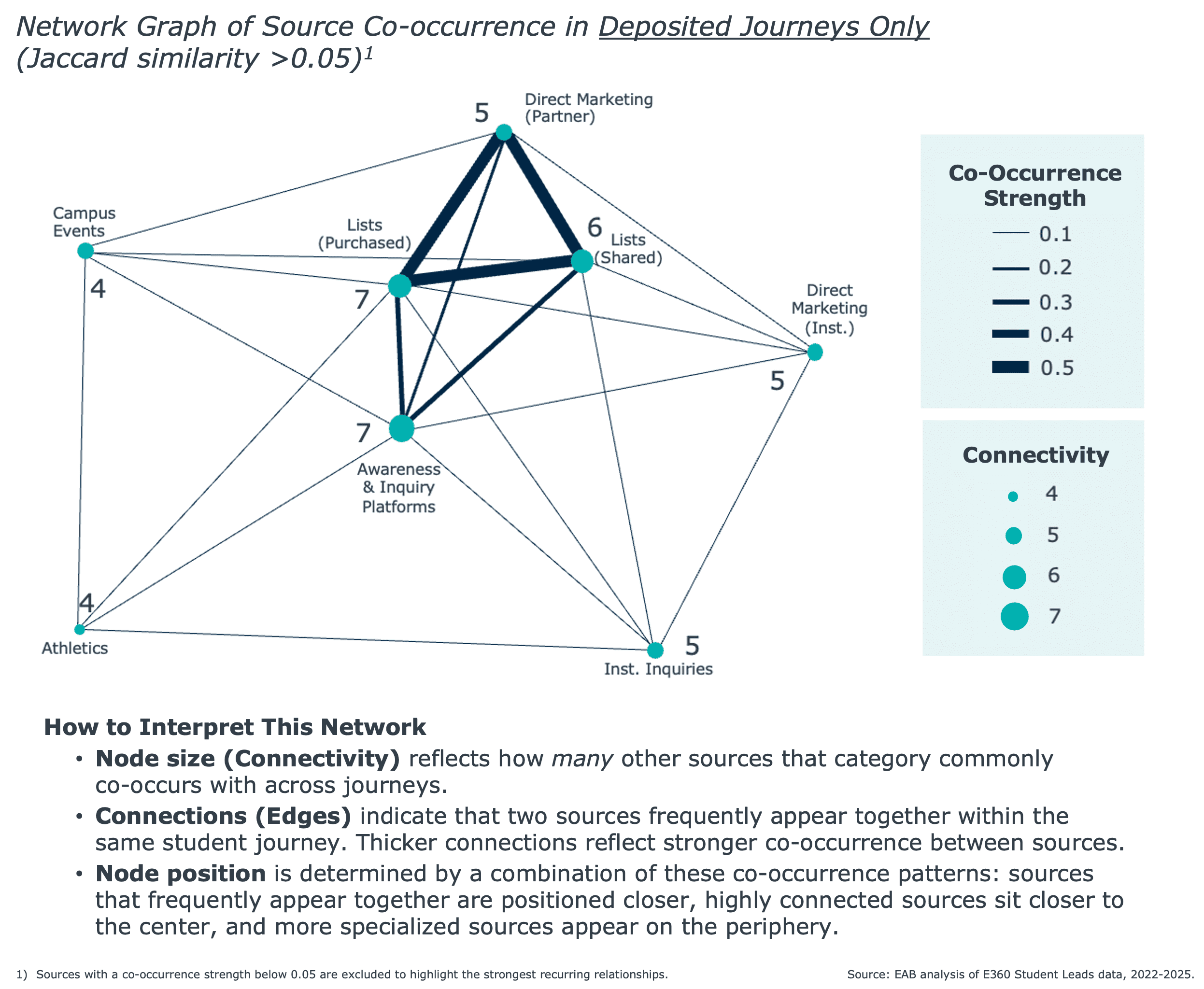
This network view changes the question. Instead of asking which source is “best,” it shows which sources are central to successful journeys, which appear in more specialized contexts, and how different sources connect to one another. In other words, successful journeys are not simply multi-source—they have structure. For enrollment teams, this means evaluating sources less by whether they appear first or most often, and more by the role they play in the broader journey.
Sources play different roles in a recruitment ecosystem
Three categories of recruitment source form the structural core of the network: (1) lists, (2) awareness and inquiry platforms, and (3) direct marketing. That all three are central is important because these sources do different kinds of work but together form a structural core of recruitment journeys that result in enrollment. This points us to three core functions within a recruitment ecosystem:
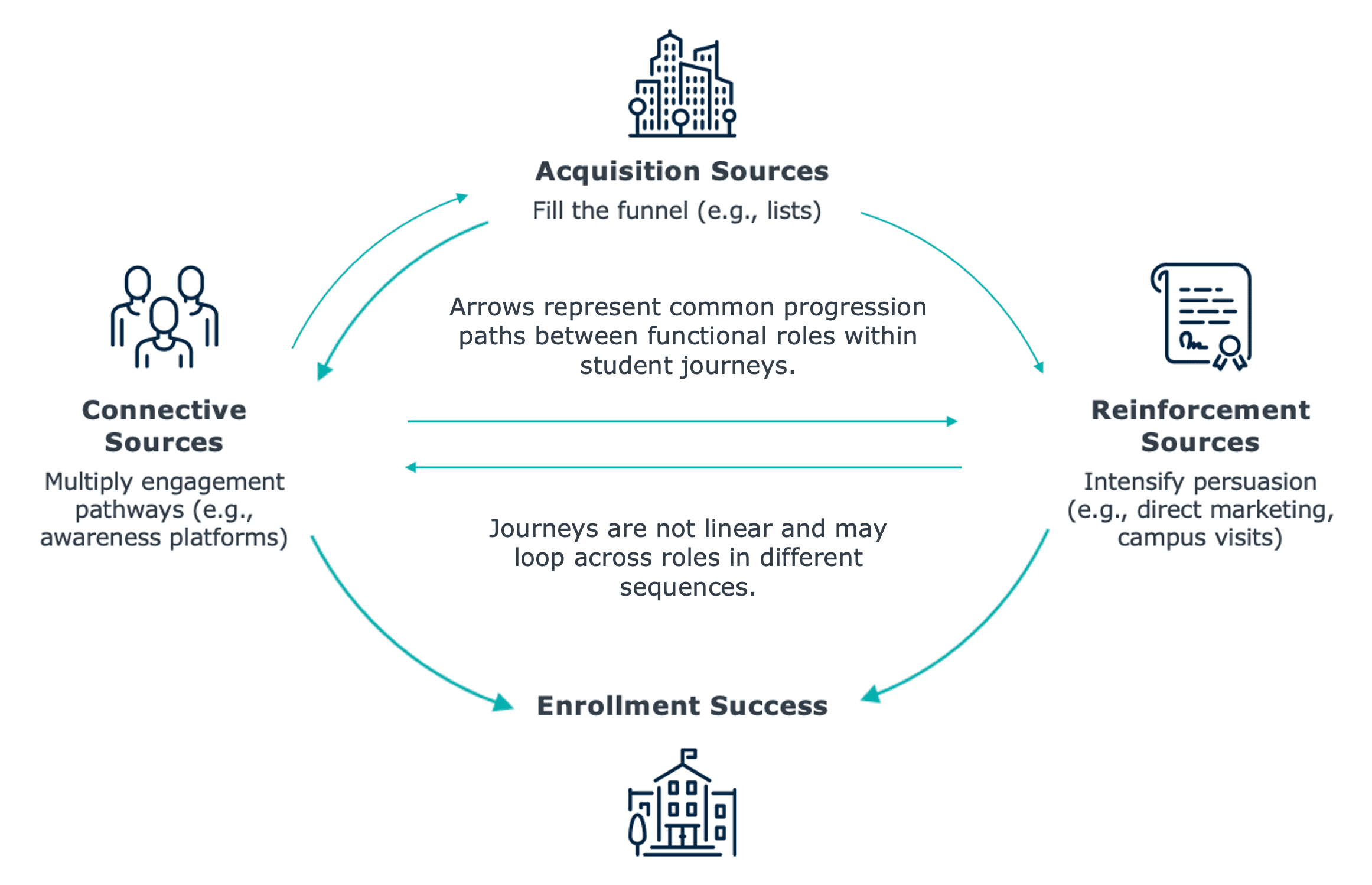
Acquisition sources fill the funnel by helping institutions identify and reach prospective students. Lists are the clearest example.
Connective sources multiply engagement pathways by helping students discover institutions, explore opportunities such as scholarships or virtual tours, and signal interest that can help institutions tailor the reinforcement that follows. Awareness and inquiry platforms play this role most clearly.
Reinforcement sources deepen affinity and help move students toward action. Direct marketing serves this function, as well as campus visits, virtual events, and other outreach activities.
Enrollment success is associated with how well these roles are layered and coordinated over time. The strongest recruitment ecosystems are built around the kind of coordination that accounts for all three. They do not just reach students once, they create multiple, connected opportunities for students to discover, engage, and build affinity over time.
-


Connective sources are uniquely flexible
Connective sources are flexible because they are not limited to one point in the funnel. They can help students discover an institution, explore fit, signal interest, and generate information that shapes later outreach. Awareness and inquiry platforms are the clearest example, though institutional websites can perform a similar function. These sources multiply engagement pathways: a student might first encounter a school through one of these channels, return later to compare it with other options, explore scholarships or virtual tours, and eventually submit an inquiry that gives the institution a clearer signal of interest.
How to assess your recruitment ecosystem
The full study includes a self-assessment to help enrollment teams apply this model to their own funnel. That starts with two foundational steps: categorizing your recruitment sources consistently and assessing how many source categories comprise a typical recruitment journey. But the key question raised by this analysis is more specific: Does your recruitment source mix include acquisition, connective, and reinforcement roles?
Use those roles as a quick diagnostic:
- Are acquisition sources connected to what follows? Lists and other acquisition sources can fill the funnel, but they can’t do the full work of recruitment on their own.
- Do students have multiple ways to engage after initial awareness? Connective sources should help students explore fit, signal interest, and generate information that can shape later outreach.
- Does engagement lead to relevant reinforcement? Direct marketing, visits, events, and other outreach activities should build on student signals and help move interested students toward action.
If one role is underdeveloped, recruitment journeys can stall. A funnel dominated by acquisition may generate names without enough follow-up to build momentum. A funnel with strong reinforcement but weak connective infrastructure may miss the signals that indicate which students are ready for more personalized engagement. And a funnel with connective signals but limited reinforcement may identify interested students without doing enough to move them toward action.
If the first step is adopting a multi-source mindset, the next step is assessing whether your source mix actually performs the functions needed to move students through their journey with you. A balanced recruitment ecosystem should help students discover your institution, explore it in different ways, signal their interest, and receive timely reinforcement. The more intentionally those functions are connected, the stronger the pathway from awareness to enrollment becomes.
Ready to learn more?
This analysis draws from EAB’s The Science of Multi-Source Recruitment, which examines how different sources of awareness and engagement combine across recruitment journeys—and how those patterns relate to enrollment outcomes.
Download the full paper or watch the on-demand webinar to explore what these findings mean for your enrollment strategy.

More Blogs

How to talk about college cost before families bring it to the holiday table

What we’ve learned from testing earlier yield engagement