3 ways graduate enrollment leaders can protect staff capacity
In our latest survey with NAGAP, 49% of graduate enrollment management professionals said their enrollment goals grew this year. It is no surprise then that 85% of graduate enrollment leaders described their current work situation as at least moderately stressful. And more than half (53%) are considering leaving their roles.
The graduate enrollment management professionals we surveyed said their greatest stressors at work stem from state and federal policy uncertainty, budget challenges, and leadership changes. While many of these challenges are outside of graduate enrollment teams’ control, survey respondents did point to two factors that could be addressed internally: unfilled staff positions and heavier workloads.
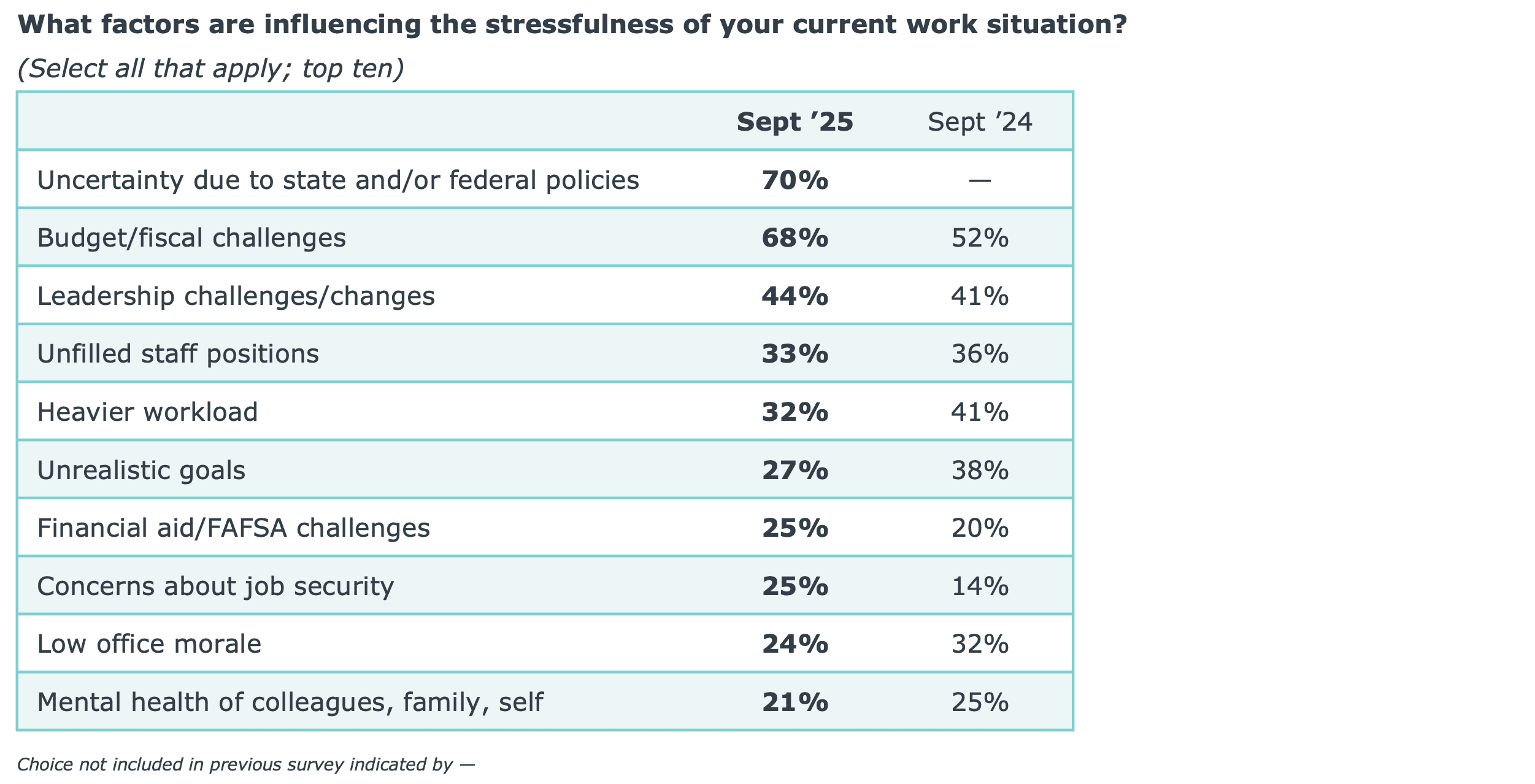
In a tight budget environment—one in which hiring additional staff isn’t always feasible—leaders need to ask a more strategic question: Which tasks are draining capacity without driving enrollment? Here are three steps enrollment leaders can take to improve staff experience and expand team capacity.
About the survey
To help university leaders understand the graduate enrollment landscape, EAB’s Adult Learner Recruitment team partnered with NAGAP on a series of surveys of graduate enrollment professionals. Conducted between September 2025 and February 2026, the three surveys explored a variety of topics relevant to graduate enrollment leaders, from staffing challenges and the growing use of AI to enrollment outcomes and recruitment tactics.
1. Critically assess the time required to support noncritical tasks
Understanding where staff time is going is an important first step in addressing team burnout—especially because not all work contributes equally to recruiting, admitting, or enrolling students. Focus on understanding which activities are consuming staff time and which help prospective students move forward in their enrollment journey.
Start by sorting enrollment work into three categories:
- High-impact activities that directly support enrollment outcomes;
- Necessary but time-intensive functions that leaders can streamline; and
- Highly specialized work that requires expertise beyond what a lean team can reasonably maintain in-house.
This exercise can help enrollment leaders identify where staff are spending too much time on manual, repetitive, or overly complex tasks at the expense of higher-value, enrollment-driving work. The goal is to help teams focus their limited capacity on the work they can do best.
2. Identify tasks that may be redundant across units
Once leaders understand where staff time is going, the next step is identifying and reducing duplicative tasks. Redundant work often creeps into graduate enrollment because responsibilities are distributed across admissions, academic units, central marketing, financial aid, faculty, and program leadership. Without clear swim lanes, teams can spend too much time recreating work, chasing approvals, or managing unclear handoffs.
Leaders should review roles and workflows to identify where multiple teams may be touching the same task without adding distinct value. Common sources of duplication include teams writing similar recruitment messages and staff moving data manually between systems.
3. Review and adjust staffing models if necessary
Graduate enrollment staffing models should reflect the complexity of the work, not just the number of programs, applications, or inquiries a team manages. This is especially important as enrollment expectations continue to rise despite widespread capacity strain. Nearly half of respondents said their enrollment goals increased compared to last year.
Leaders should review whether current staffing models match how graduate recruitment works today:
- longer decision timelines,
- more complex student motivations,
- the need for sustained follow-up with students,
- varied program formats, and
- multiple start dates.
A team supporting high-volume online programs may need a different model than one supporting smaller, specialized, or in-person programs. Similarly, a team recruiting working adults may need different outreach expectations than a team focused on recent graduates.
This review should also clarify which functions truly belong in-house and which may be better supported by an external partner. Consider whether your enrollment team is getting stuck on functions that need scale, require specialized knowledge, or are time- and labor-intensive. An external partner may be able to provide additional capacity and expertise in these areas.
Graduate enrollment management has become more complex, with higher stakes and staffing models built for a simpler market. The teams best positioned for enrollment success will reassess and redesign how the work gets done.

More Blogs

AI search is reshaping brand and enrollment strategy. Is your institution ready?

AI is impacting students’ college selections