Students are engaging earlier. Enrollment strategies should follow.
For several years, evidence suggested that students were delaying their college search— pushing meaningful engagement later in high school, often into senior year. That pattern shaped how enrollment teams thought about timing: when to prioritize outreach and where to focus limited recruitment resources.
New inquiry data point to a sustained shift in that search timing. When we look across the last four entering classes, the most recent cohorts are beginning to engage with colleges earlier in high school than their predecessors. This change suggests that student search behavior is moving back toward earlier timelines that were more typical before the pandemic—and that schools may have a larger window of influence than they did just a few years ago.
About the data
The inquiry trends presented below are based on aggregated user data from Appily, a college search platform in EAB’s Enroll360 ecosystem. Appily maintains a broad and stable share of the high school population, making it a reliable indicator of overarching search behavior.
Prospective students are engaging earlier
The charts below show cumulative inquiry activity on Appily over time for the Classes of 2022, 2023, 2024, and 2025. Each line represents the share of students who had inquired with at least one college, beginning in the summer before freshman year and continuing through the end of senior year.
In both these charts, you’ll notice that the Classes of 2022 and 2023 track closely across much of their high school careers, reflecting the later search timelines that became more common several years ago now. By contrast, the Class of 2024 begins to pull ahead earlier and the Class of 2025 earlier still, especially during their freshman and sophomore years.
The biggest shift is in freshman and sophomore year
To highlight that divergence, the first chart zooms in on inquiry activity during freshman and sophomore year.
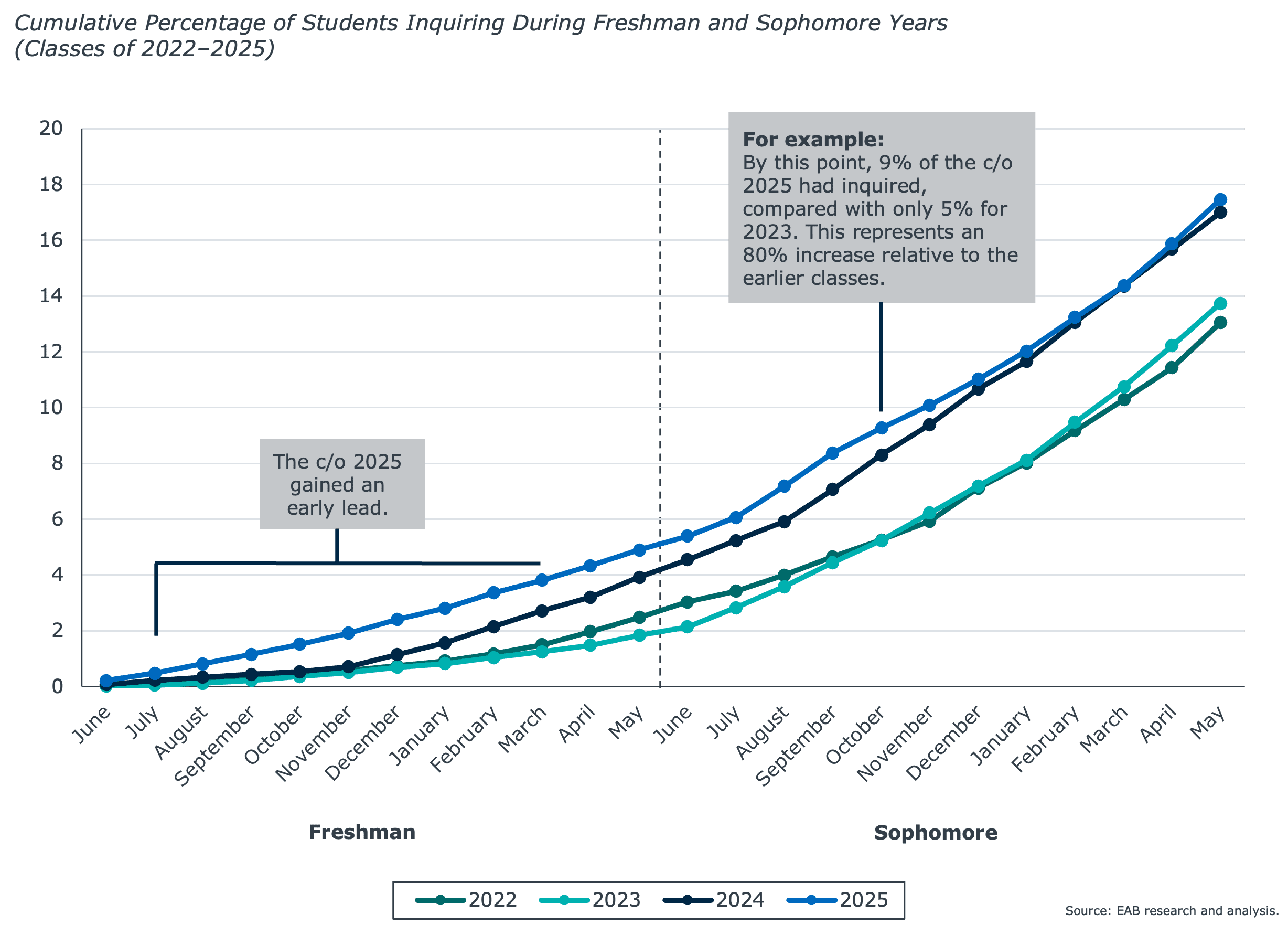
In these early stages of the college search, the growing differences between cohorts are striking. By October of sophomore year, 9% of the Class of 2025 had already inquired with a college, compared with just 5% of the Class of 2022 or 2023 at the same point. That four-percentage-point gap represents an 80% relative increase in early engagement.
This isn’t limited to a single outlier cohort, either. The Class of 2024 shows a similar (if smaller) early lead, and the pattern is consistent across the early years of high school. Together, these data suggest a systematic shift toward earlier engagement, not just random variation from year to year.
The early opportunity continues into junior and senior years
Importantly, these early differences don’t disappear as students move through high school. Charting inquiry activity during junior and senior years (below) shows that the Classes of 2024 and 2025 maintain much of their early lead into the later stages of high school.
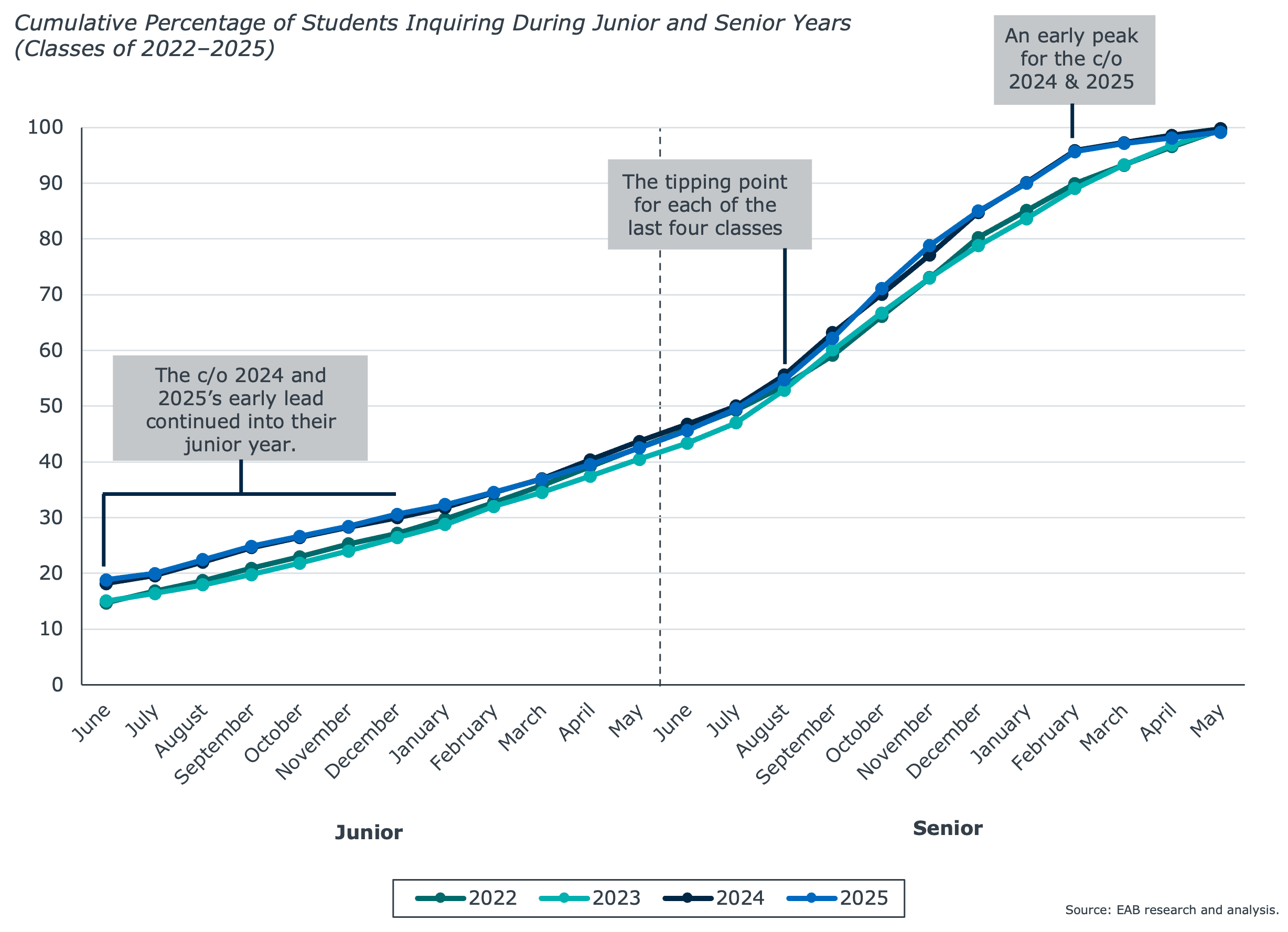
In fact, while inquiry activity converges for all classes as they approach the senior-year tipping point (which remains consistent across classes), the Classes of 2024 and 2025 continue to sit modestly ahead of their predecessors in overall engagement both before and after that hinge point. They also reach peak engagement slightly earlier in senior year. In other words, students are engaging earlier not only across the arc of high school, but even within the later stages of the search process itself.
Earlier engagement is a strategic advantage
This trend is particularly important when considered alongside another recent piece of EAB research, which shows that the timing of a school’s first meaningful engagement with a student is strongly correlated with downstream outcomes. Specifically, students engaged earlier in high school are significantly more likely to apply and enroll than those first contacted as seniors—over two times more likely. The implication is not that late-stage recruitment no longer matters, but that earlier engagement creates a longer runway for influence and affinity-building, which can compound over time.
Taken together, these trends point to a clear takeaway: students are engaging earlier, and early engagement matters. Institutions that wait to establish a relationship risk arriving after key preferences have already formed. For enrollment leaders, this means re-evaluating how awareness, brand-building, and other forms of engagement fit into the early years of high school.
This analysis draws from EAB’s College Search Trends Across Space and Time: 2025 Edition, which details how demographic forces interact with inquiry, application, enrollment, and migration trends.
Download the full paper or watch the on-demand webinar to explore what these changes mean for your institution’s market strategy.

More Blogs

Is your institution visible in AI search? Here are six questions to ask

Marketing teams are stretched thin. Here’s what the data says to do next.