You’re measuring the wrong moment in the enrollment funnel
Most enrollment teams still evaluate marketing performance based on the first lead source, which is where a student first enters the funnel. It’s easy to track and, in many cases, it’s the only metric available. However, it only tells part of the story.
Students encounter your institution across multiple channels over time—emails, search platforms, events, and more—before deciding where to apply and enroll. When you focus only on where a student entered your funnel, you overlook everything that happened after, even though that’s where the real marketing influence typically lies.
The limitation of first-source thinking
First-source reporting answers a narrow question: Where did this student come from?
It does not answer a more important one: What contributed to this student’s decision to enroll?
This distinction matters. In a typical recruitment journey, a student might first appear in your funnel through a purchased name, then engage with your emails, explore your website or profile on a search platform, attend an event, and ultimately apply. First-source attribution assigns full credit to that initial list, regardless of the interactions that followed.
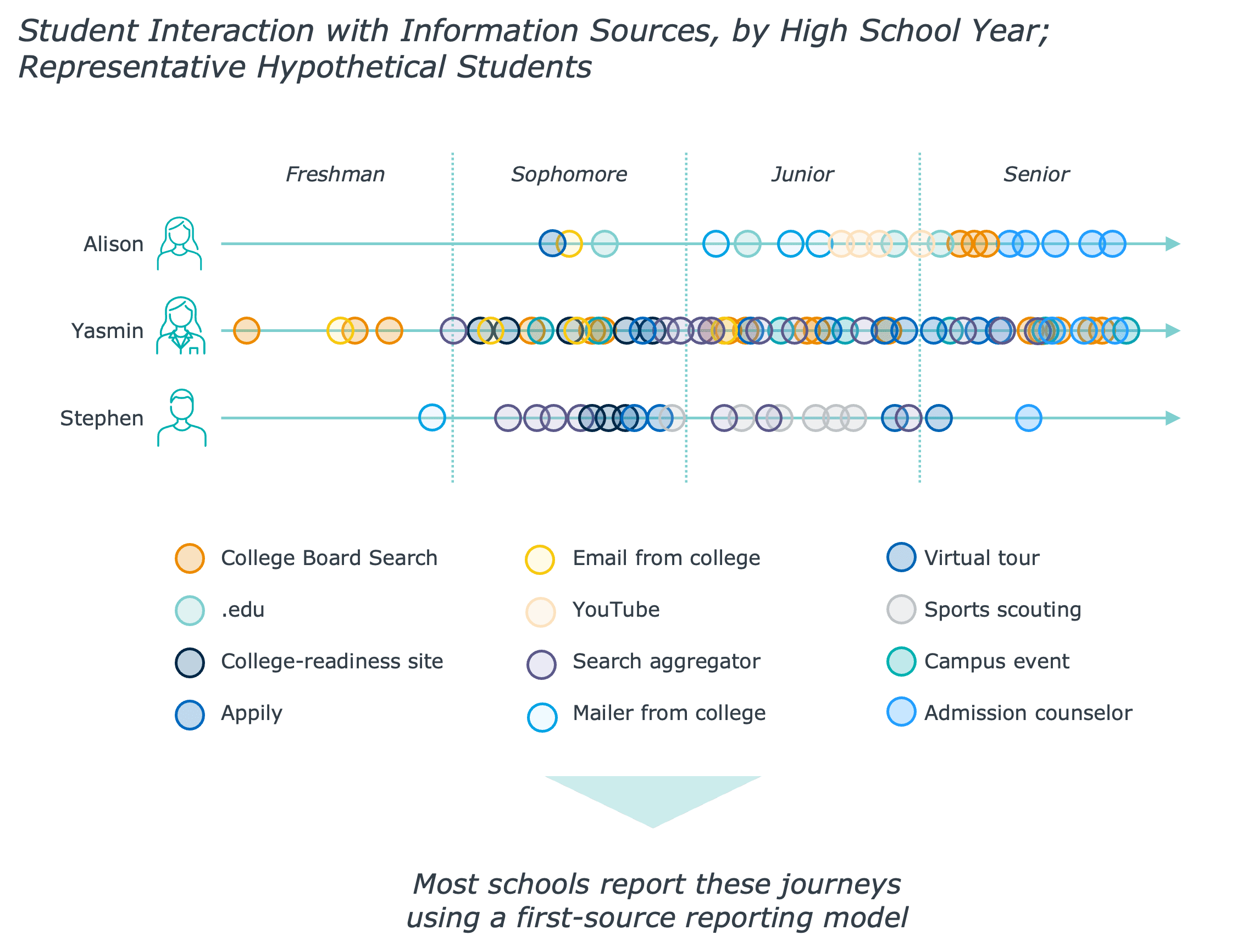
That isn’t to say first source is unimportant, only that an approach focused solely on it is incomplete. And when incomplete information becomes the basis for evaluating performance, it can lead to incomplete—or even misleading—conclusions about what is working.
A different way to look at enrollment journeys
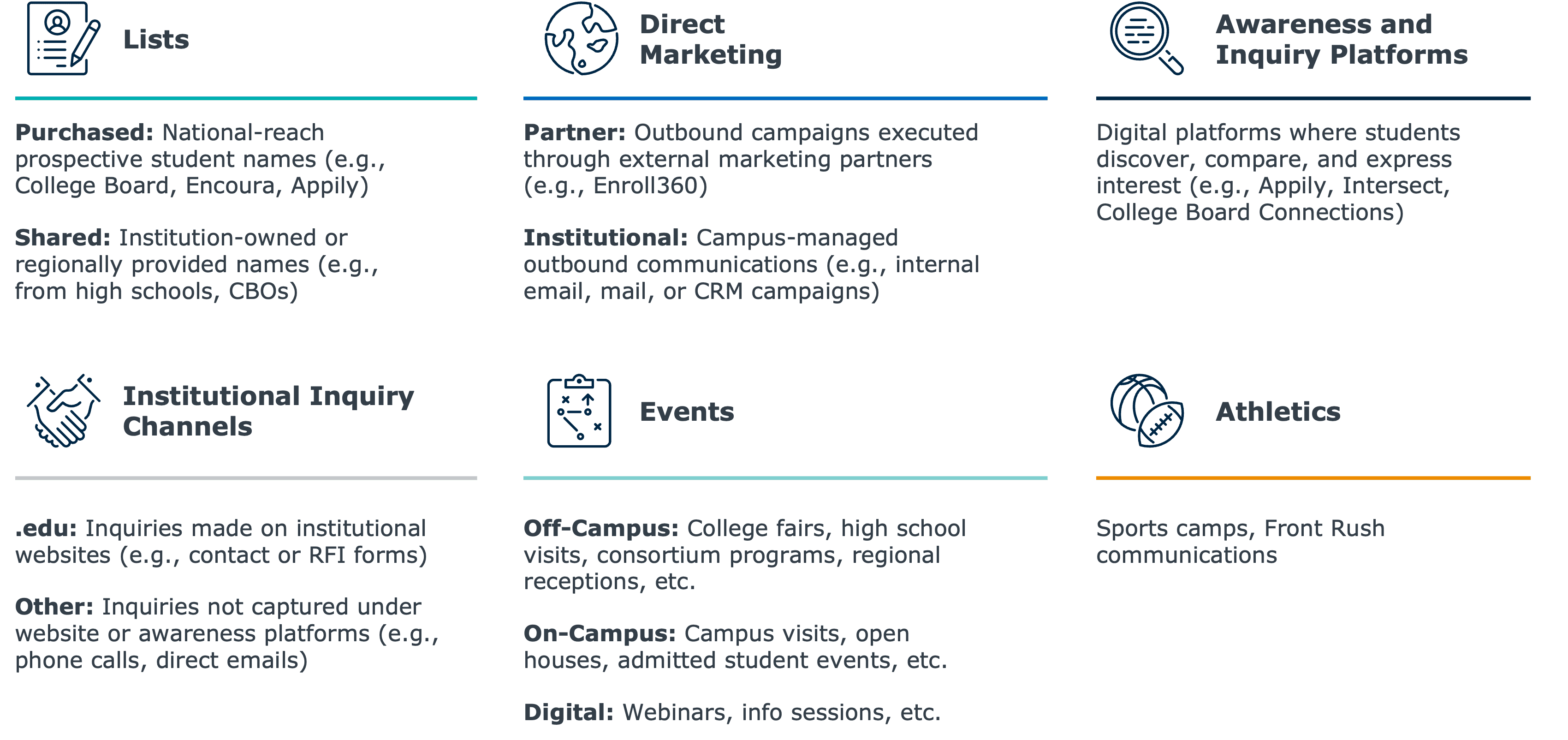
To better understand how marketing sources relate to enrollment outcomes, we analyzed more than 7 million student journeys across 50+ institutions using all-source funnel data. Rather than focusing on a single point of entry, we examined the full set of sources of awareness and engagement present in each student’s journey—and how those patterns differed between students who enrolled and those who did not. What emerged was a clear and consistent pattern: Enrollment outcomes are associated with multi-source marketing efforts, not single sources alone.
Two findings stand out in the data
First, the most common sources are not necessarily the most impactful. Purchased lists (e.g., from College Board) are the most common sources by a large margin, appearing in most student’s college-search journeys (65%). They play a critical role in filling the funnel and remain foundational to most recruitment strategies. But when we compare journeys where students enroll to those where they do not, lists appear at identical rates in both groups. In other words, they are essential but not differentiating.
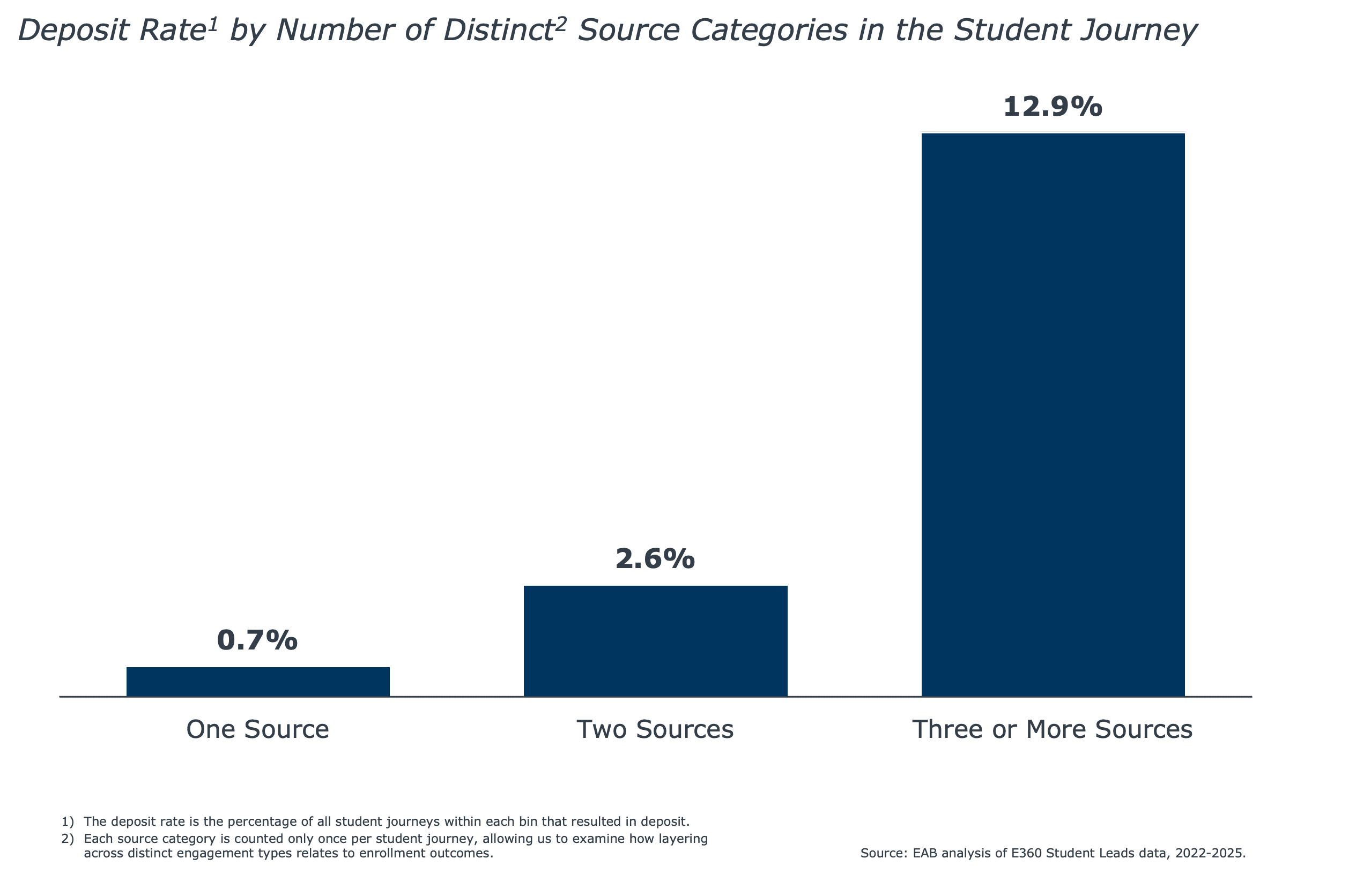
Second, journeys that include multiple sources are far more likely to result in enrollment. When we group student journeys by the number of distinct sources involved (i.e., one, two, and three or more), we see a sharp increase in conversion as journeys become richer and more layered. Students who encounter a school through just one source are far less likely to deposit. Students who engage across multiple sources—combining awareness, outreach, inquiry, and events—are substantially more likely to do so. This pattern holds across institutional segments.
The case for a multi-source mindset
Taken together, these findings point to a simple but important shift: Enrollment success is not explained by the first source (or any single source). It is shaped by how you combine distinct sources to build awareness and reinforce engagement over time. If we rely exclusively on first-source reporting, we risk overvaluing sources that introduce students into the funnel while undervaluing those that engage interest, build affinity, and ultimately influence decisions.
So, instead of asking which single source “drives” enrollment, we should ask how different sources contribute to a broader engagement process. This shift doesn’t require advanced analytics or complex attribution models. In the full study, we outline practical ways enrollment teams can begin applying this perspective using the data they already have.
If enrollment outcomes reflect layered engagement across multiple sources, the next question becomes clear: What does an effective mix of sources actually look like? In a follow up to this post, we will explore how various sources function within recruitment journeys—and how successful enrollment strategies combine them.
This analysis draws from EAB’s The Science of Multi-Source Recruitment, which examines how different sources of awareness and engagement combine across student journeys—and how those patterns relate to enrollment outcomes.
Download the full paper or watch the on-demand webinar to explore what these findings mean for your enrollment strategy.

More Blogs

AI is impacting students’ college selections

The enrollment recovery masks sharp divides