The next frontier for higher ed shared services
Higher education is officially sliding off the enrollment cliff. After a long period of steady growth, the pool of college-age students peaked in 2025 and will continuously decline for the next 18 years (and likely longer). Many colleges and universities now find themselves overextended and are already beginning to feel the pain of maintaining facilities, classrooms, and operations for shrinking student populations.
What’s more, the cost of running a university continues to rise: Commonfund reports that 2025 marked the fifth consecutive year that the higher ed inflation rate has exceeded the prior decade’s average. As cost pressures increase and tuition revenue declines, more institutional budgets are moving into the red: two-thirds of colleges show at least one sign of financial distress, per the Federal Reserve Bank of Philadelphia. Since leaders remain hesitant to restrict spending on academic units, they instead look to lower costs on the administrative side.
For many colleges and universities, the next opportunity for administrative scale may not come from further centralization on campus, but from deeper collaboration across institutions.
Shared services have helped institutions scale—but only up to a point
Facing pressure from state political leaders and the economic environment, higher ed business and finance leaders have sought to boost administrative cost-effectiveness and service quality through shared services.
-


What are shared services?
Shared services are arrangements in which operational, administrative, or transactional support functions that were previously handled separately within individual units are delivered through a centralized or pooled delivery structure.
The value proposition of shared services is scale. By pooling transactional work, institutions can increase work completed per FTE, strengthen purchasing power, and create more consistent service experiences across units.
Institutions typically pursue scale through a continuum of organizational models, from campus-based shared service hubs to partnerships that extend beyond institutional boundaries:
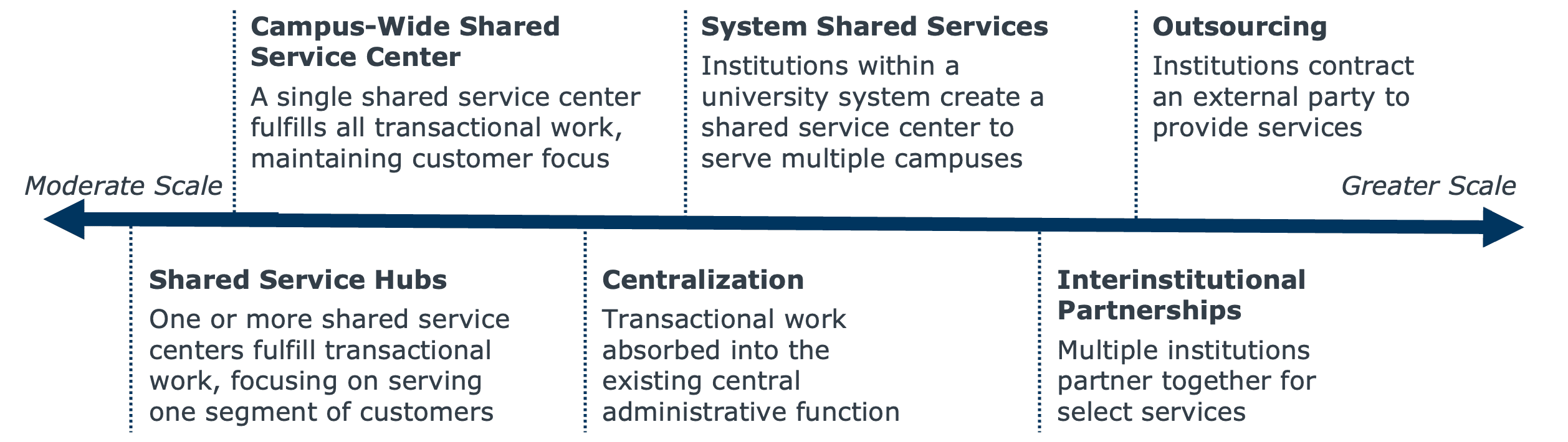
However, the ability to harness scale is limited by the size of the institution. Larger institutions with a deeper volume of tasks, transactions, and departments have historically been able to realize the greatest benefits when moving to shared services. Smaller institutions that have already centralized and don’t have expansive bureaucracies to consolidate are often left with fewer opportunities for administrative cost savings.
The promise of interinstitutional partnerships
Some higher ed leaders hope to build scale by expanding the idea of shared services beyond the metaphorical walls of the institution. Colleges and universities are organizing into new cross-institutional shared services structures or consortia to take advantage of multi-campus scale. The Chronicle of Higher Education report, “The Budget Crisis Is Here,” finds that about one-fifth of institutions are considering sharing administrative functions with another institution, a clear sign that the sector is beginning to respond creatively to cost pressures:
Percentage of institutions considering sharing administrative functions with another institution
Thus far, system-level offices and state political bodies have often led the charge to consolidate administrative services across institutions. This push has come from demands to cut costs and recommendations to adopt new system-level arrangements.
For example, a January 2026 report from Oregon’s Higher Education Coordinating Commission identified the decline of shared administrative services as a “missed opportunity,” and the South Dakota Board of Regents recommended that public institutions consolidate across several functions, including food services, human resources, compliance, and even high-performance computing.
The momentum behind interinstitutional partnerships is even catching on overseas, where Universities UK, an association of 142 UK-based universities, recently called for its member institutions to “make best use of existing, underutilized shared services to fully support entrepreneurial, locally driven initiatives and encourage nationwide growth.”
While still relatively rare, interinstitutional partnerships are not new in higher education. EAB has previously profiled some of these arrangements, and several notable initiatives have been announced over the last few years. The examples in the table below show that interinstitutional collaboration can take many forms, from long-standing consortia to newer partnerships focused on ERP alignment and back-office consolidation.
| Name | Member organizations | Founding year | Description |
|---|---|---|---|
| The Claremont Colleges Services | Seven private institutions in Southern California | 1925 | Modeled after Oxford University’s organizational structure, the consortium was founded with independent academic colleges united around a shared library and administrative apparatus. Throughout its existence, it has grown in sophistication and function based on the demand of its partner institutions. |
| The Boston Consortium for Higher Education | 24 Boston-area colleges and universities | 1995 | Offers shared services, peer networks, and professional development designed for higher education institutions. Key focus areas include operational collaboration, risk management, internal audit, travel programs, and cross-institution learning. |
| Collaboration for Higher Education Shared Services | Six independent New Mexico community colleges | 2021 | Collaboration to align student services and key business processes and systems within a single ERP. |
| San Francisco Bay Region Network | Three California State University institutions | 2026 | Consolidation of back-office administrative and transactional functions into one single cost-effective structure. |
Help define the future of shared services
Alongside the promise and momentum of interinstitutional shared services, these arrangements face numerous challenges related to governance, change management, and technological complexity. EAB continues to research creative solutions to assist institutional leaders in pursuing these partnerships. We recently conducted a national survey on intra- and interinstitutional collaboration, and the results will help us identify how shared services models are evolving, where institutions are finding the greatest opportunities for scale, and what support higher education leaders need next.
More on shared services

Design a Shared Services Model That Reflects Campus Priorities

Ease the Transition to Shared Services with a Plan for Change Management Hurdles

Compendium of Interinstitutional Partnerships
Get expert guidance on administrative efficiency
Fill out the form to learn how Strategic Advisory Services helps chief business officers transform operations on campus.

More Blogs

Why higher ed administrative transformation stalls at scale

How CBOs can prepare for higher ed’s less stable future