Why higher ed administrative transformation stalls at scale
Administrative transformation rarely stalls because leaders choose the wrong priorities. More often, it stalls because decisions made at the cabinet level do not translate cleanly into day-to-day action across the institution.
That challenge was a central theme at EAB’s April retreat, Securing the Future of Leading Research Institutions, co-hosted with Arizona State University (ASU). Sessions focused on higher education finance trends, opportunities to scale back-office improvements, and ways to sustain innovation in administrative functions. Chief business officers (CBOs) discussed how to operationalize transformation while balancing four goals: cost savings, labor redeployment, service improvement, and risk reduction.
One CBO captured the tension succinctly: “We’re not in a moment of equilibrium. We’re in a moment of transition.” For research institutions, that transition exposes the real challenge: moving from cabinet decision to operating reality. This blog examines where administrative transformation stalls and how CBOs can strengthen communication, coordination, and adoption at scale.
Transformation breaks down when decisions reach the operating layer
Budget model redesign offers one of the clearest examples of the breakdown between intent and execution. As finances tighten, many institutions are moving toward more centralized budget models that create greater flexibility. Cabinets often experience these changes as straightforward decisions to increase financial leverage, but staff may experience them as a loss of control when they lack visibility into how institutional finances operate or why resources are being reallocated.
One event attendee highlighted this tension. Leaders at their institution introduced position control to redirect unused funds toward strategic priorities, including year-end pools for department-level funding requests. But the rationale did not travel clearly through the organization. Staff understood the change as the university sweeping vacant salary funds for its own priorities, which sowed mistrust in the new model.
The lesson is not that centralized budget models are flawed. It is that strategically sound decisions can still fail when leaders do not plan how to communicate the purpose, trade-offs, and implications of change across reporting lines.
-


10 tools to communicate decisions transparently
Use our toolkit to identify when to consult and inform campus stakeholders about administrative changes, cabinet decision-making, and institutional strategy.
AI helps reduce ambiguity at the point of action
While scaling transformation is challenging, CBOs shared practical examples of where AI can support change by reducing friction in day-to-day decisions. The most compelling use cases help staff and students act faster and with more confidence, without waiting for a person, office, or standard business-hours process to become available.
Examples discussed included:
-

ASU’s Parky bot
The bot answers parking and permit questions 24/7 at a very low cost per interaction compared with phone-based service.
-

Automated invoice processing
This improvement reduced invoice turnaround time by 50%, decreased student worker headcount by 40%, and eliminated overtime and cross-department support needs using AI-powered accounts payable automation and a virtual AP helpdesk.
-

Travel and expense redesign efforts
Leaders across several institutions emphasized the need to understand the real user problem before deploying a new system or moving work to shared services.
The operational gains in these examples matter, but the behavioral gains may matter more. By reducing ambiguity, AI can help staff act with greater confidence and consistency. Over time, that consistency builds trust in systems that have often felt opaque while also making complex administrative processes easier to use.
Three ways leaders can improve execution at scale
CBOs and their cabinet partners set the direction for administrative transformation, but the institution succeeds only when that direction translates into shared understanding and coordinated action across every layer. EAB’s research on thriving institutions identifies six attributes that help colleges and universities move through periods of disruption: executive resilience, decision resolve, unapologetic focus, portfolio logic, change-ready systems, and urgent long-termism.
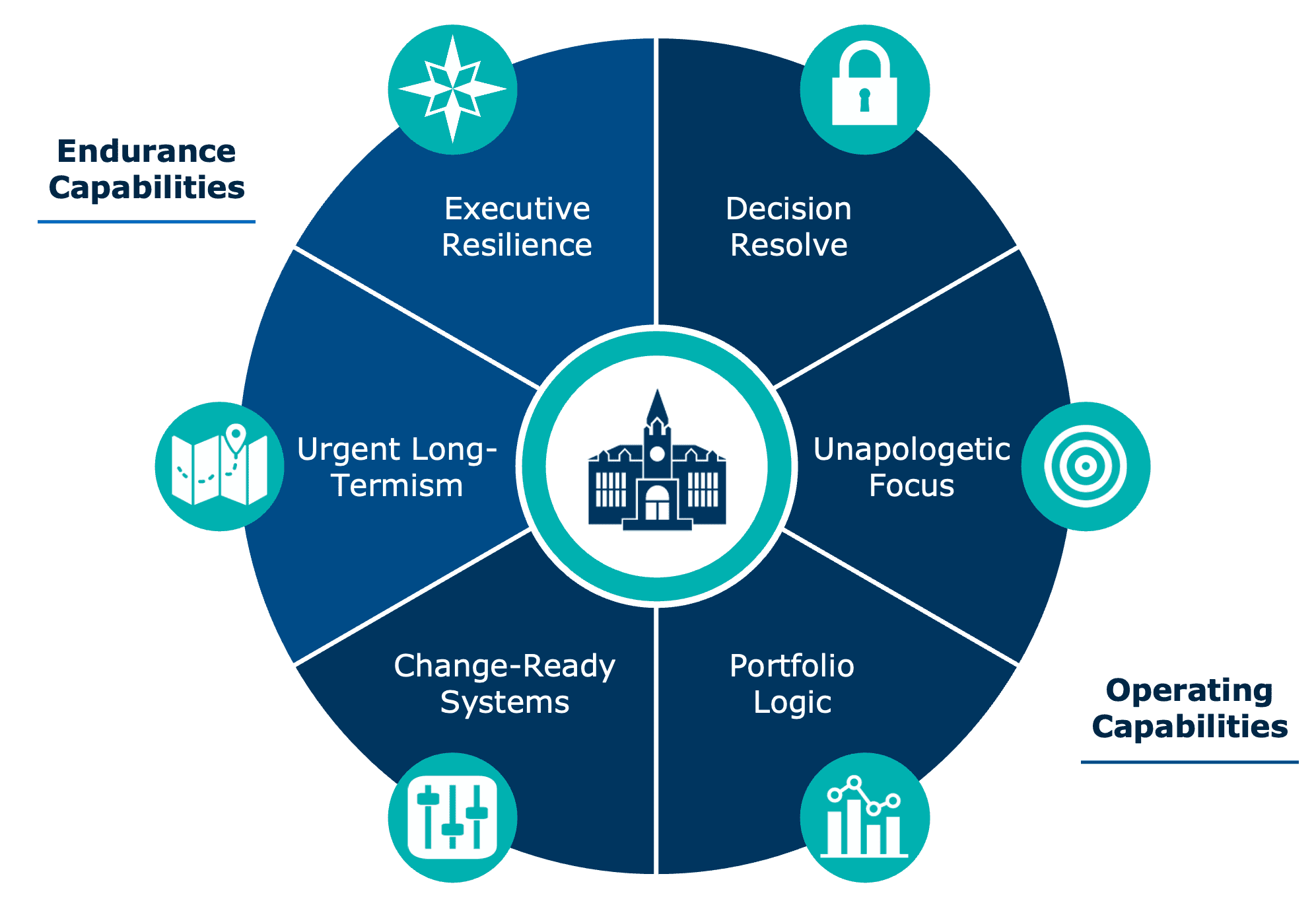
Several of the attributes surfaced as especially relevant for CBOs as they move from administrative transformation strategy to execution.
- Use decision resolve to make communication part of implementation. Before announcing a major change, leaders should define the core message, tailor it by audience, and identify how they will confirm understanding at each level of the organization.
- Apply unapologetic focus and portfolio logic at the cabinet level. Cabinet leaders should define the non-negotiables before rollout, including what will stop, what will move, who owns the decision, and where exceptions require senior-level approval.
- Build change-ready systems that cascade execution intentionally. Cabinets should work with communications leaders to map how change will move through each leadership layer, equip each messenger with audience-specific language, and create a feedback loop back to senior leaders.
-

Embrace the attributes of agile institutions
Our infographic dives deeper into the six characteristics that will equip your college or university to respond to mounting sector pressures.
Sustain transformation beyond the cabinet
Administrative transformation does not end when the cabinet sets the direction. It succeeds when leaders translate that direction into clear messages, coordinated execution, and daily behaviors that staff can sustain.
Through our research and advisory services, EAB helps college and university leaders pressure-test execution plans, strengthen communication strategies, and identify practical tools for moving transformation from strategy to daily work. To assess where your current efforts may stall, contact [email protected] or your Strategic Leader to schedule a call with an EAB expert or explore a partner-specific strategy intensive.
Move administrative transformation from strategy to execution
If you are not yet a Strategic Advisory Services partner, fill out the form to speak to an expert about how your institution can strengthen administrative transformation efforts.

More Blogs

How CBOs can prepare for higher ed’s less stable future

The next frontier for higher ed shared services