Does our college website need a full redesign or targeted improvements?
When the conversation turns to improving your college website, how quickly does it become a discussion about a full-scale redesign? In my work as a principal strategist for EAB’s Web & Digital Solutions, I often hear CMOs weigh the scope and scale of change needed against limited budgets, staff time, and campus support. The right decision starts with understanding what your website needs to accomplish and what’s holding it back.
AI is adding new demands. Your .edu must be an authoritative source in order for students to find you, validate what they’ve already learned, understand what makes your institution distinctive, and compel them to the next step toward enrollment. Meeting those expectations may require changes to content, information architecture, navigation, or UX. If your site’s structure or technology can no longer support your goals, a comprehensive redesign may be the right investment.
These five questions can help CMOs identify where their website needs attention before deciding what and how much to change.
Five questions to assess what your .edu needs next
1. Do search engines and AI platforms understand, trust, and accurately represent our institution?
If you’re still wondering how much AI search matters to enrollment, consider this: in EAB’s recent survey of 11,700 prospective students, 50% said they used AI tools to search for colleges. Among those students, 23%removed a school from consideration based on an AI-generated answer. This makes being highly visible and accurately represented in AI search table stakes for institutions.
A good place to start is with enrollment-critical pages, including academic programs, admissions, and cost pages. Is the information current, consistent, clearly structured, and easy to find? Check for conflicting details, unanswered student questions, or key information buried in PDFs.
Then understand how search engines and AI platforms mention and cite your institution using questions students ask about enrollment-critical topics. Compare the answers with your content to identify missing or inaccurate information and the web pages that need improvement.
2. Does our website connect the entire enrollment journey?
Your .edu should be at the center of your recruitment efforts, connecting paid media and organic search through interest, inquiry, and enrollment action. But how well do those experiences actually connect? One way to find out is to secret-shop your own institution.
Walk through these experiences as a prospective student: follow a paid ad to its landing page, explore an academic program and try requesting information, or take a virtual tour.
Then, compare what you encounter with your website analytics. Does the landing page deliver what the ad promised? Are next steps easy to find and complete? Together, these checks help identify where the website may be helping or interrupting an otherwise effective recruitment effort.
3. Do we have the governance and measurement needed to keep improving our website?
Consider how content decisions, updates, and improvements actually happen at your institution. Who owns enrollment-critical pages? Who checks their accuracy? Are content author skills strong and consistent? How does the team use performance data to decide what to improve?
When academic departments or administrative offices publish independently, content quality and consistency can vary considerably. That’s why clear ownership and shared standards are so important. Each priority page should have a designated owner, with common content standards and a central list of improvements needed. Bring web staff and campus content owners together monthly to upskill, coordinate updates and resolve issues, with executive sponsors reviewing priorities and resources quarterly.
4. Can our content management system (CMS) support more personalized experiences?
Before assuming you need new technology to deliver more personalized experiences, it’s worth exploring what’s possible with your current CMS. For example, ask your web and IT teams to demonstrate how your current CMS could deliver a specific personalized experience, such as recommending programs based on a student’s interests, goals, and preferred delivery format. What content, student data, integrations, or development would it require? Use that review to distinguish capabilities you already have from those that require additional investment.
Personalization in practice: Help students find programs that fit their interests and goals
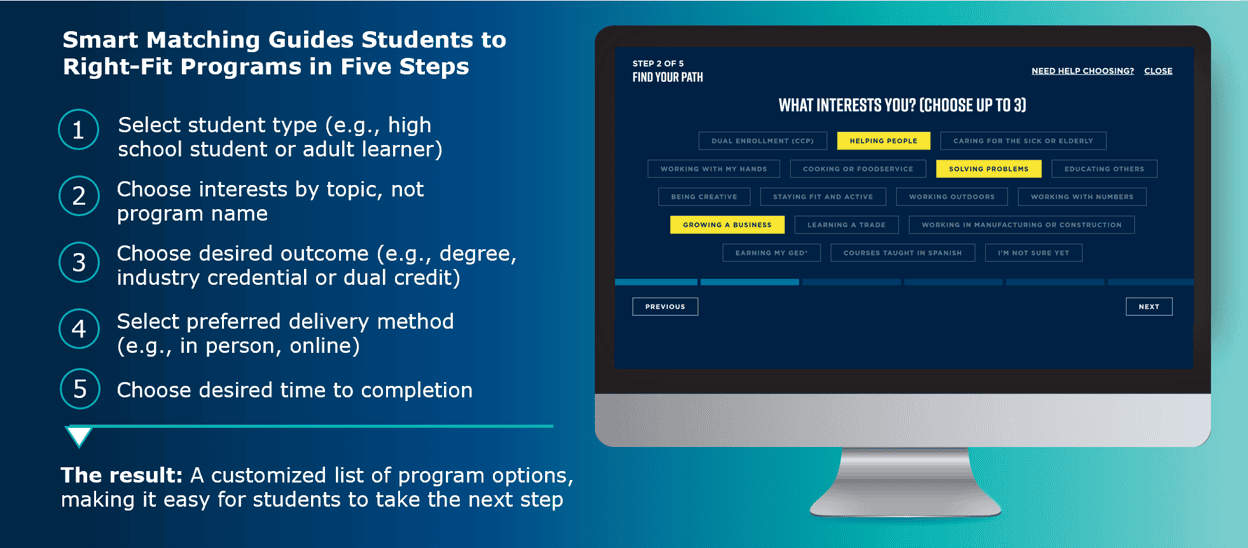
Example of a custom, reusable website module built for a public two-year institution
5. Does our website clearly communicate why students should choose us?
Review whether your website gives students specific, compelling reasons to consider—and choose—your institution. Program pages and other enrollment-critical content should reinforce the value students encounter across the channels you own—and those you don’t.
While consistency is important, your messaging also needs to help students understand what makes your institution a good fit for their goals. AI search monitoring tools can help you compare how AI platforms describe your institution and competitors, including which strengths and proof points they highlight. Those comparisons can reveal content gaps to address through targeted improvements or a broader redesign.
Use the answers to define the right investment
Your answers to the five questions above should help identify where further investigation is needed. Gaps in content, messaging, or governance may call for focused improvements, while broader limitations in site structure, technology, or integrations may require more extensive work. Even a website performing well today may need changes to support future plans. Validate those needs with your web, IT, and enrollment teams before deciding on the scope.
EAB’s .edu decision framework outlines five steps for turning that assessment into a plan:
-


Document your current state
Map core systems, integrations, and technical constraints across your .edu.
-

Understand your priority audiences
Combine audience research with analytics to identify needs and gaps in the student and parent experience.
-

Align your vision to market dynamics
Review competitor websites and higher ed best practices for navigation, content, and design. Use AI search insights to understand how your institution compares with peers and inform what your .edu should deliver.
-

Assess your architecture’s needs
Establish requirements for content, site structure, and technology.
-

Build a prioritized roadmap
Define the scope, sequence, ownership, costs, and dependencies.
Involve executive sponsors and campus teams early so they can agree on priorities and resources. The result should be a clear case for the work your .edu needs, whether that means targeted improvements, a broader refresh, or comprehensive redesign and development. Whatever the scope, EAB’s Web & Digital Solutions team can help.
Find the right next step for your .edu
Connect with an EAB expert to discuss your website’s needs and explore options, from targeted improvements to a full redesign.

More Blogs

AI search is reshaping brand and enrollment strategy. Is your institution ready?

AI is impacting students’ college selections