4 steps to ensure your .edu remains the trusted source for students—and AI
Based on “Office Hours with EAB” podcast, Episode 233, How to Optimize Web Content for AI-Powered Search.
In my work supporting EAB’s Web & Digital Solutions, I’ve seen how AI is becoming the front door for prospective graduate students during their college search—6x as many graduate and adult learners used AI to search for programs in 2026 vs. 2024 according to our latest survey (new report coming soon). Instead of clicking ten blue links in Google, students are reading AI-summarized answers first.
At the same time, trust in AI is still evolving. Even as someone who uses AI tools regularly, I still question how reliable the answers are and the sources behind them. By comparison, graduate prospects still consider institutional websites the most trusted sources in the search process. But if your .edu content is unclear or hard to find, AI will fill in the gaps with information from other sources.
Below are four steps your marketing team can take to ensure AI tools surface the information students need to evaluate your programs.
1. Identify your enrollment-critical pages and ensure they’re clear, accurate, and complete
If AI is summarizing information about your institution, it will lean heavily on the webpages that are easy to find, understand, and interpret. Many schools unintentionally split critical enrollment information across multiple pages, PDFs, and outdated announcements. That’s when AI and students start connecting dots that weren’t meant to connect, and they may make assumptions or draw conclusions from inaccurate information.
Start by identifying your enrollment-critical pages such as admissions, academic programs, or cost pages. These pages should serve as the source of truth for high-intent questions like:
- What programs do you offer (and what’s required)?
- How much does this program cost (and what aid is available)?
- What are admissions requirements and deadlines?
- What do outcomes look like (careers, internships, professional advancement)?
Ensure those pages are clear, current, and consistent with your brand and enrollment strategy. When your content is easy to understand and regularly maintained, it’s more likely to inform accurate answers for both AI tools and prospective students.
2. Structure content around how students ask questions
Engagement with AI-powered search tools behaves more like a conversation than a keyword match. Prospective students search by asking a question, getting an answer, then immediately following up with another question. The most effective content is structured around these question chains—the natural “if this, then what?” progression students move through when deciding where to apply.
For example, a program page that only lists tuition price leaves key questions unanswered. But a student’s actual journey might look like:
- What’s the cost of attendance?
- What will I pay after aid?
- What scholarships or assistantships are common?
- Can I estimate my costs quickly?
- What are the next steps to apply for aid?
When your page content anticipates follow-up questions, students can move forward with less confusion and fewer clicks. At the same time, you’re giving AI a clear, authoritative source of information to summarize.
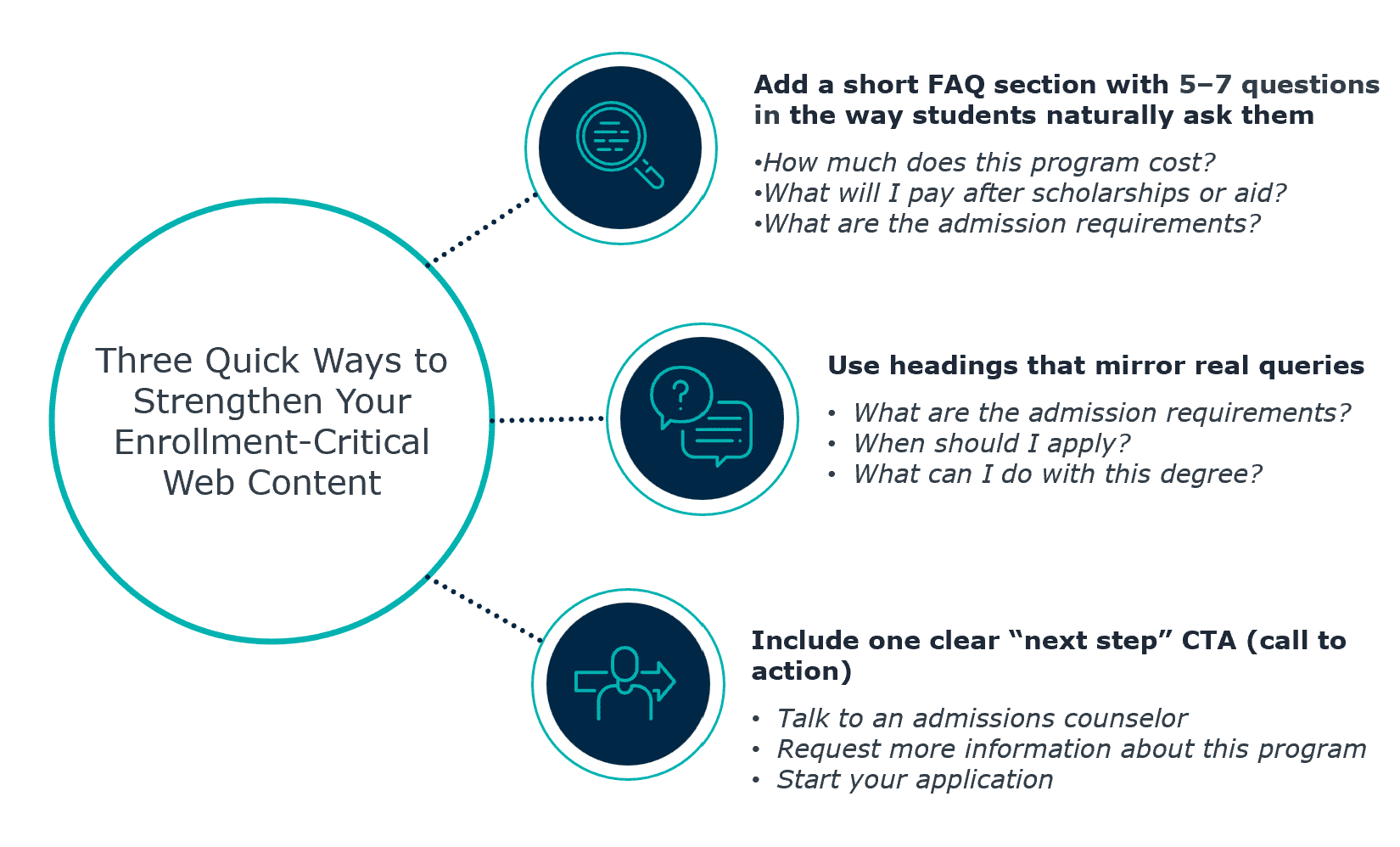
3. Make content easy to understand (for students and AI tools)
A lot of teams hear “optimize for AI” and assume it means chasing new tactics. What it really means is strengthening fundamentals: structure, consistency, and clarity. SEO fundamentals still matter, arguably more now, because they help both search engines and AI systems interpret your content.
When AI pulls from your site, it relies on content that’s clearly labeled, well organized, and specific, with details like dates, requirements, numbers, and policies stated plainly.
This is also where institutions accidentally create “blank spaces.” When key details are locked in PDFs, buried behind clicks, or written in dense policy language, important answers are harder to find. In those gaps, both students and AI tools may turn to less reliable sources of information about your programs and institution.
4. Add credibility signals that students can trust and AI can cite
Clear, credible content that follows E-E-A-T (experience, expertise, authority, and trust) makes your site easier to understand and trust. Both prospective students and AI look for signals that information is current and accurate. That includes clear and up-to-date outcomes, accreditations, student support services, and content that reflects real student experiences.
Short videos and webinars are popular ways to share student experiences and build trust, and they’re increasingly showing up in AI-powered results. Because this content is often already phrased in natural, student-friendly language, adding transcripts or converting insights into structured Q&A gives AI more clean text to reference while also making your site more accessible.
What this means for your .edu
How your institution appears in AI-driven search is increasingly shaping prospective graduate students’ trust and perception. When your key program or enrollment content is unclear, inconsistent, or incomplete, AI tools will still generate answers—often by pulling from other sources.
To remain competitive, make sure your site is the most reliable, accessible source for those answers. By improving your website for the way today’s students search, structuring content around real questions, and making credibility easy to see, you position your programs to be found and trusted earlier in the search process.
Ready to improve your website?
To speak with an expert or request a demo, please submit this form.
More Blogs

AI search is reshaping brand and enrollment strategy. Is your institution ready?

AI is impacting students’ college selections