The opportunity gap undermining your enrollment strategy
Before launching our survey of more than 120 higher ed marketing leaders, I could’ve predicted a few trends: tight budgets, rising expectations, stretched teams. And we all could have guessed that their top strategic priority was driving enrollment growth.
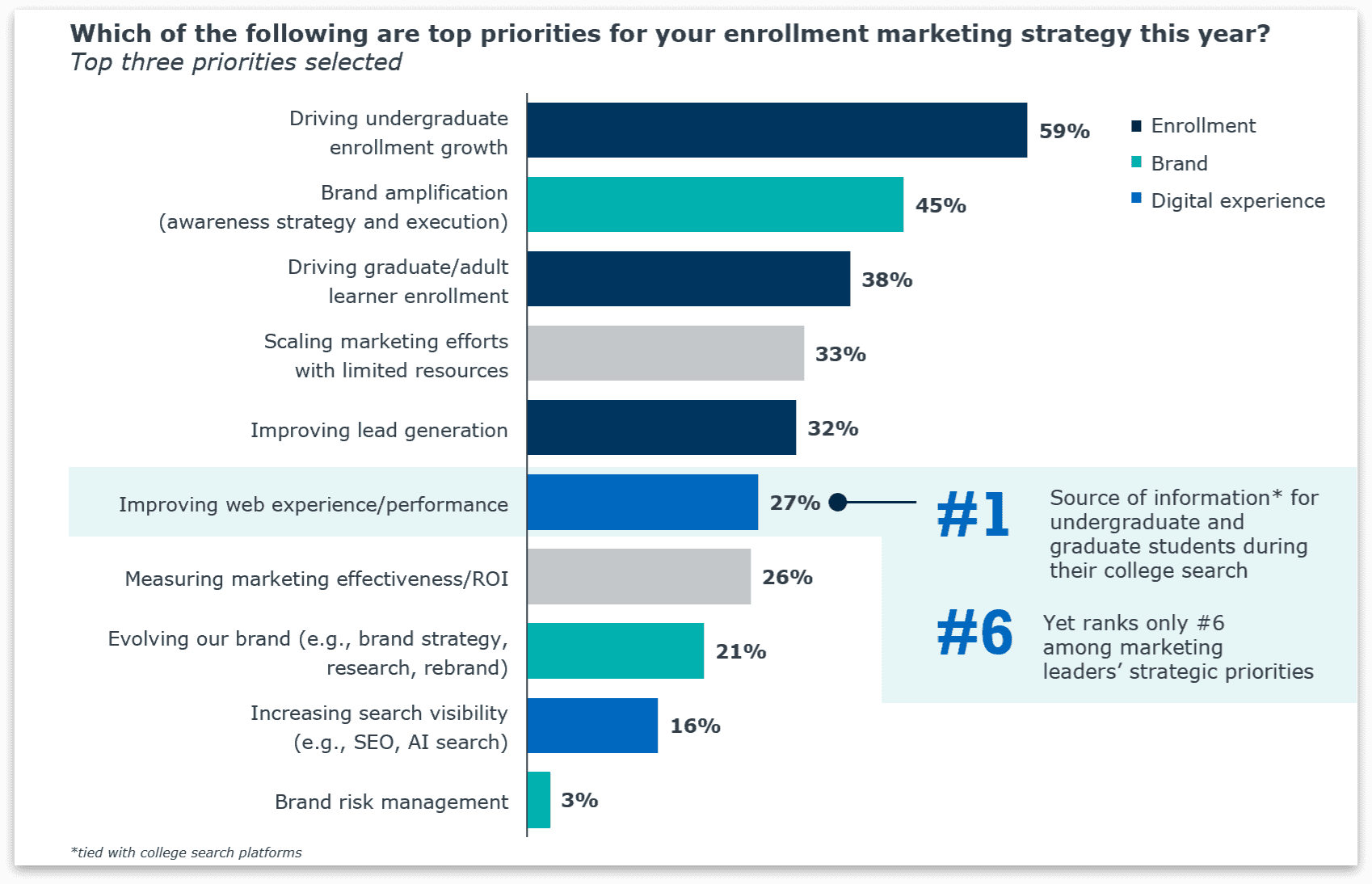
What I didn’t expect was the quiet but persistent disconnect between growing enrollment and the marketing asset students and leaders agree is most influential in enrollment decisions: the .edu. Students name university websites as their top college search resource (tied with college search platforms), and leaders rank the .edu as their most effective enrollment driver. Yet improving the website experience still landed only sixth on leaders’ priority lists.
That disconnect creates a clear opportunity gap between the .edu’s impact on enrollment and the attention it receives. Institutions can choose to close it—strengthening the .edu to drive enrollment gains—or risk falling further behind as student search behavior and the digital environment continue to shift.
Read on to learn why this gap exists, why addressing it matters more than ever in an AI-disrupted landscape, and how to begin strengthening your .edu without a full redesign.
The .edu: Students’ #1 resource, marketing leaders’ #6 priority
Why the .edu matters more than ever
For years, EAB’s Digital Agency team has referred to the .edu as “the front door” to your institution. But as AI reshapes search, discovery, and student behavior, something fundamental has shifted. Increasingly, AI is making your first introduction to students, not your website.
Students are researching colleges more independently and forming opinions earlier in the funnel. Their first interaction with your institution may still be a paid ad or an email you sent. But today, it’s often an AI-generated summary drawn from your .edu. The accuracy, freshness, and clarity of your website content now shape students’ first impressions of your school and programs long before they ever land on your site.
AI-driven visibility is a space few institutions are actively monitoring. If AI is the new front door, it’s unlocked and unsupervised. Sixty percent of marketing leaders told us they had researched AI tools to improve visibility in AI search, yet only 33% have conducted a search visibility audit of any kind in the past year. Most teams simply do not know what AI is pulling from their .edu or how those summaries are shaping early perceptions.
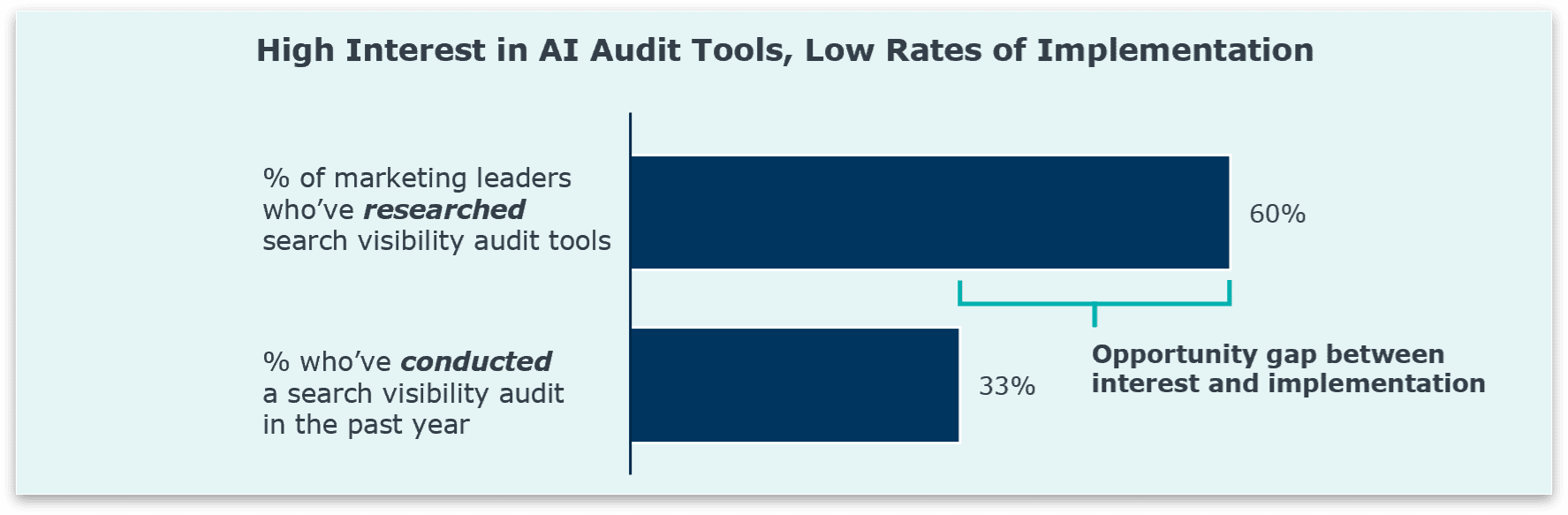
This visibility gap creates real risk for your digital strategy. The .edu remains the most direct and measurable way to influence enrollment outcomes. It’s the foundation that informs AI models, reinforces brand authority, and converts visibility into traffic, inquiries, and applications. When outdated or incomplete content from your website becomes the basis of your university’s introduction, your enrollment strategy starts on the back foot. That’s why understanding your current visibility is the place to start.
-


Your next step:
Conduct a visibility audit. Establish how you appear in organic and AI-driven search, then prioritize the updates that most directly strengthen enrollment performance.
Why marketing teams deprioritize the .edu
Marketing leaders aren’t deprioritizing the website because they doubt its impact. Most already recognize it as central to enrollment performance—survey respondents ranked the .edu as the #1 most effective enrollment driver among digital marketing assets. The real challenge is that many teams lack the capacity, resources, or cross-campus alignment necessary to keep the .edu competitive.
Survey data shows that the biggest barriers to digital progress are familiar: limited budgets, insufficient staffing, outdated infrastructure, siloed operations, and difficulty measuring ROI. Sixty-nine percent of surveyed marketing leaders reported flat or declining digital marketing budgets, even as expectations for marketing impact continued to increase.
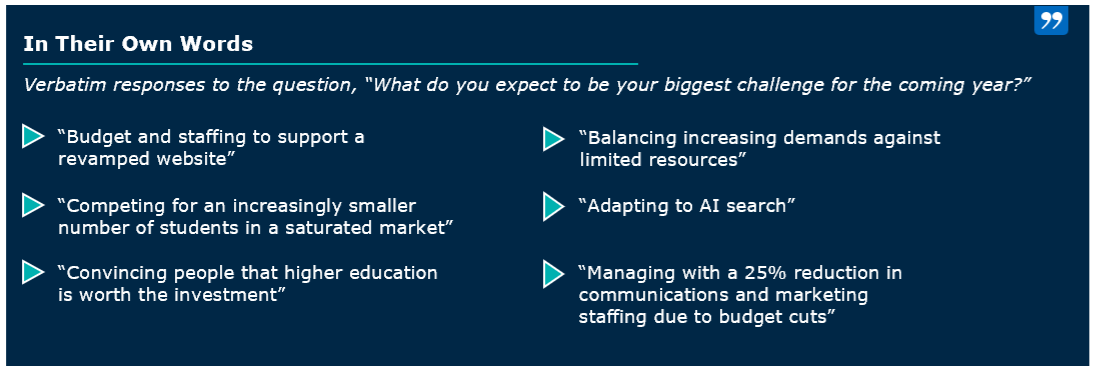
Teams know the website needs work. Outdated websites ranked as a top-five barrier for nearly every institutional segment. But without sufficient capacity or specialized expertise, website improvements stall or happen incrementally, leaving teams further behind as student expectations continue to shift.
-
Your next step:
Ruthlessly prioritize your team’s resources and capacity. Identify the enrollment-critical fixes your team cannot complete due to capacity gaps, then create a plan to address those bottlenecks through focused resourcing or external support.
Why now is the perfect time to close the .edu opportunity gap
Search visibility, content strategy, and website experience are becoming essential links between brand and enrollment. As AI-driven discovery expands, a strong website is no longer a “nice to have.” It is a strategic necessity that determines how your institution appears in search, how prospects interpret your value, and how efficiently they move toward conversion.
Many marketing leaders are already responding—if not by action, at least by near-term budget reallocations. Nearly half of survey respondents plan to increase investment in search visibility, and more than a third plan to increase spending on AI tools and website experience in the next 12 to 18 months. Schools that focus on these foundational assets create resilience against declining organic reach as well as broader market challenges like rising ad costs. These strategic moves ensure they maintain visibility in an increasingly competitive landscape.
-
Your next step:
Re-center your digital strategy on the owned assets that drive enrollment. Prioritize improvements to your .edu, search visibility, and content structure so you can optimize your spend and compete effectively in an AI-driven landscape.
Where your institution should start
You don’t need a full, costly redesign to make your .edu work harder for enrollment. Start with the foundational updates that improve visibility, content quality, and conversion.
Your .edu optimization checklist:
-

Audit your .edu search visibility
Understand how your institution appears in organic and AI-driven search, then identify the updates that most directly improve enrollment outcomes.
-

Reorganize and update high intent content
Ensure program, admissions, and cost pages reflect student search behavior and answer top questions clearly.
-

Strengthen technical performance
Ensure SEO fundamentals such as site speed, metadata, and structured data are optimized to support both traditional and AI-driven visibility.
-

Optimize conversion pathways
Clarify next steps across priority pages, simplify forms, and reduce friction in your lead generation flows.
-

Align teams and workflows for faster updates
Address bottlenecks that slow content or UX improvements, whether through internal resourcing or flexible external support.
-

Improve attribution to understand what drives enrollment
Evaluate whether your analytics setup captures the full impact of your .edu across the funnel. Strengthen tracking, goals, and reporting so you can demonstrate how website improvements translate to inquiries, applications, and yield.
The enrollment advantage of closing the .edu opportunity gap
You don’t need to redesign your .edu to improve enrollment results. Prioritizing the right content strategy—aligned with AI-driven discovery and evolving student behavior—delivers stronger visibility, higher-quality engagement, and a digital experience that supports enrollment growth. Schools that refocus their .edu efforts now will turn that momentum into meaningful competitive advantage.
As student expectations shift and AI continues to reshape college search, institutions that invest in these foundational enhancements will move faster, adapt more easily, and demonstrate clear marketing impact. The insight paper explores these trends in greater depth and offers research-backed recommendations to help teams close this opportunity gap with intention and confidence.

More Blogs

Marketing teams are stretched thin. Here’s what the data says to do next.

Five tips to recruit community college students for this fall (and beyond)