Who gets to shape the future of student success?
If you need a reason to feel excited about higher ed’s future, spend a few days at CONNECTED, EAB’s annual student success and strategy conference. This year, more than 1,200 leaders and practitioners joined us to explore what it means to be “Architects of the Modern Student Journey.” Change isn’t easy in higher ed, but it was encouraging to see so many people ready to rethink how they work because they want better for their students.
In his opening keynote, former Disney innovation leader Duncan Wardle encouraged us to start with two words: “Yes, and.” It’s easy to hear an idea and immediately think of all the reasons it won’t work. We’ve all done it. But what happens when we give ourselves more time to explore the idea and let other people build on it?
In session after session, I heard examples of people doing just that: trying new approaches, learning from each other, and finding ways to make things work. Below are a few that stood out to me.
Yes, we can use technology to coordinate better support—and the people doing the work should help shape how it’s used.
In one of the many partner-led sessions, Frederick Community College (FCC) described a challenge many campuses will recognize: “We weren’t lacking people who care; we were lacking a coordinated system.”
FCC had previously relied on a homegrown early alert system, spreadsheets, and manual outreach to support students. They replaced all three with EAB’s Student Success CRM Navigate360, using automations to connect faculty concerns to appointment invitations and success coach follow-up. When a professor flagged missing assignments, for example, the student could receive emails and text reminders to meet with a coach, talk through what was getting in the way, and make a plan.
FCC’s faculty hadn’t made much use of the last early alert system. Rather than assuming the same would happen with Navigate360 and scrapping the idea, FCC involved faculty in figuring out what would increase their participation.
To do this, a liaison committee representing every academic unit helped refine alert options and student communications. Alongside training and follow-up, those efforts helped increase faculty participation from 70% to more than 96%. FCC also used Navigate360 to add athletic coaches to student-athletes’ Success Teams, giving them visibility into alerts so they could reinforce outreach and help students follow through. As a result, FCC reported that student-athletes’ average cumulative GPA increased from 2.43 to 2.85.
26-point
increase in faculty participation, from 70% to more than 96%
0.42-point
increase in student-athletes’ average cumulative GPA, from 2.43 to 2.85
When you’re changing a process, invite the people who use it every day to help figure out what would work better. Their experience can reveal problems, and possibilities, that are easy to miss.
Yes, we can reach more students—and make support more personal
During their keynote on day 2, EAB’s Chris Johnson and Erin Doyle Lastowka outlined EAB’s vision for the future of student success: make every student feel like they’re your only student. Their session offered a look at the future of student success work, including how EAB is evolving the technology practitioners rely on today and exploring what AI makes possible next:
-


Yes, we can send reminders—and hear what’s getting in the way.
AI Agent Campaigns turn outreach into two-way conversations. University of Vermont used them to reduce summer melt and influence +$1.59M in estimated annual net tuition revenue.
-

Yes, we can document appointments—and stay focused on the student.
AI meeting summaries reduce manual notetaking. St. Edward’s University used Navigate360’s AI Meeting Summary Assistant to save success coaches 10 minutes per student appointment, freeing up time for coaching and student support.
-

Yes, we can see that a student has good grades—and recognize when they still need support.
Interaction Scoring will help teams look beyond GPA to signals like engagement, advising participation, and belonging. University of Wisconsin-Whitewater showed the value of broader views of student needs through student check-in surveys, which identified financial worries and personal challenges. Students who completed its fall 2025 survey earned 2.69 more credits and had term GPAs 0.52 points higher than those who didn’t.
-

Yes, we can make progress reports easier for faculty—and get more information from them.
LMS data pre-populates progress reports, and the questions can be tailored based on the time of year. Virginia Commonwealth University used Navigate360’s progress reports to help more students get support before issues escalated. Students with a negative alert who met with support staff were 16 percentage points more likely to persist.
-

Yes, we can improve support on our campus—and extend that impact to other institutions.
New “Backpacks” in Navigate360 let campuses package Navigate360 workflows for peers to import and adapt, helping more institutions benefit from work already done. We celebrated that same spirit of collaboration in PennWest University, who received this year’s Collaborative Citizen Award, for helping another campus recreate a dashboard that showed the connection between faculty-issued alerts and student outcomes.
Yes, we can help students build independence they’ll need to succeed in the workforce—and make it easier for them to access support.
“As we ask students to take more intellectual and developmental risks, we need to make sure they have somewhere to turn for help.”
–Carla Hickman, Vice President of EAB Research
Carla Hickman, Vice President of EAB Research, closed the conference with “The New Rules of Workforce Readiness,” new research her team has conducted on preparing new college graduates for the world of work. The presentation began by asking us to picture a student six months after graduation, facing a problem with no clear instructions. What would help them know where to begin?
As AI takes on more routine work, graduates may reach those moments sooner. They need practice making decisions, questioning analyses, and explaining their thinking while they still have opportunities to get feedback and try again. That’s what Carla called “productive friction.” But creating room for that friction and meaningful challenges requires institutions to remove the unproductive friction that slows students down.
A student facing a basic needs crisis should be helped immediately. As Carla explained, we shouldn’t manufacture a lesson out of crisis. Productive friction looks more like students clarifying an unclear request, making a recommendation, or revising their work after receiving feedback.
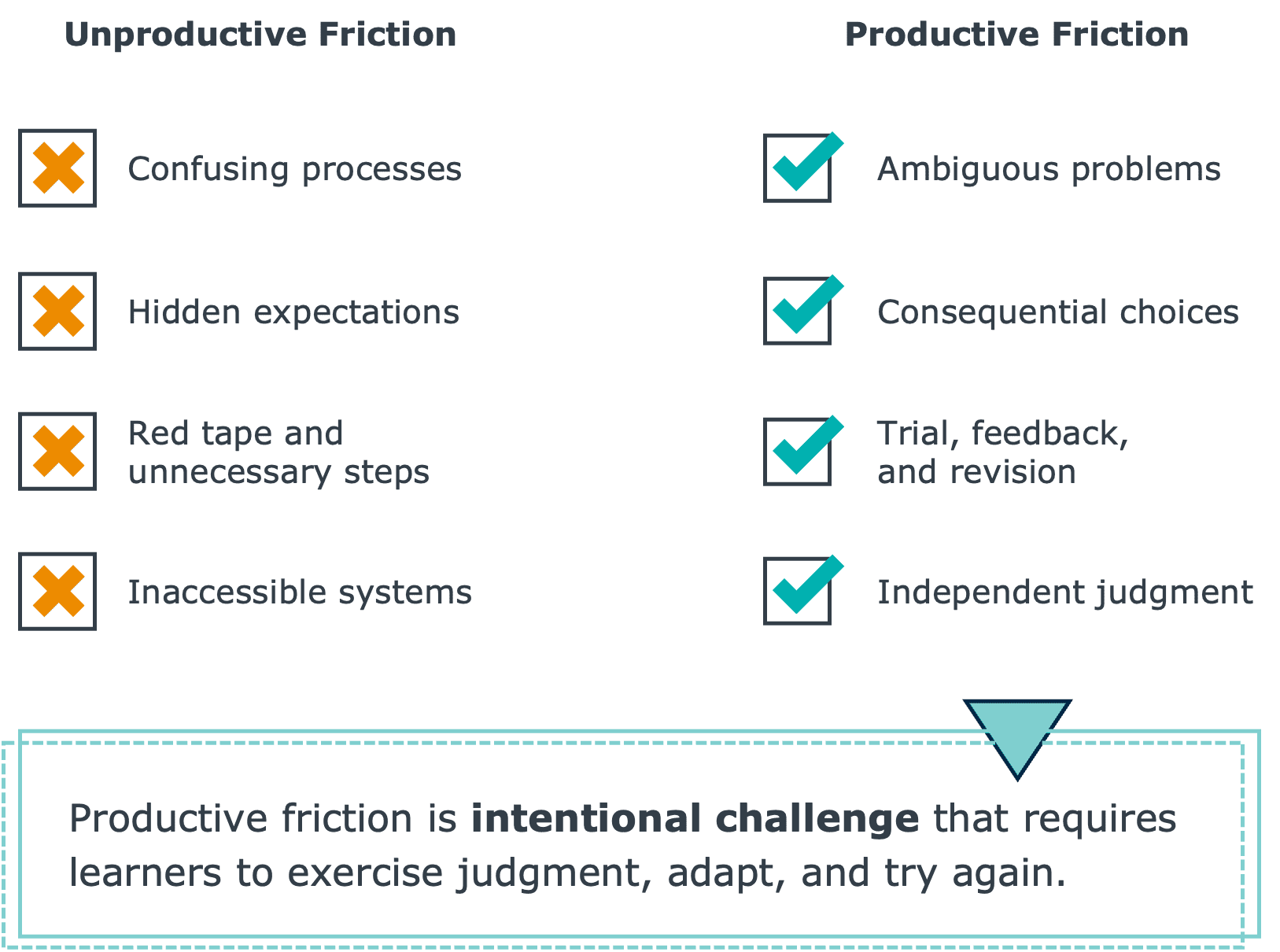
Leaders should ask themselves, “What is this teaching the student?” If it helps them make decisions or learn from feedback, give them support to work through it. If it’s just a confusing process or an unnecessary step, it’s probably worth removing.
Yes, it’s hard to find the time—and this work is still worth doing
I understand it’s hard to make room for “yes, and” when everyone is stretched thin and just trying to get through this term. But my hope is that these examples from CONNECTED26 prove that the time you invest now can pay off in a process that works better for your team and your students.

More Blogs

How to keep human connection at the center of your campus AI strategy

How to improve student success in short-term credential programs