How far are students willing to travel to college?
One of the many factors driving students’ choices in the college search process is an institution’s location and proximity to home . This raises the question: how far are students willing to travel for college? Given uneven regional changes in the college-age population and growing skepticism about the value of college, enrollment teams must make every recruitment investment count. Understanding how far students are realistically willing to travel is therefore vital to deciding where to extend your recruitment strategy.
Let’s take a look at some of our updated research into college search trends to understand how students’ willingness to travel has changed—both in terms of how much farther students are traveling and which market segments are seeing the most growth in students from reach markets.
About the data: These analyses use fall 2024 IPEDS enrollment data, the most recent nationally complete data available for four-year institutions.
Most states attracted students from fairly far away
The map below shows that out-of-state students traveled substantial distances to attend college in 2024. In 78% of states, the median out-of-state student came from at least 500 miles away. Most commonly, that median distance fell between 500 and 750 miles—a range that often spans several states and, in some cases, entire regions.
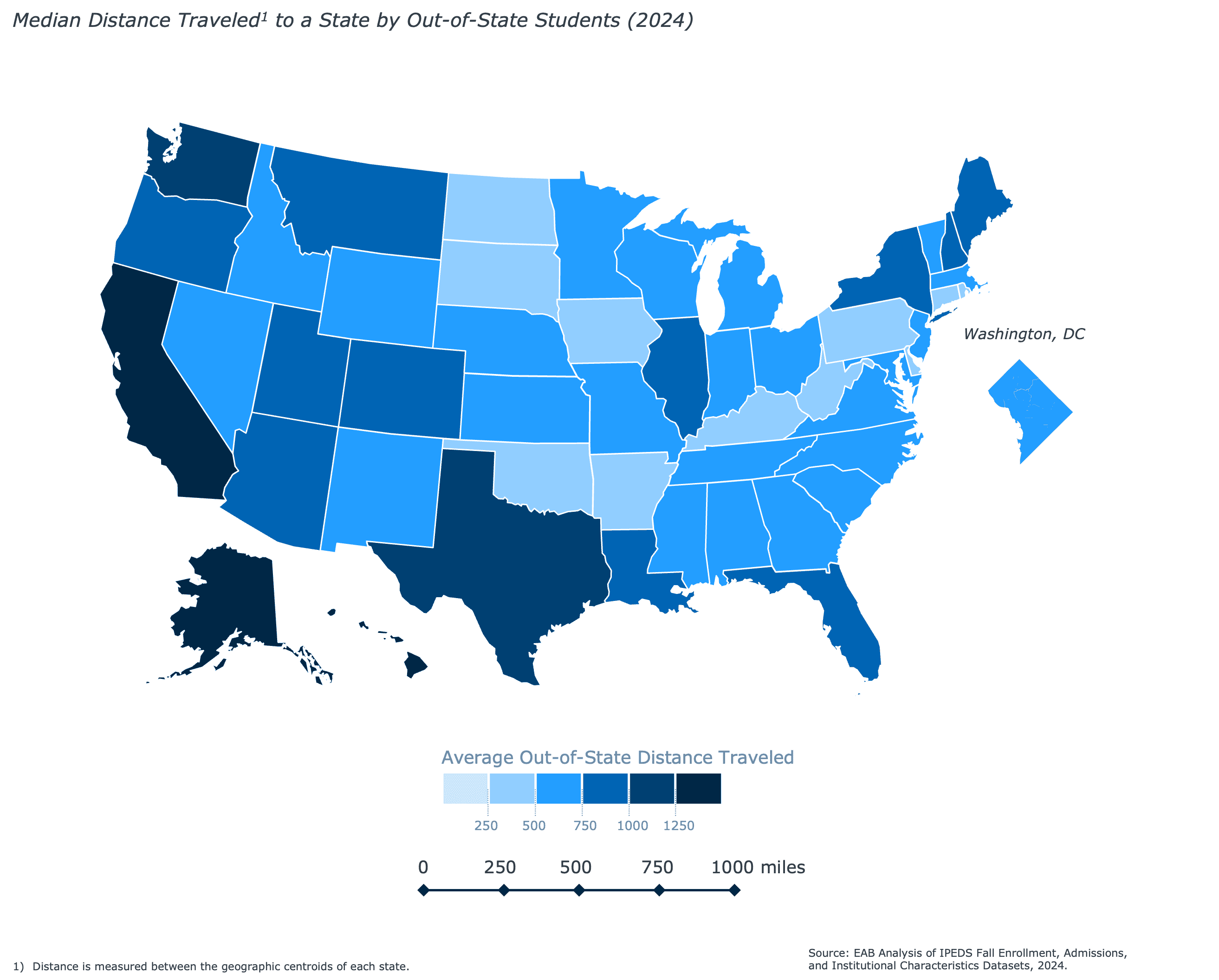
Interestingly, our research shows several states that attract students from the greatest distances—750 miles or more—also have high in-state enrollment rates, such as Washington, California, Texas, and Florida. This dual attraction suggests that schools in these states are successfully competing on a national scale, drawing both local and distant students.
Students traveled the farthest to attend private schools, but some public schools are close behind
As expected, the average distance students traveled to attend a school in 2024 varies by the institution’s size, sector, and region. Across all five geographic regions, the overall ranking (from farthest to shortest distance) was:
- Large private schools
- Small private schools
- Large or flagship public schools
- Small or regional public schools
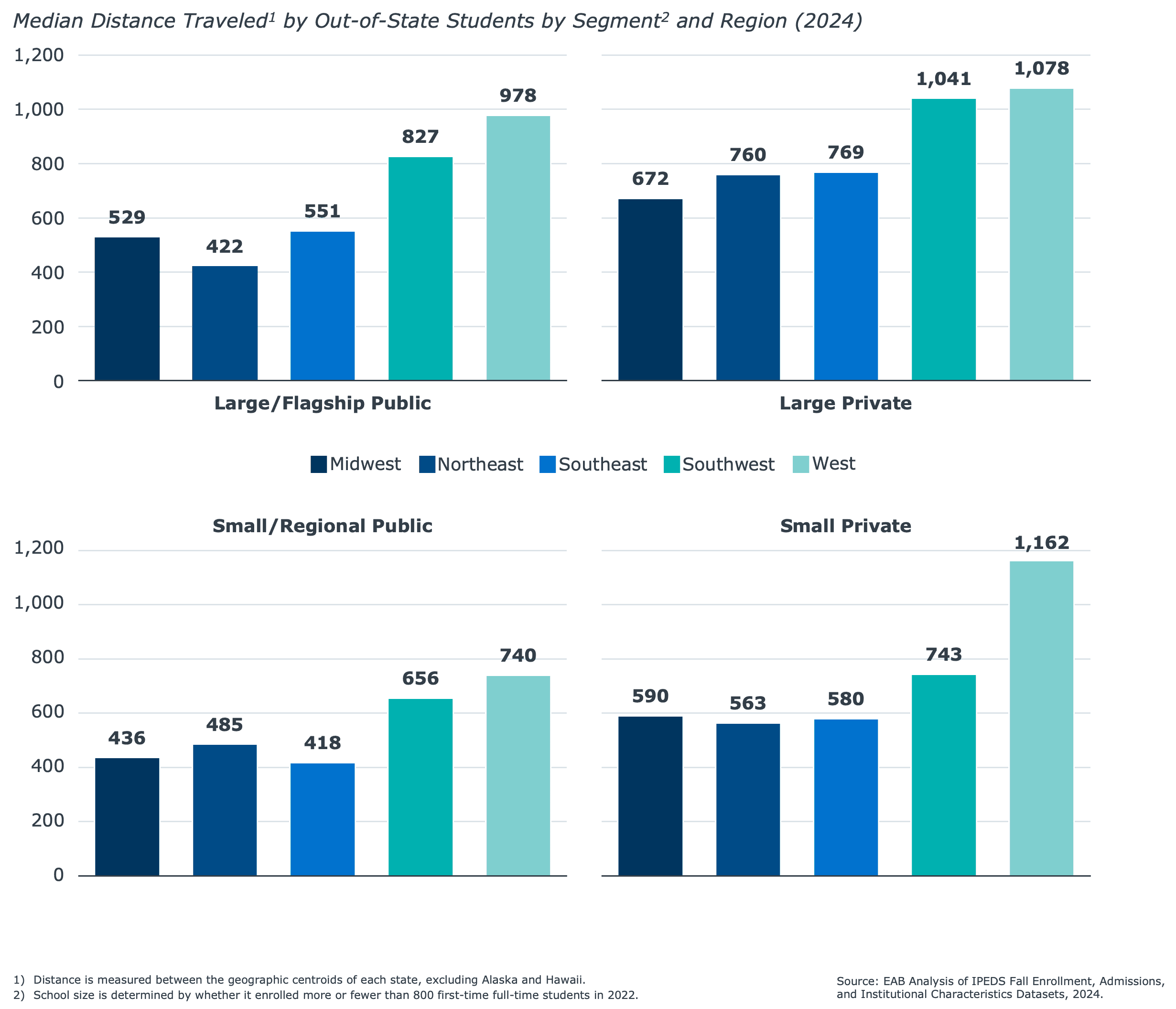
What is perhaps most surprising is the significant distance many out-of-state students traveled to attend public schools—even smaller or regional ones. This finding indicates that all types of schools, regardless of size or status, can attract students from far beyond their immediate geographic area.
Broad growth in students traveling particularly far
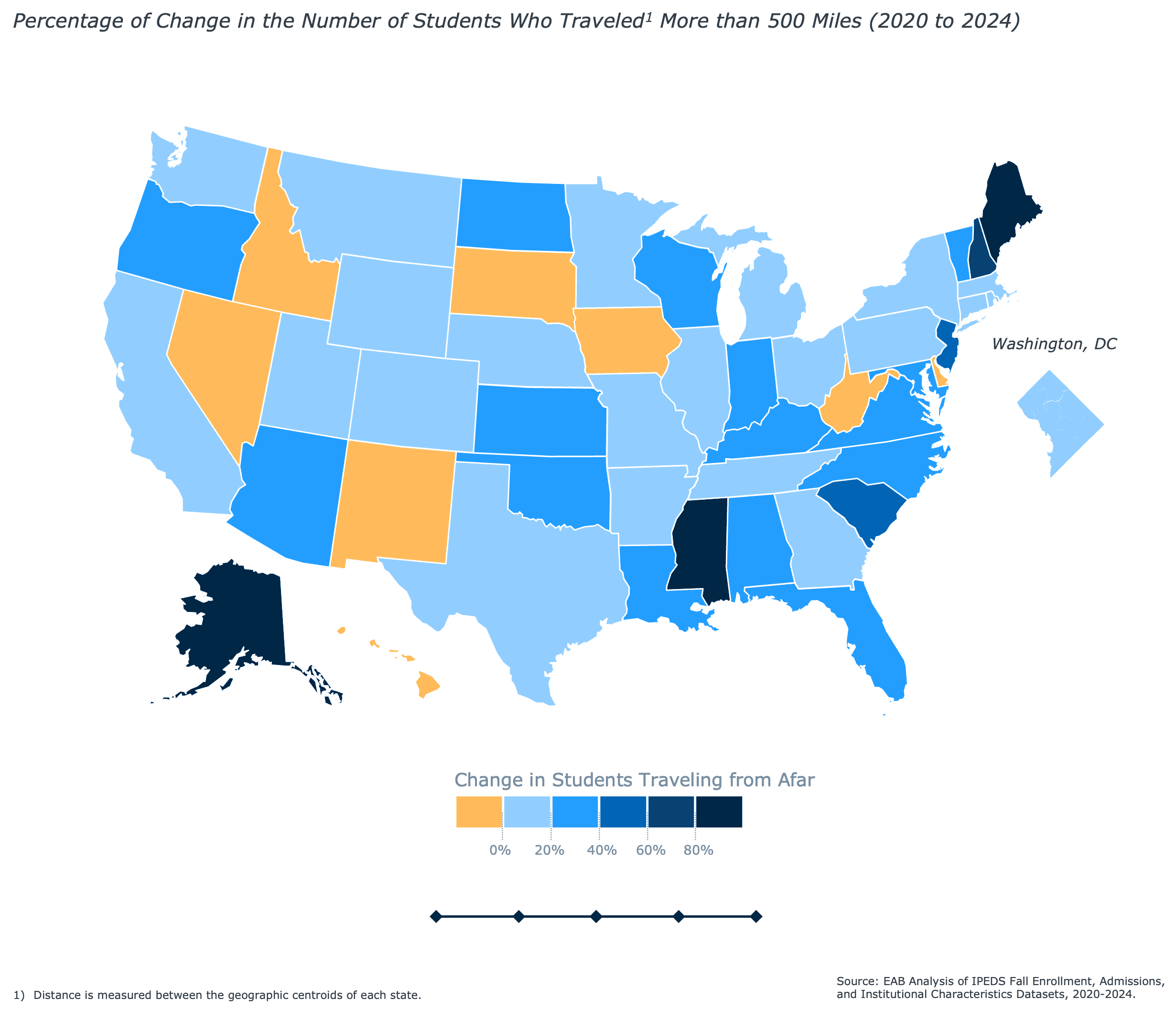
To illustrate just how much this willingness to travel has changed since 2020, let’s take it a step further and zoom in on how much growth there was in students traveling 500 miles or more. As you can see on the next map, below, an overwhelming majority of states (84%) saw an increase in how many students traveled at least 500 miles to attend schools there.
Reach-market growth is spread across the country
The growth in students traveling at least 500 miles is not limited to one region. Every region includes states where enrollment of students from reach markets grew substantially, including several with increases of more than 20% (e.g., OR, AZ, WI, VA, VT). Although the Southeast contains a notable cluster of growth, strong gains also appear across the Northeast, Midwest, Southwest, and West. This geographic spread suggests that the ability to grow enrollment from reach markets is not limited to schools in a particular part of the country. Institutions across a wide range of markets are attracting more students from beyond their traditional recruitment areas.
Large and flagship public schools lead in reach-market growth
Breaking down the growth in students traveling more than 500 miles by segment and region reveals some remarkable results. While the absolute distance students traveled on average remained higher for private schools in 2024 (as shown in the previous chart), large and flagship public schools in every region experienced very strong growth (illustrated in the chart below).
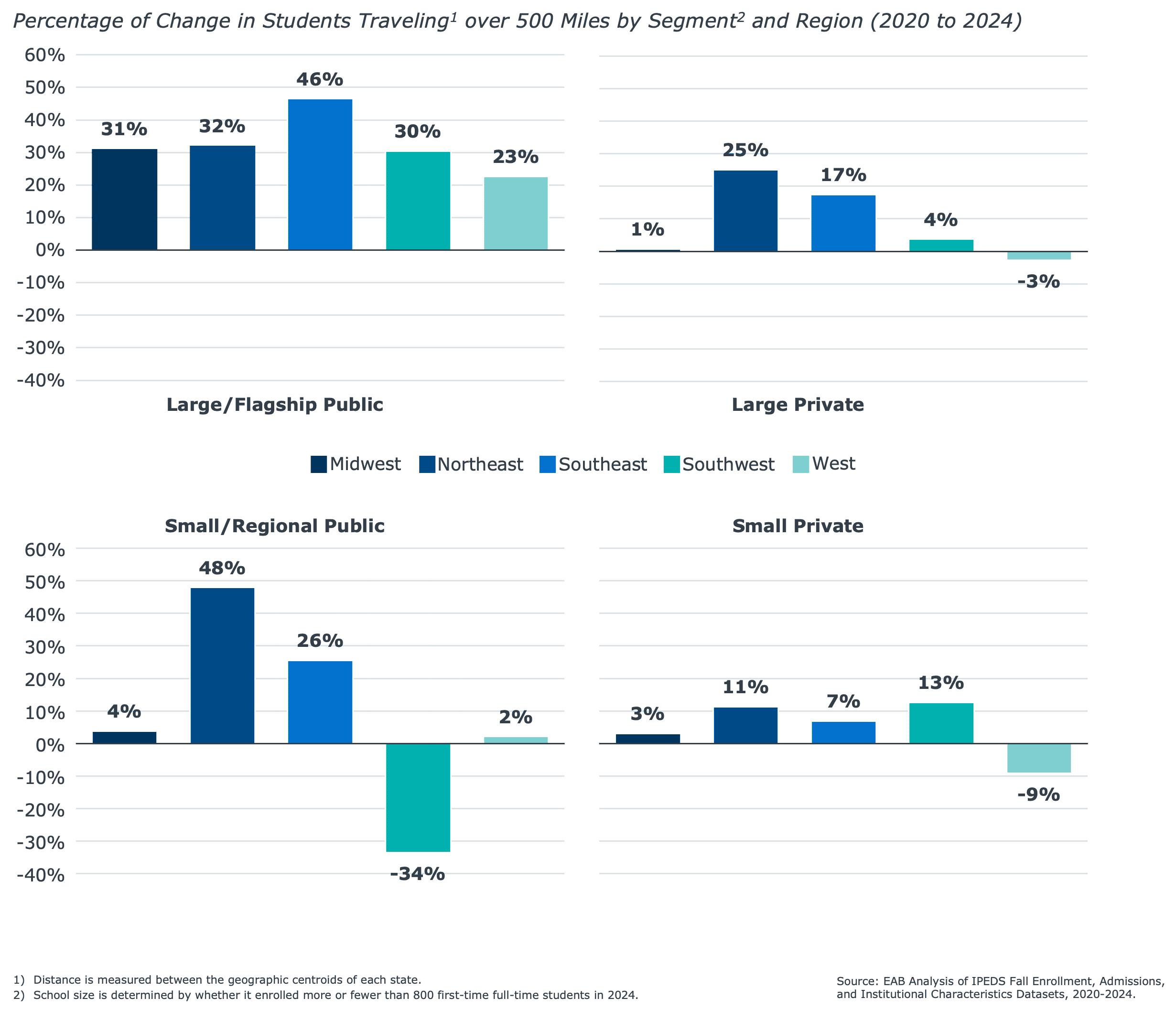
The other three segments also grew their reach enrollment in most regions, if less consistently. It’s notable, though, that even small or regional public schools in regions significantly impacted by demographic changes saw an increase in reach students. The Northeast stands out in particular: Every segment attracted more reach students, including 48% growth among small and regional public schools and 25% growth among large private schools. In a region facing especially steep declines in its college-age population, that broad-based growth may be helping institutions offset losses in their traditional markets—and may help explain why enrollment has not declined as sharply as demographic trends alone might suggest. Expanding geographic reach may therefore be an increasingly important component of enrollment stability.
Turning reach-market opportunity into recruitment strategy
These results show that students are willing to travel significant distances for college—and that schools across regions and institutional segments can attract students from beyond their traditional markets. Of course, enrollment teams should look for evidence of fit before committing resources to a new market. Historical inquiry, application, and enrollment performance can reveal places where an institution already has awareness or traction. Student interest in peer institutions, academic programs, and similar college experiences can provide additional signals that a market is worth testing.
Once promising markets are identified, targeted and sustained outreach can help convert that potential into enrollment. Our research shows that schools engaging with high-intent inquiries on platforms such as Appily are particularly successful with out-of-state students. Taken together, these findings suggest that even schools facing demographic or value-related headwinds can expand their reach by identifying markets with evidence of fit and engaging high-intent students within them.

More Blogs

How to talk about college cost before families bring it to the holiday table

What we’ve learned from testing earlier yield engagement