AI is impacting students’ college selections
Earlier this year, EAB surveyed more than 11,000 high school students and recent graduates to learn more about their attitudes and behaviors with respect to AI. In today’s post I wanted to share with you some top-line findings from that work, with a special focus on the very real impact that AI is having on students’ choice of college. I also have some recommendations about things enrollment leaders can do to mitigate the negative impacts of AI on student recruitment and to tap its latent potential.
Widespread and rapid uptake of AI by students
Some important context is just how mainstream AI has become among high schoolers and how quickly that has occurred. A large majority of students report having used AI tools, and many cite moderate to high levels of aptitude with them.
The trajectory of uptake is also significant. The percentage of students reporting more than a year of AI use grew significantly in 2026.
Broad AI Adoption and Mature Usage Among Students
-


86%
report having used AI tools
-

74%
rate themselves as intermediate, advanced, or expert
-

45%
have used AI for more than one year
-

54%
use AI at least a few times a week
AI is deeply embedded in students’ lives
Students are flocking to AI for the same reason the rest of us are—because it makes large, complex, and time-consuming tasks much, much faster and easier to accomplish and thereby greatly improves our productivity.
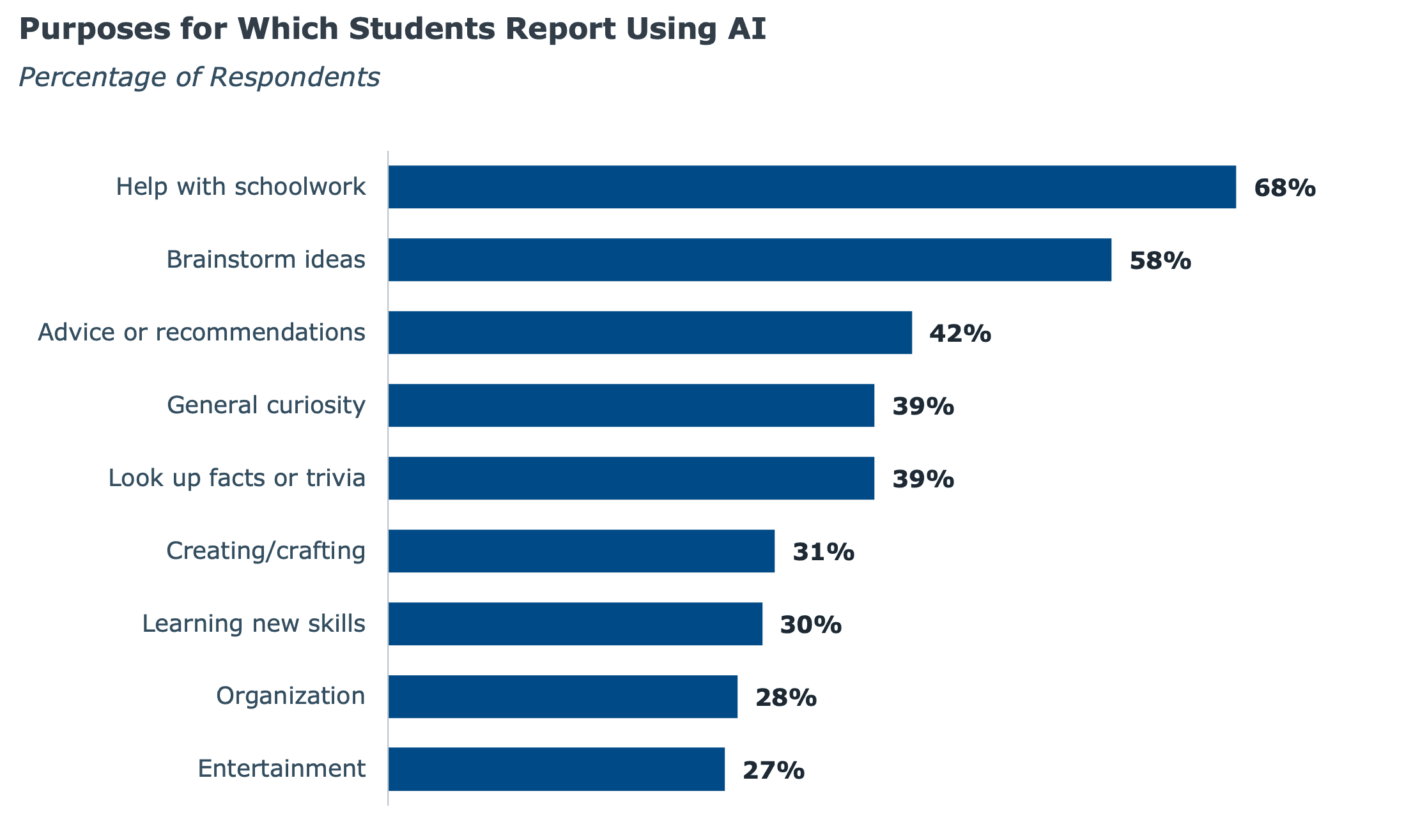
But that’s an oversimplification. For the students we surveyed, AI serves as a kind of Swiss Army knife, used not only to solve a wide range of practical problems but also to enhance personal development and promote enjoyment of leisure time.
The special case of AI in college search
There’s one particular use students make of AI that should be of urgent interest and concern to enrollment leaders—identifying and vetting schools they might eventually apply to and attend.
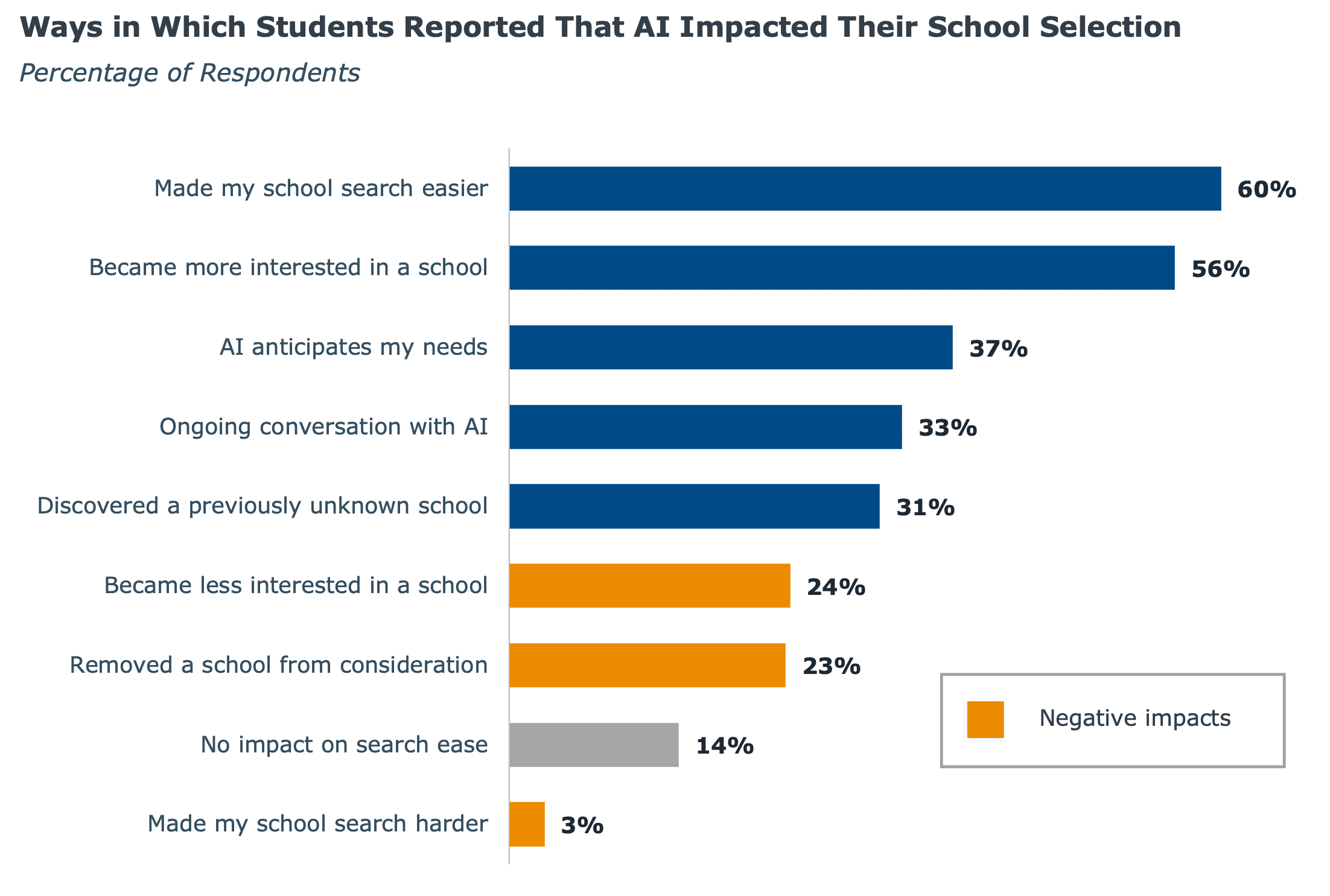
Half of students report using AI to gather information on colleges, and 60% of them said it made their college search easier. More to the point for admissions teams, students reported a wide variety of ways that AI influenced their awareness of and attitudes toward particular schools. Almost a third said that their AI-enabled research helped them identify schools they were previously unaware of, and more than half said it made them more interested in a school.
That dynamic cuts both ways, however. Almost a quarter of students said that information from AIs made them less interested in particular schools, and a similar proportion reported removing institutions from their consideration set based on what they learned from AIs.
Three recommendations for enrollment leaders
The general picture I just sketched out is one of AI increasingly coming between you and the students you are trying to recruit—for better and for worse. Crucially, this is happening against a backdrop of reduced efficacy of channels we’ve historically relied upon to reach and influence students. Email, for example, while still an important part of any well-designed recruitment-marketing program, is losing its efficacy as more of your related effort needs to go into sustaining deliverability and open rates.
This context suggests the need for a deep rethinking of how we engage with prospective students. There are three areas in particular I wanted to highlight.
First recommendation: Treat AIs as an audience
Since the information students get about you is increasingly generated by the AIs they’re relying on for advice, you’ll want to make it easy for them (AIs) to find you, and you’ll want to ensure that that the messages they’re passing on to students are the ones you’re most eager for them (students) to hear.
A key way of doing that is via generative engine optimization (GEO). GEO is to AI what SEO is to pre-AI-era online search. It is based on research you do to gauge how visible you are to AI platforms like ChatGPT and how reliably they are relaying your most important messages to students. It also entails making modifications to your online presence that improve how you’re performing on both counts. Your .edu plays an outsized role here. You’ll want to ensure that the content on it translates into on-brand “readings” of your institution by AIs. You’ll also want to make sure your online technical infrastructure is not placing barriers between you and AIs or causing them to downgrade key elements of your online presence.
Second recommendation: Prioritize innovation in your recruitment marketing
Students will never only get their information on you from AIs, and there are better and worse ways of using other channels.
An important consideration here is personalization; students react really well to communications that recognize their particular interests, priorities, and concerns. In the past it was difficult to do this at scale with any meaningful level of depth. AI has changed that. It is now entirely feasible to create a recruitment email that comes in thousands of variants within a single campaign, based on different combinations of student characteristics.
Students Want Outreach that Honors Their Individuality
-

93%
of students say personalized messages increase their interest1
-

73%
of students say personalization makes them feel desired by a school1
-

64%
of students say college outreach lacks personalization2
- “Personalization in College Recruitment Marketing: The Student’s Perspective,” EAB
- “Students Pour Their Hearts Into College Admissions. Do Schools Care?”, Forbes
Third recommendation: Work on your brand
A lot of people think of brands in narrow terms, equating them with things like logos, slogans, and, perhaps, a “personality.” In fact, brands go much deeper than that. They are an exploration of and a concise, emotionally activated statement of how what you offer overlaps with what matters most to students.
When well-executed, brand projects entail a lot of deep thinking about your institution’s strategy, including its unique strengths and weaknesses relative to its competitors and the priorities of the particular demographics it serves. An example of an extremely helpful and important output of related processes is your messaging framework, or “map”—a detailed articulation of your brand pillars. The messaging map ensures that your communications, from your .edu to parent-facing digital ad campaigns, focus consistently on key aspects of your value proposition.
AIs like that kind of consistency. If you’re able to achieve it, it will boost the odds of them “seeing” you and passing on to students the things you would most like them to know about you.
Technology and context
The AI landscape will continue to evolve; there will undoubtedly be remarkable advances in the underlying technologies, a related expansion of their capabilities, and innovations in their practical application.
Equally important, however, are the social, legal, and cultural contexts in which that evolution will occur and by which it will be influenced. This dynamic has special relevance for student recruitment. For example, concerns over safety might lead regulators to restrict teens’ access to AI. Or, conversely, a laissez-faire approach might dominate. Would students, under the latter scenario, hand over most or all of their search activities to AI agents? These are the sorts of questions we need to anticipate in the coming months.
Surveys like the one discussed in this post will be a critical means of ensuring we recognize those changes promptly when they do come.

More Blogs

The enrollment recovery masks sharp divides

How to talk about college cost before families bring it to the holiday table