The enrollment recovery masks sharp divides
Colleges have spent years working to rebuild enrollment after the tumult of the pandemic, and both the demographic cliff and lower college-going rates have added yet more pressure to recruitment efforts. Against that backdrop, our latest College Search Trends research provides some reason for optimism: By fall 2024 (the most recent data available from IPEDS as of this writing), first-time undergraduate enrollment at the four-year institutions in our analysis was 4.1% above its 2019 level nationally. Enrollment had also increased in every region over the preceding year, and four of five regions had surpassed their pre-pandemic levels.
Collectively, these institutions had regained their pandemic-era enrollment losses and added students beyond that baseline. Yet those gains were far from evenly shared: Larger institutional segments generally grew, while many smaller segments remained below their pre-pandemic enrollment levels. Let’s examine how this divide played out across institutional segments and regions—and what those differences mean for enrollment leaders’ competitive strategies.
Enrollment broadly recovered across regions
Our analysis of IPEDS data tracks first-time undergraduates at four-year institutions from fall 2019 through fall 2024. Enrollment increased in every region during the final year of that period, and all but the Northeast had exceeded their 2019 enrollment levels. These results point to a geographically widespread recovery across very different regional markets, which, for a sector rebuilding after the pandemic, is an encouraging sign.
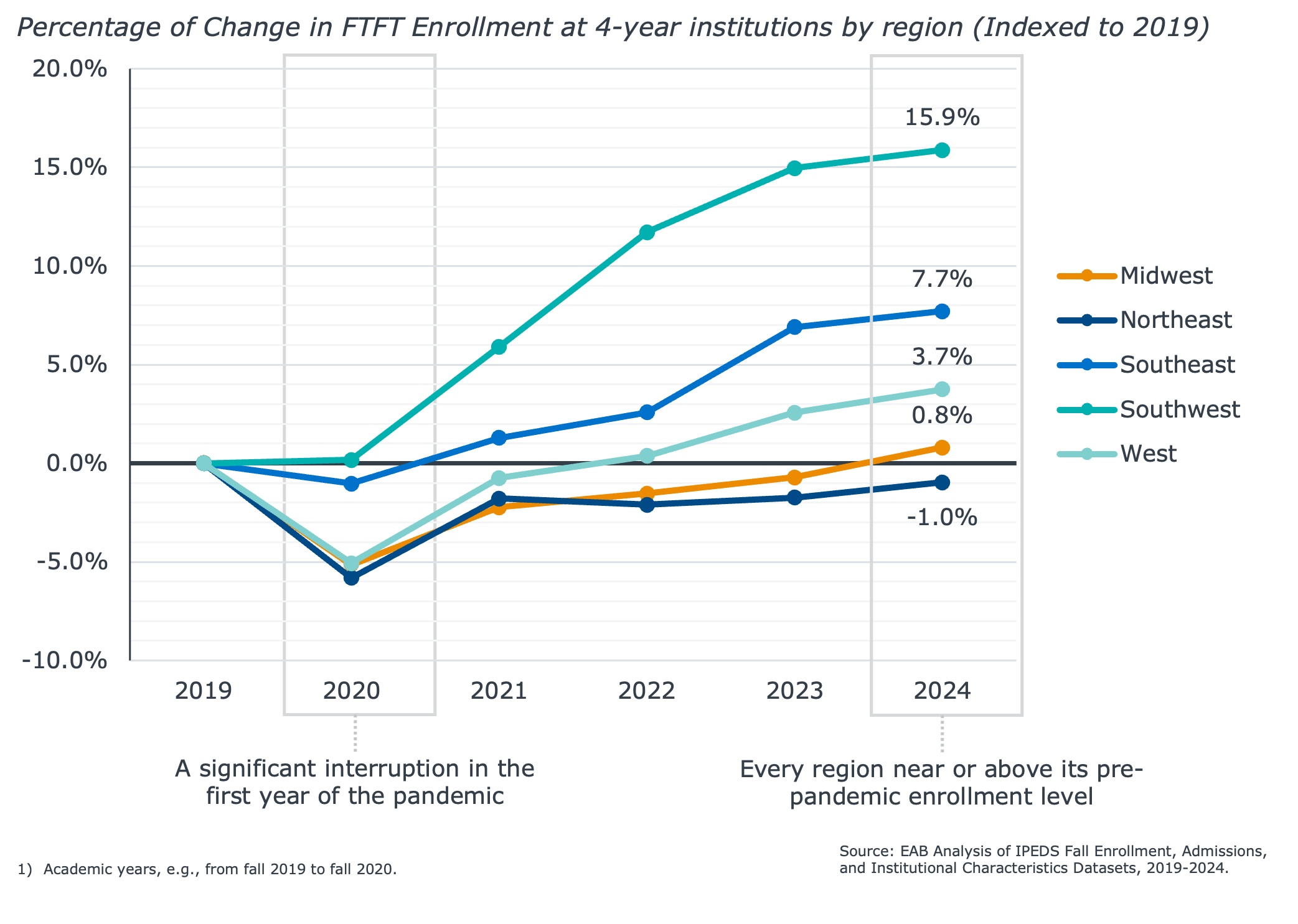
The cumulative gains did vary considerably from region to region, though. Enrollment grew 15.9% in the Southwest and 7.7% in the Southeast between 2019 and 2024. The West posted a more modest 3.7% gain, while the Midwest was just 0.8% above its pre-pandemic level and the Northeast remained 1.0% below it. These results help explain why enrollment leaders in different regions might view the recovery differently. But, as we’ll see below, regional totals also conceal even more substantial differences among the types of institutions operating within them.
A sharper divide emerged between large and small schools
Breaking those regional results down by institution size and sector (i.e., market segments) reveals a much sharper divide. Large and flagship public institutions grew enrollment in every region from 2019 to 2024. Large private institutions also grew in four of five regions, with the Midwest the sole exception. Smaller institutions had a very different experience, though. Enrollment at small and regional public schools, as well as small private ones, remained flat or declined in four of five regions. Some smaller segments ended 2024 with enrollment as much as 10% to 13% below their 2019 levels—even as enrollment increased regionally.
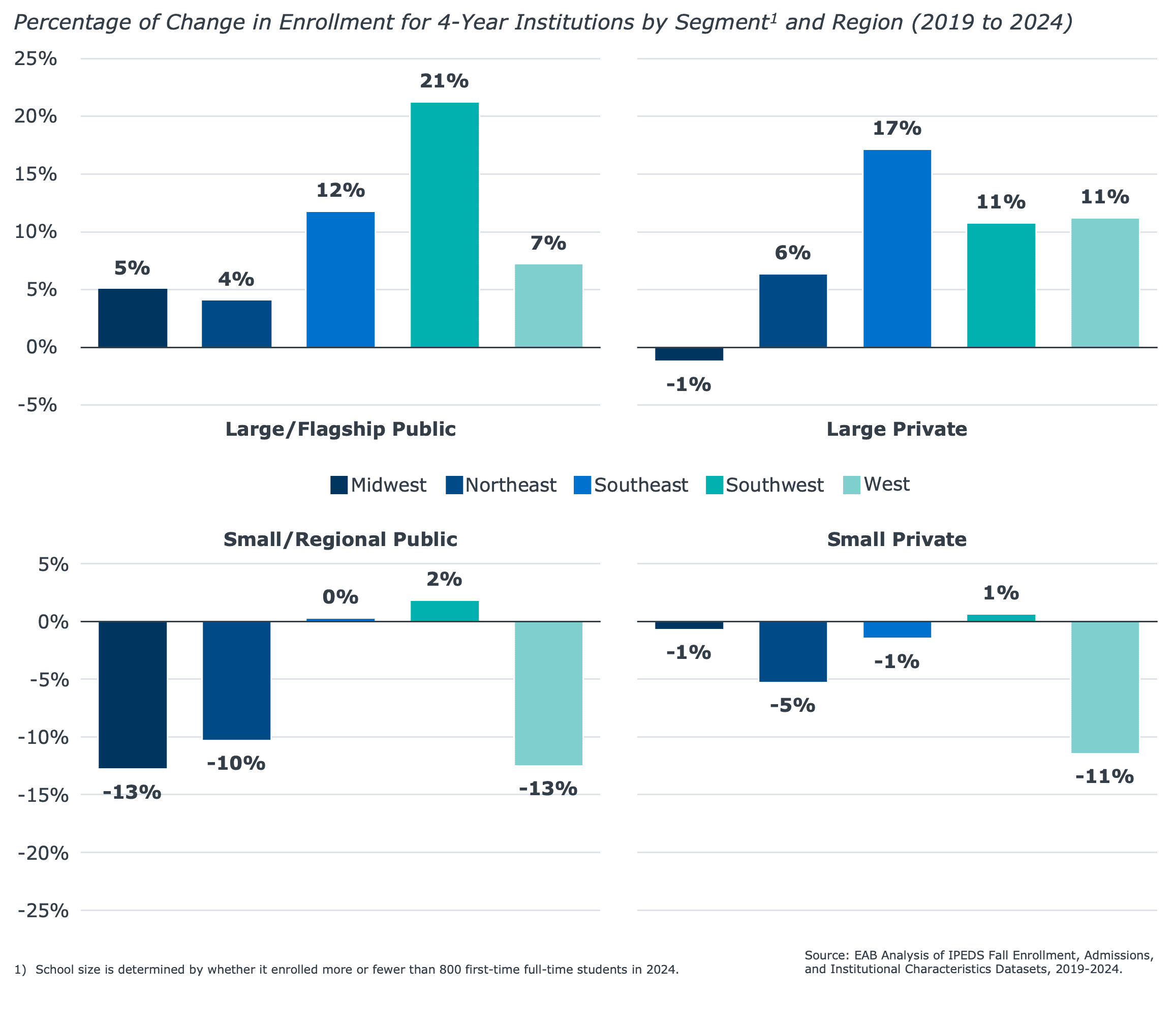
This pattern resembles the “K-shaped recovery” of the US economy in the wake of the pandemic: Overall growth masks divergent outcomes, with some groups rebounding strongly while others struggle to recover their losses. For smaller institutions, this divide becomes more consequential as graduating high school classes begin to shrink (especially in certain regions), making the recovery of lost enrollment even more difficult. A national recovery—or even a regional one—therefore offers little reassurance when an institution’s own segment has lost ground and the market ahead is becoming more constrained.
Regional advantages did not erase the size divide
Smaller institutions in the Southeast and Southwest generally fared better than their counterparts elsewhere, reflecting the regional advantages also evident in the paper’s demographic, application, and migration findings. Even so, smaller institutions substantially trailed larger institutions in those same regions. In the Southwest, for example, enrollment at large and flagship public schools grew 21% from 2019 to 2024, compared with 2% at small and regional publics. Similarly, large private enrollment in that region grew 11%, but only 1% at small private ones.
That same pattern offers encouraging news for larger schools in regions facing greater headwinds. For example, large and flagship publics grew moderately in the Northeast and Midwest despite those regions’ weaker aggregate enrollment outcomes. Geography shaped the strength of the recovery, but larger institutional segments fared significantly better than smaller ones within each regional market.
What this sharp divide means for enrollment leaders
1. Contextualize your enrollment performance
Compare your institution’s results with trends for its region, sector, and size. Those comparisons can help you explain market conditions to your cabinet or board and set better-informed expectations. For example, holding enrollment steady may represent a different achievement in a struggling market segment or region than in one growing rapidly.
2. Identify your actual competitors
Institutions in your segment are not necessarily the only ones directly competing for your students. Examine overlapping admits and where students enroll instead of your institution, including schools outside your customary peer group. Look for larger institutions gaining ground among the students you hope to recruit, then investigate what is attracting those students.
Our team’s Competitive Intelligence for Enrollment Leaders paper provides a practical framework for this work. As our related institutional personas research also explains, students often compare institutions that look different on paper but appeal to them for similar reasons. Combining enrollment outcomes with that perspective can help you identify competitive threats your usual comparisons miss.
3. Differentiate around what students value
Use that competitive understanding to make a more specific case for why students should choose your institution. Identify the characteristics students value most, assess how your institution compares with their alternatives, and focus your messaging on strengths you can demonstrate. Our competitive-intelligence guidance connects those insights to both institutional strategy and recruitment tactics.
For smaller colleges, this means examining what makes their experience attractive to the students they can serve especially well. For larger institutions that have grown, the task is to understand and protect the sources of their appeal. In either case, the next national enrollment headline will be more useful when you can connect it to your specific competitive position.

More Blogs

AI is impacting students’ college selections

How to talk about college cost before families bring it to the holiday table