AI search is reshaping brand and enrollment strategy. Is your institution ready?
AI search is quickly shifting from a new discovery channel to a decision-making engine for students as they build and narrow their college lists.
For CMOs, this shift requires a clear view of performance today and ongoing, as AI search technologies advance by the day. Marketing leaders should be asking: do we have a coordinated AI search optimization (GEO) strategy to track, benchmark, and improve how our institution appears in AI search platforms and influences student decisions?
Drawing on insights from our AI Search Readiness Scorecard for Higher Ed, I’ll explore how AI search is reshaping the student journey, preview six key areas to assess, and show how to prioritize your next steps.
What is AI search readiness?
AI search readiness is the ability to track and understand the metrics shaping AI search optimization, identify where to focus first, and improve the .edu content and signals influencing AI answers.
How AI search is reshaping the enrollment journey
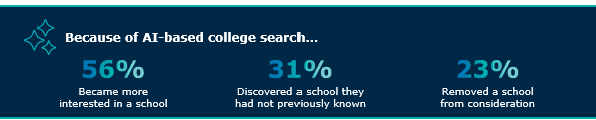
In a recent survey, we found that among undergraduate prospects who used AI in their college search, 56% became more interested in a school based on an AI answer while 23% removed a school from consideration. Among prospective graduate students, AI usage in program search has increased 6x since 2024.
Marketing and enrollment teams have long used metrics such as organic web traffic and inquiry volume as early indicators of enrollment performance. But as zero-click search becomes the norm, causing industry-wide declines in web traffic, those indicators are becoming less reliable.
Part of the challenge is that AI can influence students’ impressions of your institution before they ever reach your site. Beyond discovery, it can shape how they understand your strengths and priority programs, whether your .edu reinforces what they learned, and whether they reach clear next steps to inquire or apply. More of that journey is now playing out across channels and in ways institutions cannot fully control.
Broader web traffic analyses point to the potential value of AI-referred traffic. While it still represents a small share of total traffic and can be difficult to track, those visitors are 4.4X more likely to convert than traditional search visitors.
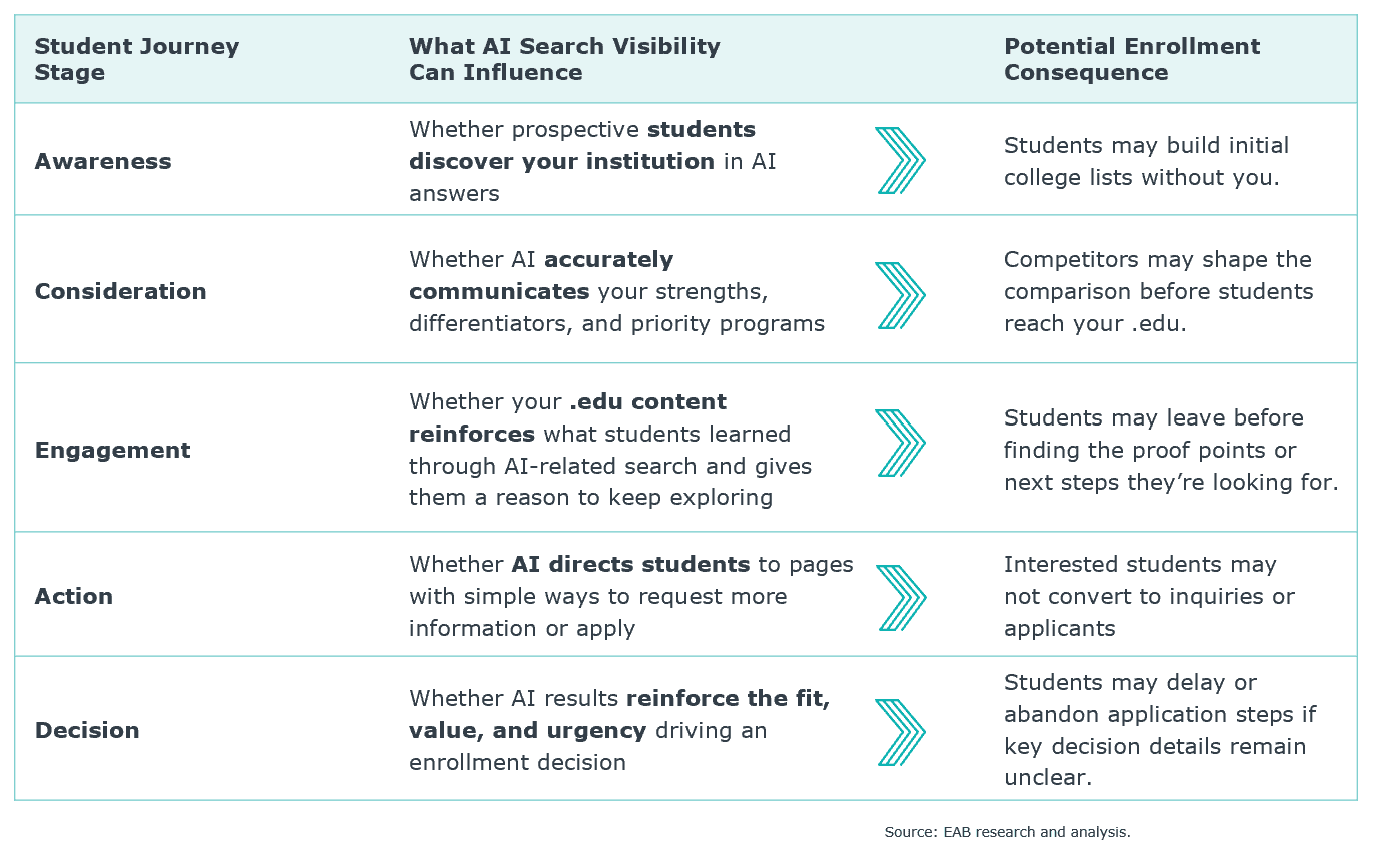
Mapping AI’s influence across the student journey makes the enrollment implications clearer. The chart below shows what AI can influence at each stage and the respective consequence of not having optimized for it.
AI’s Impact Across Each Stage of the Enrollment Journey
What to assess: the six areas of AI search readiness
For most marketing and enrollment teams, AI search is still an early discipline. Many leaders know AI search visibility matters, but their teams lack a consistent way to measure their presence, understand the signals shaping AI answers, and prioritize improvements. In fact, in a recent webinar poll, 39% of leaders said they recognized the need for an AI search strategy but had no coordinated efforts underway.
To be truly AI search-ready, your institution must track and understand these six metrics:
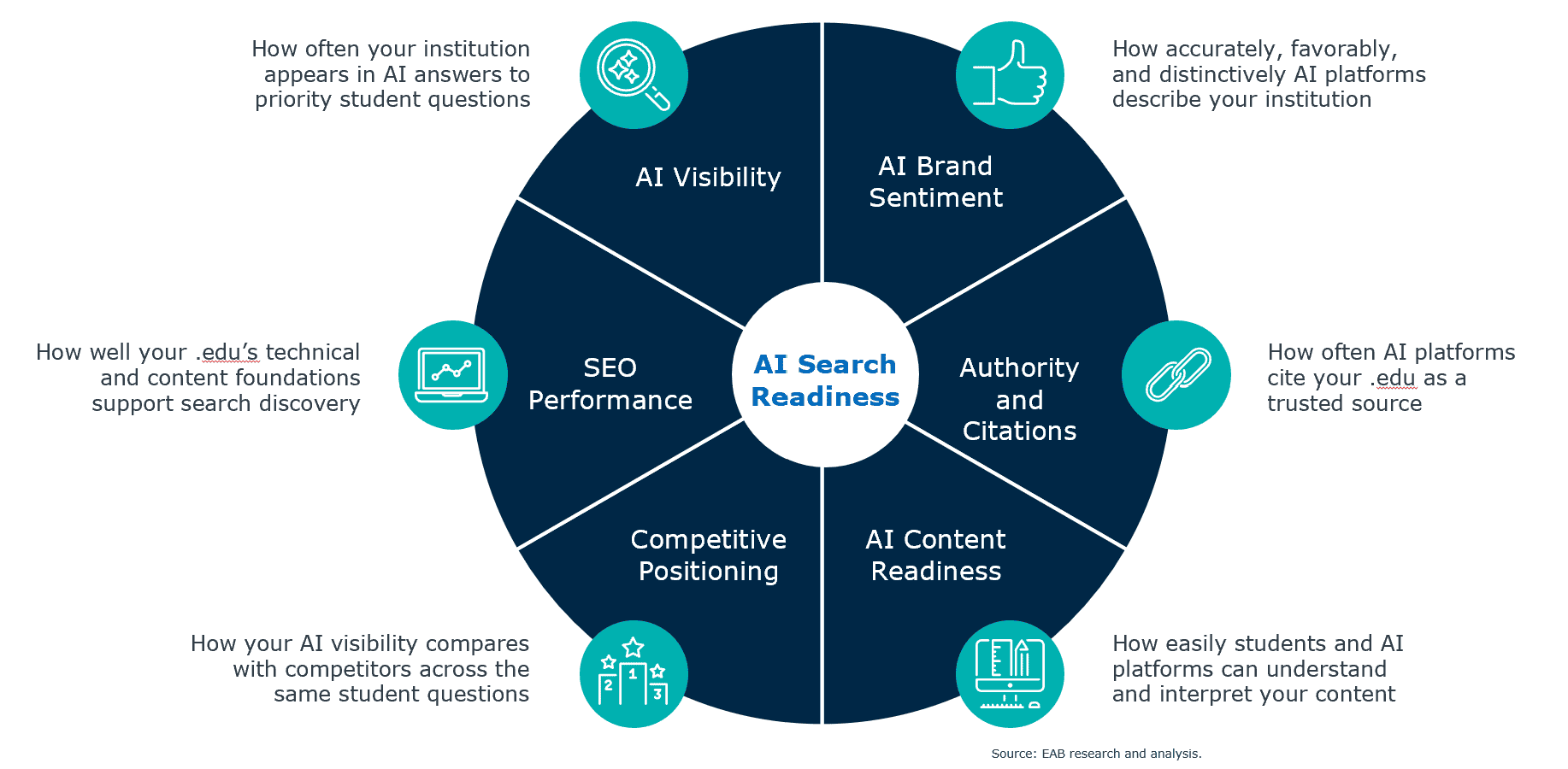
For each area, EAB’s scorecard provides a short self-audit to help you gauge whether the right measurement practices, foundations, and processes are in place.
Sample self-audit questions include:
- Do we know where competitors appear in AI results but we don’t?
- Are AI platforms accurately communicating what makes our institution distinctive?
- Are we tracking change over time or relying on one-off checks?
- Do we have a process for identifying and correcting inaccurate, incomplete, or misleading AI descriptions?
Rating your institution across each metric establishes a baseline so you can identify where your biggest readiness gaps remain.
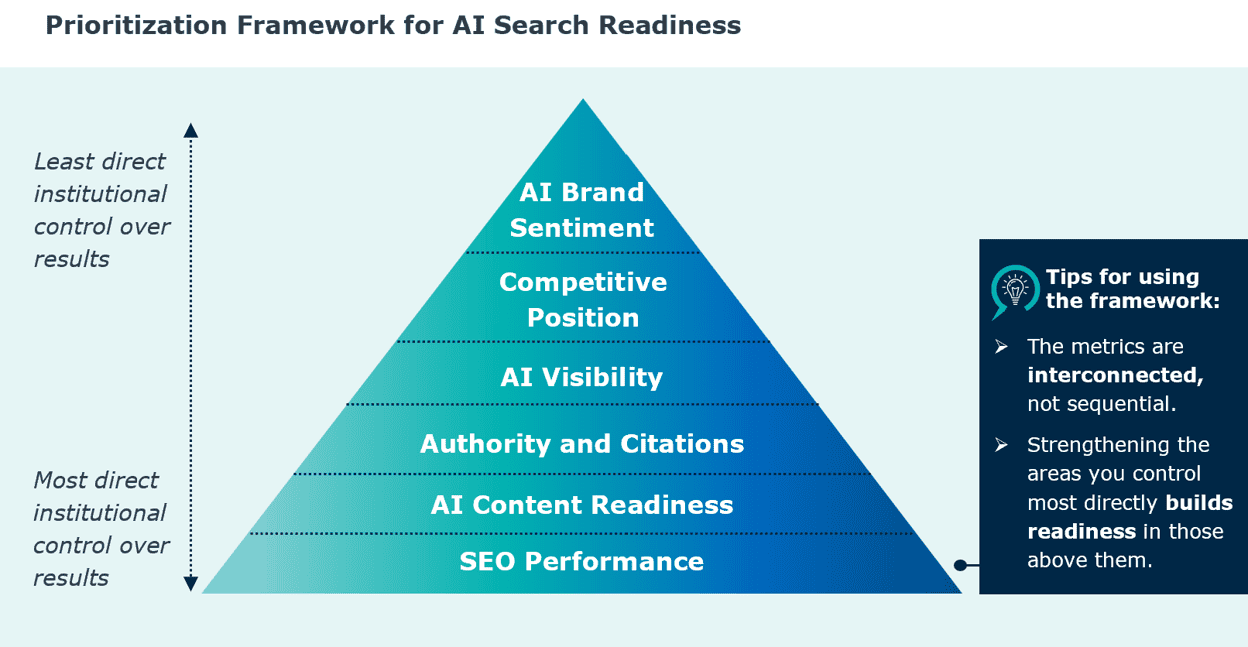
Start with the areas you can most directly improve
The six areas above are interconnected, so a readiness assessment will likely reveal more than one opportunity. Focus first on the areas where your team has the most control over the results. Strengthening SEO performance and AI content readiness, for example, can build readiness in areas such as authority and citations, AI visibility, or competitive position.
AI search readiness requires shared ownership
AI search optimization requires data and expertise that often sit across different teams. Marketing may see brand, visibility, and competitive signals first. Web and digital teams shape the technical performance, content, and analytics that influence what students and AI platforms understand. Enrollment brings the priority programs, audiences, and outcomes that determine where those improvements matter most.
Once you’ve assessed your readiness, bring those teams together around the gaps that matter most. What do the results suggest about priority programs or audiences? What can you realistically improve this quarter or this year? Who owns each next step? For CMOs, that shared view turns AI search measurement into coordinated action around priority audiences, programs, and goals.
Your next step
The scorecard provides a starting point. Sustained AI search optimization requires consistent measurement, benchmarking over time, and a clear way to turn what you learn into improvements across search, content, and the .edu experience.
For teams that want to improve their AI search readiness, EAB’s Web & Digital Solutions can help turn a one-time assessment into an ongoing AI search strategy, combining GEO Intelligence with targeted .edu improvements informed by the data.

More Blogs

AI is impacting students’ college selections

The enrollment recovery masks sharp divides