4 predictions for 2026: What’s next for graduate and online enrollment
2025 was a year of unprecedented disruption for graduate and online education, characterized by fluctuating enrollment patterns, softening demand across several master’s markets, uneven performance in online programs, and significant federal policy shifts.
For me, 2025 included crisscrossing the country, attending conferences, meeting with our 200+ Adult Learner Recruitment partners, and sharing our research with institutions of all shapes and sizes. Here are the trends I observed this year—and my four predictions for what 2026 has in store for leaders of graduate and adult enrollment.
Prediction 1: Graduate enrollment inequality will widen—with new winners and losers
Over the last several years, graduate enrollment has become a tale of two markets. While some institutions have been able to withstand market volatility, others have struggled to recover from international enrollment declines and shifting domestic demand. In 2026, that gap will widen even further.
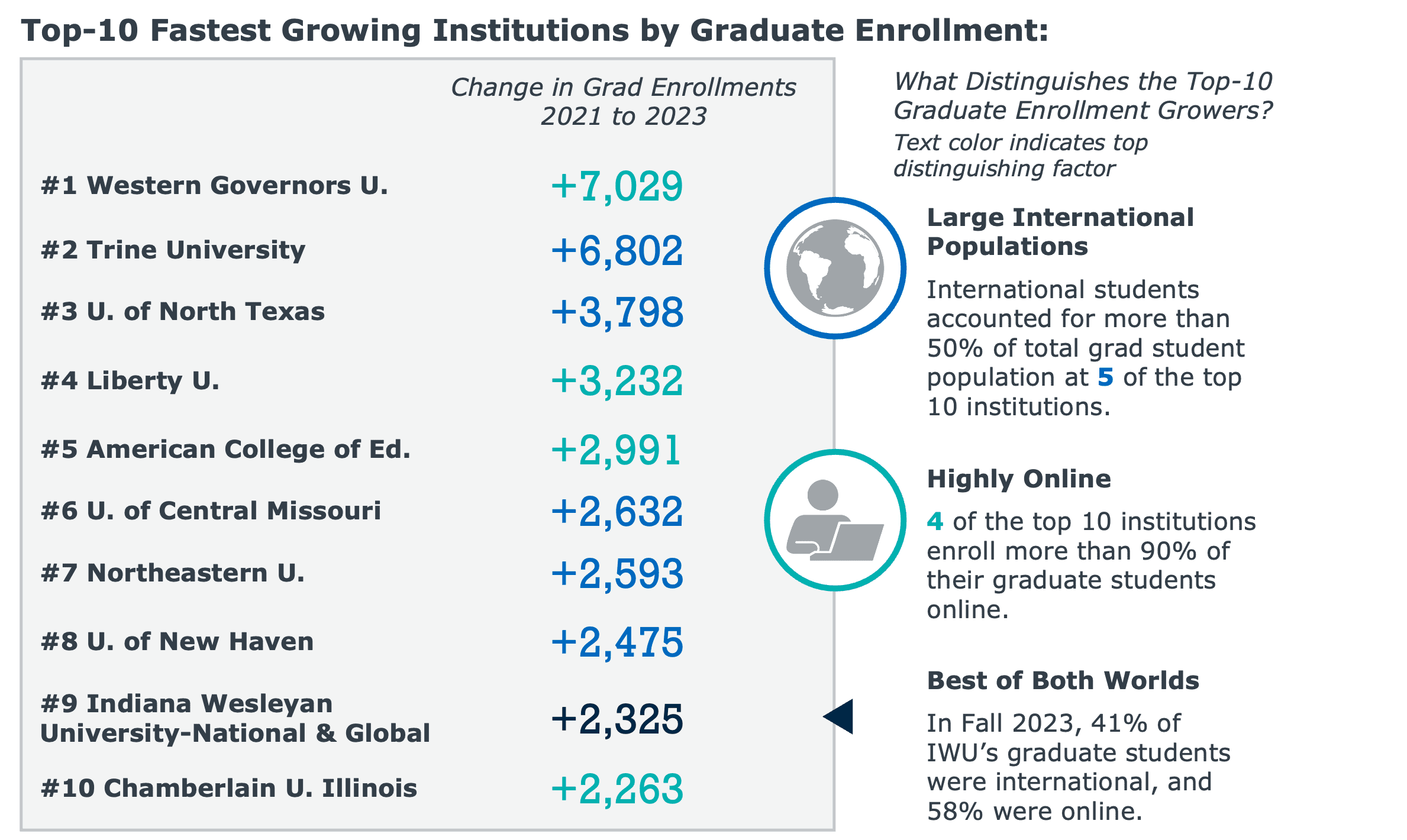
The institutions poised to win will be those that build strong domestic pipelines, invest in short-format programs that confer the skills employers seek most, and position themselves to compete on price and value. Winning institutions will meet adult learners where they are with flexible, career-relevant, and recession-proof options that provide a clear return on investment. The next generation of winners will not only withstand disruption but capitalize on it, reengineering their offerings around the skills students view as both AI-proof and future-ready.
Prediction 2: Rapid AI adoption will rewrite the graduate enrollment playbook
In 2026, AI will continue to impact not only how students search for and discover programs, but also the workforce they enter (or re-enter).
Student adoption of AI
With the introduction of AI Overviews and ChatGPT and other LLMs in recent years, GenAI began shaping how prospective students search, compare, and choose their educational pathways. By 2026, AI-powered college search will be ubiquitous. This mirrors trends we’re seeing in other areas: for example, 80% of millennials and Gen Z are turning to AI for financial advice, according to a recent survey.
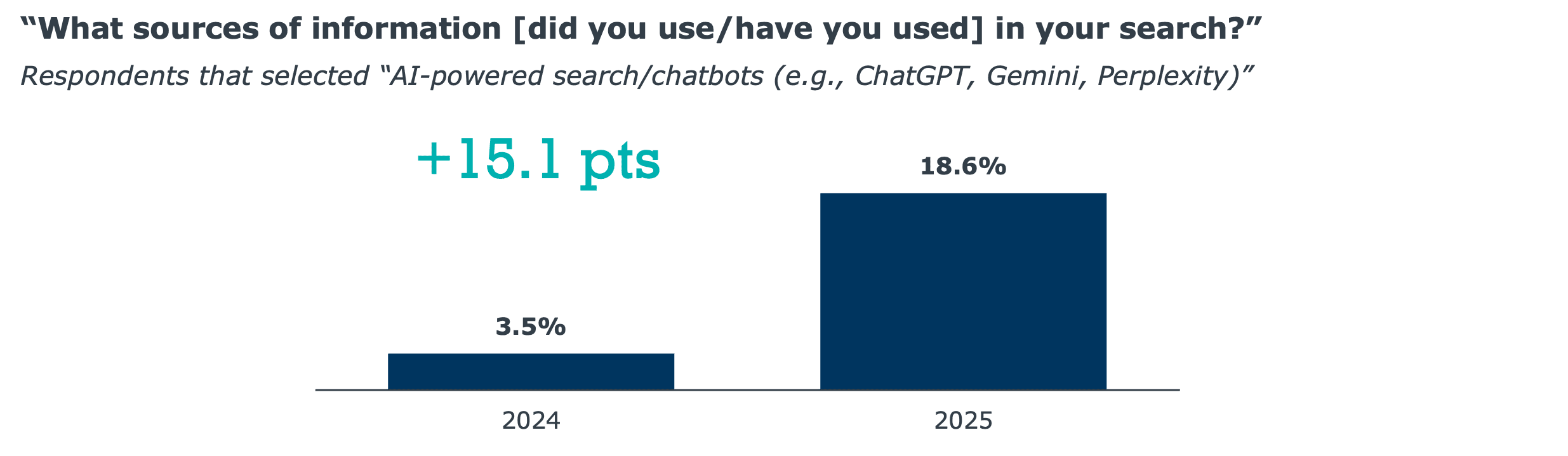
In our latest survey of adult learners, approximately one in five respondents said they used AI tools to research right-fit programs, up 5x from just 4% last year. I expect this number to continue to rise significantly as AI becomes a universally adopted advisor for millennials and Gen Z.
For enrollment leaders, students’ use of AI in the enrollment process means that the traditional marketing playbook (digital media, list buys, etc.) will be disrupted. Paid search will become more costly and less effective as AI intermediates discovery. Visibility within AI platforms like ChatGPT will be critical. As a result, leaders who diversify their marketing mix and invest in AI visibility audits, organic content tailored to AI prompts and queries, and their website will be best positioned to capture future demand.
Workforce adoption of AI
Historically, recessions have accelerated tech adoption, and this cycle is no exception. Companies are leveraging AI to reduce payroll costs and increase productivity. Entry-level roles in fields like software development, financial advising, and data science are among the most vulnerable to AI-driven declines.
So, what does this mean for your graduate programs? STEM programs, which have historically had high student demand, will face multiple threats from declining international enrollment and declining domestic enrollment as students pursue outcomes that are likely to be less impacted by AI—at least in the short term.
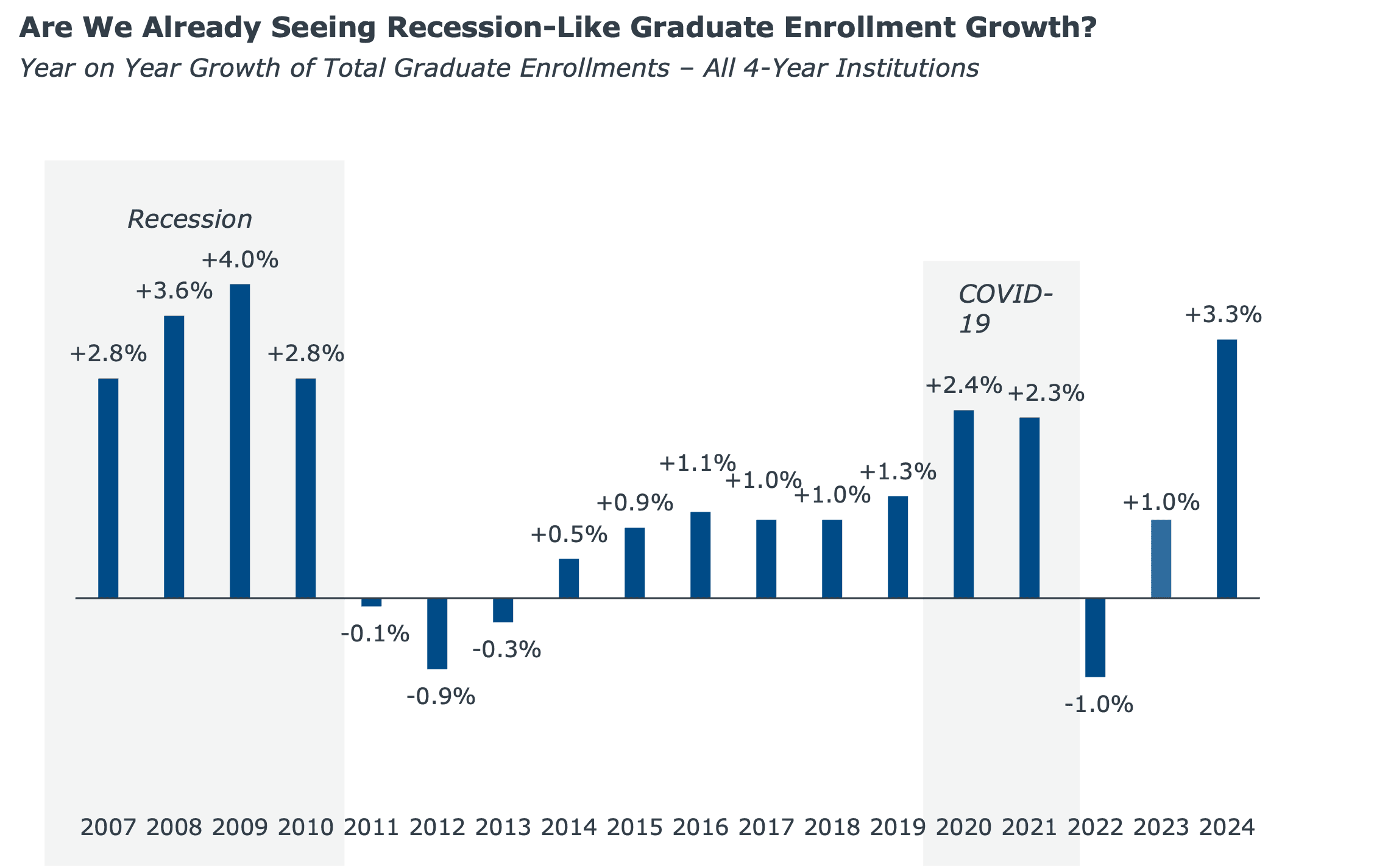
But there is a silver lining: a weak job market often drives demand for graduate education and reskilling. The chart below illustrates the countercyclical pattern of graduate enrollment: enrollment grows as the economy contracts (see 2007-2010 and 2020-2021).
Prediction 3: AI will move from driving operational efficiencies to enrollment impact
Last year, we predicted that higher ed would move from AI experimentation to action—and that prediction proved to be an understatement. Savvy enrollment and marketing teams used AI to gain operational efficiencies in admissions and outreach, scaling outreach through AI chatbots and accelerating file reading and content creation. But 2026 will usher in a new chapter: one where AI is leveraged not only for operational efficiency, but for delivering clear, measurable enrollment gains.
Our new survey of higher ed marketing leaders found that website personalization, predictive lead scoring, and search visibility optimization have emerged as top AI investment priorities for the coming year. And when we asked about 2026 marketing budget allocations, marketing leaders most often cited two related areas for increased investment: search visibility and website experience.
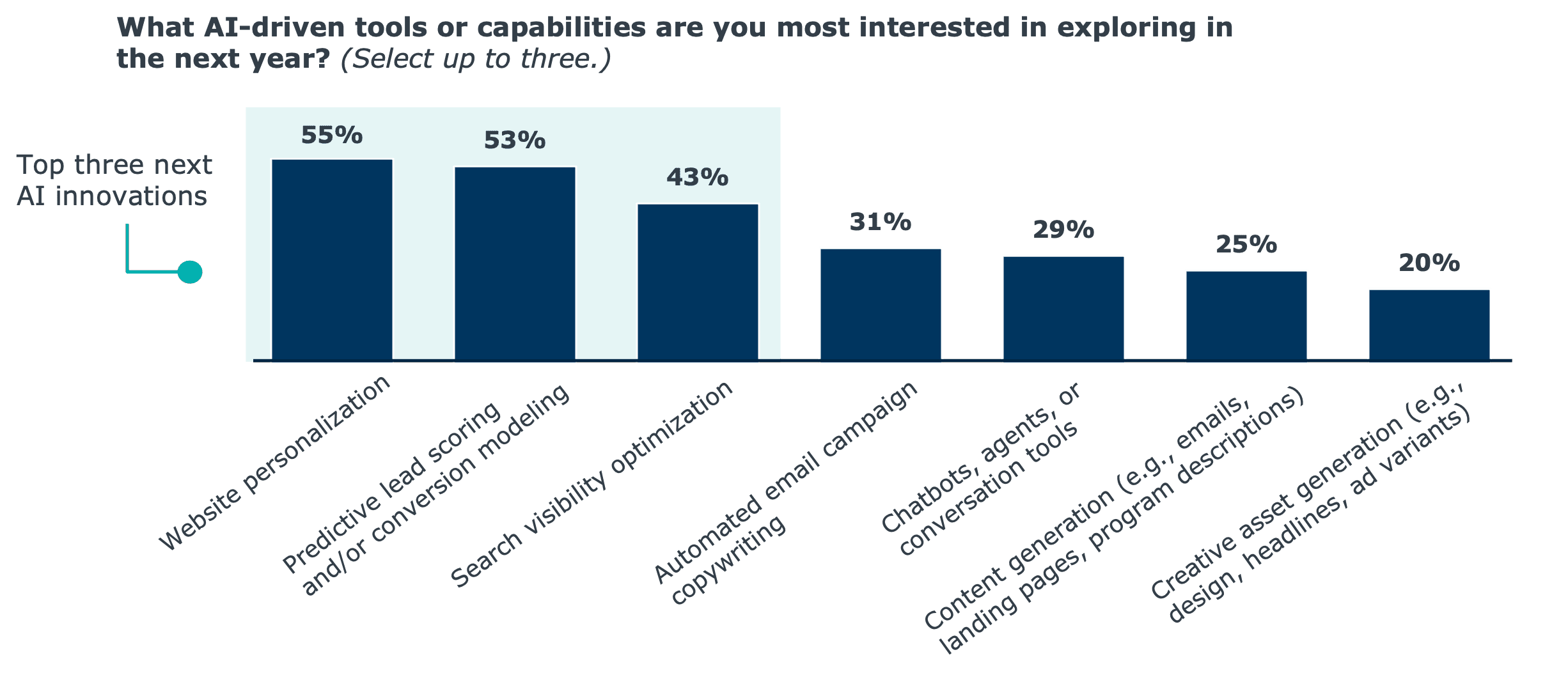
These findings underscore that AI readiness is now a priority for enrollment leaders. But enthusiasm around AI often outpaces institutional readiness. One-quarter of respondents said they are “unsure” how much budget to allocate to AI tools (such as chatbots or agents), or how their budget for AI will change in the coming year. The colleges and universities that win will be those that leverage AI to grow enrollment, test new ideas, and risk failure to innovate within their campuses.
Prediction 4: Institutions will double down on enrollment marketing efficiency
Enrollment marketing budgets have been tightening for years, and by 2025, institutions were under even greater pressure to control costs as enrollments softened and federal funding shifted. The result: brute-force cuts like travel bans and hiring freezes were the first line of defense in a race to balance budgets.
In 2026, forward-thinking graduate enrollment leaders won’t rely on blunt budget cuts. Expect to see institutions streamline agency relationships, replace costly OPMs, and build more integrated marketing operations, either through a single partner or stronger in-house capabilities.
Media strategy will also evolve. As paid media prices continue to climb, marketing teams will intensify their focus on driving down cost-per-click and cost-per-lead. That means greater use of long-tail keywords, more precise audience targeting, and a shift toward lower-cost geographic markets.
As disruptive as the past year has been, there’s real momentum building. Schools that focus on programs with a clear ROI for students, invest in operational agility, and embrace AI to support recruitment, advising, and program delivery will be best positioned to succeed in 2026 and beyond.

More Blogs

The big bets that actually drive online enrollment growth

How to use state demand data to launch or revitalize programs