Four ways to rethink graduate aid and scholarship strategy amid federal borrowing changes
As federal borrowing limits tighten on July 1, graduate enrollment and finance leaders are asking more urgent questions: Where should we add, increase, or reduce scholarship awards? How do we expand affordability without hurting net tuition revenue (NTR)? And how do we strategize rather than react?
Some institutions are already responding aggressively to OBBB funding changes. Business schools are increasing discounts, law schools are introducing guaranteed scholarships, and others are resetting tuition altogether to stay competitive as policies take effect. Many programs are also bracing for increased late-cycle melt as students receive tuition bills and reassess how they’ll finance graduate education without Grad PLUS loans.
We’re entering one of the most borrowing-constrained markets I’ve seen in my 11 years advising on aid and pricing strategy, and scholarships can no longer function primarily as a late-stage yield tool.
Below are four ways institutions can rethink how they award graduate scholarships to make aid spending more strategic, targeted, and sustainable.
1. Centralize visibility into graduate awarding decisions
As borrowing constraints take effect, institutions need a clearer understanding of where aid is generating enrollment impact and where it may simply be subsidizing existing demand.
At many institutions, departments, colleges, and programs still make graduate aid decisions independently, with limited visibility into how funds are allocated or whether awards are driving enrollment. In practice, that can mean scholarship dollars disproportionately go to students who already intend to enroll, rather than to students whose decision-making may actually be influenced by aid.
For example, we often see very high yields on endowed or departmental scholarships because they are awarded late in the cycle to students who have already demonstrated strong intent to enroll. Institutions may generate greater enrollment impact by deploying those awards earlier, while prospective students are still weighing their options.

Before institutions can optimize how scholarships are awarded, they first need visibility into current aid spending patterns and decision-making processes.
What leaders should do now: Conduct a descriptive analysis (or let us do one for you) of current awarding sources to understand how much aid is being offered, when awards are made, who receives them, and how often they are accepted. These analyses can uncover opportunities for low-risk adjustments to awarding strategy.
For example, a low-yield program with room to grow may benefit from a lower dollar award to a mid-tier student with fewer options. Conversely, a highly competitive program seeking to reshape its incoming class academically, geographically, or by work experience may identify opportunities to reallocate funding or create targeted awards that better support those goals.
The next step is to determine whether current awarding patterns align with institutional enrollment and NTR objectives.
2. Tie scholarship strategy directly to enrollment and NTR goals
Many graduate programs still rely on “one-size-fits-all” or inherited financial aid policies that are driven primarily by operational budgets rather than enrollment or revenue strategy. But in a more price-sensitive and competitive market, institutions can no longer assume all students respond to aid in the same way—or that reducing aid will protect NTR.
More strategic awarding models allocate aid with greater precision, targeting students and programs where scholarship support meaningfully influences enrollment decisions. In practice, that may mean increasing aid selectively in areas where stronger yield and enrollment gains outweigh the additional discounting.
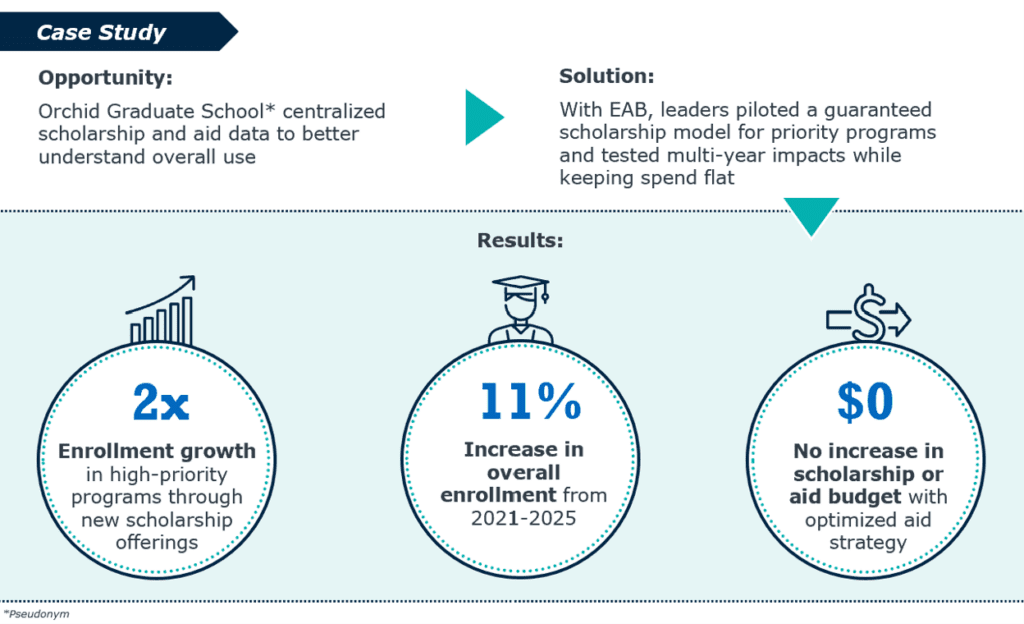
Institutions often discover opportunities to reallocate aid more effectively—not simply spend more overall. For example, Orchid Graduate School* centralized scholarship and aid data to better understand how funds were being deployed across graduate programs. In partnership with our team, Orchid piloted a guaranteed scholarship model for priority programs, using EAB’s analysis to test the impact of multi-year funding on enrollment while keeping spending flat. The approach ultimately doubled enrollment in these programs and helped drive an 11% overall enrollment increase from 2021–2025 without increasing scholarship or aid budgets.
What leaders should do now: Reevaluate whether current awarding models are designed around historical spending patterns or around measurable enrollment and revenue goals. Strategic awarding will become an increasingly important tactic for reducing late-cycle melt tied to affordability concerns.
3. Expand industry partnerships as a parallel funding strategy
As students face tighter federal borrowing limits, enrollment leaders may need to rely less exclusively on institutional aid and more on external funding partnerships that improve affordability while supporting workforce demand. Employer tuition partnerships, healthcare sponsorships, and workforce-aligned collaborations can help institutions diversify graduate funding models without relying solely on increased discounting.
These partnerships can provide an additional source of student funding while also strengthening enrollment pipelines. To maximize their impact, program leaders should develop dedicated recruitment and yield strategies with partner organizations, such as information sessions featuring employer leaders, alumni, and current students who can speak directly to career outcomes and program value.
What leaders should do now: Identify programs where employer or industry partnerships could reduce student borrowing pressure while strengthening recruitment and workforce alignment. Begin with programs that already have strong employer connections through advisory boards, apprenticeships, clinical placements, internships, or workforce agreements, and explore whether those relationships could evolve into funding or sponsorship opportunities.
4. Treat scholarships as a recruitment strategy—not just a yield tool
Graduate aid often enters the conversation late in the enrollment funnel, after a student has already applied or demonstrated strong intent to enroll. But in today’s market, where cost is the #1 reason prospective students remove a school from their consideration set, clear cost and aid messaging plays a key role in whether students engage with a program in the first place.
Scholarship strategy now shapes more than just yield. It influences inquiry generation, student confidence in your programs, brand perception, and whether your program makes a prospective student’s short list. Institutions that communicate scholarship opportunities earlier and more proactively will be better positioned to compete for students who are still deciding if graduate education feels financially attainable.
What leaders should do now: Evaluate how scholarship messaging appears throughout the recruitment funnel—not just at the point of admission—and whether aid strategy is actively supporting enrollment goals. Fifty-eight percent of today’s graduate prospects prefer to research programs independently before sharing personal information, making your .edu program pages a critical recruitment asset. Ensure scholarship and aid information is easy to find, accurate, and prominently featured so prospective students can quickly understand their funding options, whether they are searching your website directly, finding your programs through search, or discovering information through AI-powered tools.
Graduate scholarship strategy is now enrollment strategy
Federal borrowing changes are accelerating a shift that was already underway: graduate affordability can no longer be treated as a downstream financial aid issue. Scholarship strategy is now a key lever for shaping enrollment, competitiveness, and NTR.
The institutions and programs that remain competitive now will think beyond simply increasing discounts or reducing aid across the board. They’ll rethink how scholarship dollars are allocated, communicated, and aligned to enrollment goals across the student lifecycle.
In a more constrained market, programs that approach scholarships and aid with greater precision will be better positioned to sustain both enrollment and revenue.

More Blogs

The “4S” challenges reshaping graduate and adult enrollment

The higher ed SEO checklist