The “4S” challenges reshaping graduate and adult enrollment
I spend most of my workdays talking to leaders of graduate enrollment all over the country. And no matter the institution type, size, or location, most of the challenges graduate enrollment teams face come back to four forces. At EAB, we’ve defined these as the “4S” challenges: scarcity, stealth, sprawl, and scrutiny.
Here’s our latest analysis of these trends and how institutions can still compete—and win—in this environment.
The “4S” Challenges
Scarcity: Fewer dependable prospects
The most common refrain I hear from schools focused on growing graduate enrollment is that there simply aren’t enough students in the market. And it’s true: converging demographic trends are leading to fewer prospective students for your graduate, online, and adult ed programs. We’re in the middle of the “demographic cliff,” or the predicted 6.3% decline in the college-going population in the United States from 2021 to 2032. And we’re expecting an even steeper 21% decline in the 15-to-19-year-old population from 2041 to 2100.
Federal policy changes are also contributing to student scarcity. Limits on student visas led to a 4.3% decline in international graduate enrollment across U.S. institutions. The result: more competition for a shrinking pool of domestic students.
The students who remain in this market also face more barriers to enrollment. The end of Grad PLUS makes it more challenging for students to pay for their education; one in three graduate students borrow more than $65,000 and are at “very high risk” under new limits.
Taken together, these trends raise the stakes to convert every viable prospective student to enrollment. But despite this scarcity and the anticipated slowdown in graduate enrollment across the next decade, grad enrollment goals continue to grow. 49% of surveyed graduate enrollment leaders said their goals increased compared to last year.
Stealth: Prospects are harder to find and reach
Not only are there fewer students in the market, but the students who are considering your program are also harder to see. Compared to first-time, full-time undergraduate students, graduate and adult learners have always taken nonlinear paths to enrollment. But now, more of that journey is happening out of view.
Students consistently tell us that they want to explore programs independently before committing to a conversation with an admissions team. Our Professional and Adult Advisory Services team found that 80% of prospective graduate, online, and adult students shop for programs in stealth mode—meaning they are unknown to your institution until they submit an application. AI has pushed even more of the enrollment journey out of institutions’ view.
Historically, marketing and enrollment teams have used organic website traffic, inquiry volume, and applications as early indicators of enrollment performance. But as zero-click search becomes the norm—68% of Google searches now end without a click—those indicators become harder to read.
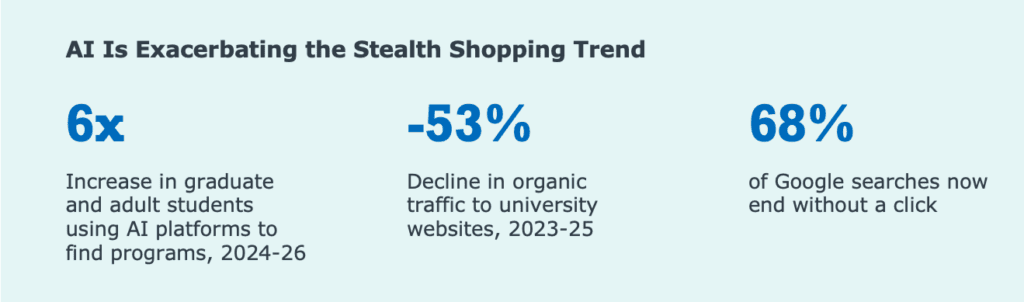
By the time a prospect visits your website, they have already asked AI tools which programs fit their goals and what they can afford. Each ChatGPT or Claude prompt helps them refine their preferences, compare options, and narrow their list. As a result, prospects often land on your site more informed and further along in the decision process.
Winning institutions will look beyond traditional funnel metrics to understand where prospects are searching, what information they find, and whether their programs show up accurately when students ask AI for recommendations.
Sprawl: More programs, more vendors, and more complexity
There may be fewer students in the market, but the students who remain have more programs to choose from than ever. The number of graduate programs has increased 24% over the last decade, while conferrals have grown only 17%. And that’s not accounting for the badges, certificates, and other programs offered by non-university providers.
Inside institutions, teams are coordinating across more programs, vendors, channels, systems, and data sources, often without a shared view of how students move toward enrollment.
We have 56 marketing contracts right now, which is insane to manage…it’s like a spaghetti maze.
VPEM
Private University in the Northeast
Enrollment leaders need to know which programs, partners, and marketing investments are contributing to growth—and where complexity is getting in the way.
Scrutiny: Prospects are demanding clearer proof of value
As choices multiply and the cost of graduate education rises, students are looking for more tangible proof that your program is worth it. They want answers to questions like: Is this program designed for someone like me? Can I afford it? Will it fit into my life? What will it help me do next?
AI is also influencing which programs students consider. 23% of the prospective graduate students we surveyed said they became less interested in an institution based on how it appeared on AI platforms.
Institutions are applying similar scrutiny to their own enrollment investments. While students are demanding proof of value, university leaders are seeking proof that efforts to grow graduate enrollment are working. In a tough market, they are looking for information about attribution, enrollment impact, and net tuition revenue. They want to know that marketing and enrollment dollars are going toward work that produces measurable results.
How institutions can respond to the “4S” challenges
Scarcity, stealth, sprawl, and scrutiny make graduate and adult enrollment growth harder. But despite these challenges, we’re still seeing colleges and universities of all types compete effectively. On average, schools are seeing 12% growth in graduate program enrollment in their first year of partnership with our Adult Learner Recruitment team.
The institutions gaining ground have a few things in common:
- They’re placing smarter bets: With fewer dependable prospects and every marketing dollar under scrutiny, successful institutions prioritize programs based on market demand, differentiation, and enrollment potential.
- They’re orchestrating campaigns across channels: Prospects may move between AI search, paid media, organic search, admissions outreach, and program websites before they ever identify themselves. Strong enrollment teams connect those channels and use student intent and behavior to make each interaction more relevant.
- They’re proving results—and acting on them: Strong teams track performance from the first touch through application, enrollment, and revenue. They establish early indicators of progress so leaders can see what is working and scale, pause, or redirect investments accordingly.
Institutions that understand how scarcity, stealth, sprawl, and scrutiny are changing student behavior can make sharper decisions about where—and how—to compete. Consider my team a resource as you navigate these trends on your own campus and work to grow enrollment despite them.
Ready to grow graduate, online, and adult enrollment?
Complete the form to connect with an EAB enrollment expert.

More Blogs

How mature is your AI search strategy?

The higher ed SEO checklist