Graduate financing after Grad PLUS: What students and institutions are telling us
“How much can I afford?”
“Am I willing to go into debt for this?”
“What if my financing falls through before I graduate?”
These are some of the questions prospective graduate students wrestle with as they search for and compare program options. The end of Grad PLUS loans for most new borrowers has made the answers to these questions even more consequential.
We recently surveyed 6,300 current and prospective graduate and adult students to learn more about their preferences and behaviors as they explore program options. Our Adult Learner Recruitment team was especially eager to hear how students are approaching their financing options in the wake of federal aid policy changes. And this year, we also conducted a pulse survey of 50 university leaders to understand how new financial aid restrictions are impacting their enrollment strategy.
Keep reading to hear what students and your peer institutions shared—and what the survey insights could mean for your graduate enrollment strategy.
Students are setting limits on what they are willing to spend
Cost remains the most important factor in students’ enrollment decision-making. Students identified cost as the top reason they removed a program from consideration, decided entirely against pursuing a graduate degree, or were unable to complete their degree. It’s no surprise, then, that affordability shapes students’ program searches. Three of the five topics students searched for most on university websites and via LLMs relate to cost: the cost to attend, scholarships, and financial aid options.
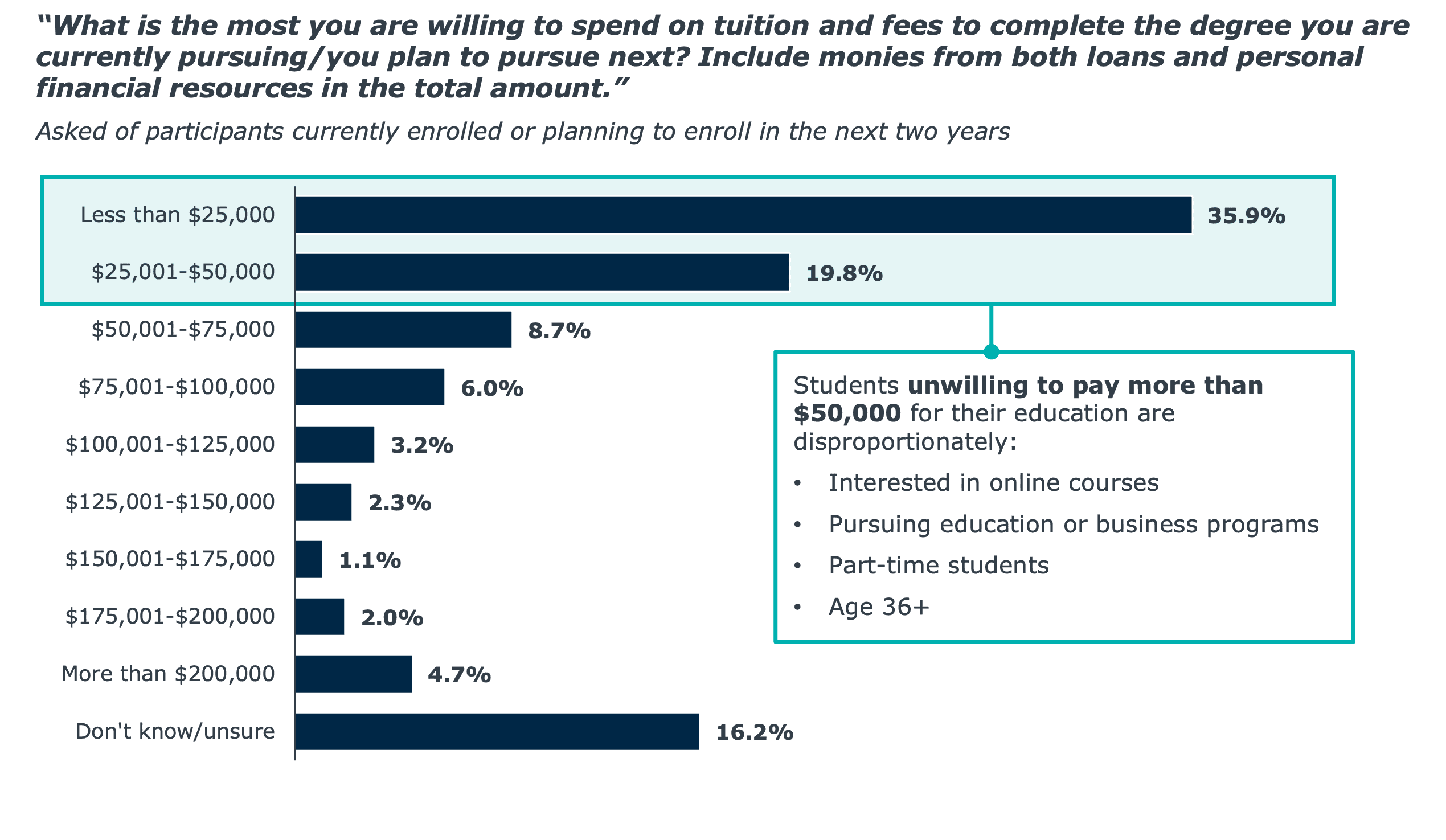
More than half of surveyed students who were enrolled or planned to enroll in the next two years said they are unwilling to spend more than $50,000 in total tuition and fees, including personal funds and loans. Students interested in online programs, those pursuing business or education programs, and students age 36 or older were especially likely to report this spending limit.
Students need financial support but remain wary of debt
Fewer students report having personal funds available to pay for their education. In 2026, 23% of respondents listed personal or household income as an available funding source for their education, down from 47% in 2023. The share of students who said they could use personal or household savings to pay for their education declined from 28% in 2023 to 22% this year.
But needing financial support does not necessarily mean students are comfortable taking on debt. Forty-three percent of surveyed students said they do not plan to use loans. And among those students, 66% said they do not want to assume debt to make up the difference.
“Loans are available, but I don’t use them…it’s unlikely I could repay.”
-Prospective graduate student
Meanwhile, 90% of surveyed university leaders said they had observed or anticipated greater use of private loans due to PLUS-related funding gaps. These findings suggest a mismatch between students’ willingness to borrow and institutions’ expectations. The availability of another loan may not resolve a student’s concerns about repayment or make enrollment financially feasible.
Preliminary data suggest we may already be seeing an impact of a changing funding landscape on enrollment. Master’s enrollment declined 3.7% from fall 2025 to fall 2026.
Students may need to revisit financing options
We conducted our student survey in July and August 2026, shortly after Grad PLUS loans officially became unavailable for most new borrowers. Among survey respondents who had not enrolled and planned to use loans, 27% indicated that they expected to use Grad PLUS. This isn’t wholly surprising given the ambiguity of and revisions to the legislation, which left students and university leaders alike confused about the federal policy changes and their effects.
Forty-three percent of the university leaders we surveyed expect that at least a quarter of their graduate students face funding gaps because of PLUS-related changes. This share may be higher at institutions with large medical or law schools; prospective students interested in doctoral programs and especially in medical or law degrees most often said they expect to use PLUS loans.
Institutions are expanding guidance for students while navigating their own constraints
So how are colleges and universities responding? In our pulse survey of university leaders, 66% said they are providing private loan counseling or lender information to students, while 46% are increasing proactive financial counseling. But fewer institutions are changing tuition or financial aid. Only 18% of respondents said their institutions are reviewing tuition, fees, or institutional discounting, and 16% are increasing institutional grants or scholarships.
These responses reflect the difficult position institutions face. Counseling can help students understand their options, but it cannot, by itself, close a funding gap. And institutions must weigh additional student financial support against their own budget constraints.
University leaders also shared that addressing federal loan changes has been a mostly manual, time-consuming process that strains students and staff alike:
“These rules are ridiculously difficult to navigate and implement. Especially for small offices that are doing everything else and don’t have dedicated staff for specialty areas.”
“This has been a mostly manual process, and we are concerned about our ability to sustain such a manual workload, and we are concerned about system functionality to automate loan changes.”
“Trying to navigate the new regulations with little to no technical support has been a huge struggle. Our systems (institutional and federal) were not ready to implement these changes and so we have had to do a lot of manual manipulation.”
“Stress on staff and students will lead to resignations and stop outs, respectively.”
Together, these surveys point to a central challenge for graduate enrollment leaders: students need a realistic understanding of what a degree will cost and how they can pay for it. Institutions are working hard to provide that guidance, often while managing limited budgets and substantial administrative demands.
For graduate enrollment leaders, the next step is to connect those conversations with decisions about pricing, aid, and recruitment. Make total program costs and available support easy to find, help students identify financing gaps early, and use those insights to evaluate where changes to institutional aid could make a difference. Clearer information and carefully targeted support can help students make informed decisions while giving institutions a stronger foundation for enrollment planning.

More Blogs

When every marketing channel performs but enrollment still falls short

How to evaluate a graduate enrollment CRM