Three ways fraudulent applications may be undermining your graduate enrollment strategy
For graduate enrollment leaders, growing application volume is typically a positive sign. More applications suggest a healthy enrollment funnel and a wider pool of prospective students to recruit and enroll.
But as fraudulent applications become more common, an increase in applications alone is no longer a reliable indicator of student interest. When fraudulent applications enter the funnel, they can distort the metrics institutions rely on to evaluate marketing performance. And when enrollment leaders can’t trust the data in their funnel, it becomes much harder to evaluate what’s working, which then makes planning for future cycles that much more of a challenge.
What are fraudulent applications?
Fraudulent applications are submitted by fake applicants or automated bots rather than actual prospective students. They may be created to exploit institutional resources or financial aid. Fraudulent application schemes result in millions in losses for institutions: for instance, the federal government reports it stopped over $1 billion in aid fraud in 2025 alone.
Read on to learn how fraud applications are impacting your success, and how to navigate this challenge.
How do fraudulent applications impact year-over-year grad program success?
1. They waste your budget and resources
As graduate enrollment teams know all too well, institutions invest significant time and resources into enrolling prospective students. With limited budgets and increasing pressure to demonstrate ROI, enrollment teams must ensure every recruitment dollar is being used to effectively reach and engage graduate leads.
When fraudulent applications enter the funnel, marketing and recruitment dollars are wasted on leads that will never enroll. Instead, institutions may allocate financial aid money and spend ad budget on non-viable applicants. This makes it more challenging to know if your budget is being spent appropriately and could create issues when planning for following terms.
2. They create a misleading picture of recruitment performance
-


3.51
Graduate students apply to only 3.51 programs on average
Metrics such as application growth and inquiry volume are often used as indicators of recruitment success. Because graduate students apply to just 3.51 programs on average, enrollment leaders need confidence that their recruitment efforts are converting leads into applications effectively. Fraudulent apps can also impact the micro-metrics your marketing team uses to assess campaign performance, such as email deliverability and bounce rates.
However, when fraudulent applications impact key marketing and enrollment metrics, it becomes more difficult to determine whether growth in the funnel reflects genuine student interest. Institutions may make decisions based on data that doesn’t accurately represent their target audience.
3. They create additional burdens for your enrollment team
Fraudulent applications also create additional work for admissions and enrollment staff, many of which are already strapped for time and resources. Teams must spend time investigating inconsistencies and managing applications that may never result in enrollments.
In fact, in a recent EAB webinar, nearly 31% of survey respondents reported that graduate application fraud is a major focus at their institution. That additional workload can limit the time available to support real prospective students who are considering a program. As fraudulent activity becomes more sophisticated, enrollment teams must balance fraud detection efforts with the personalized and frictionless experience students expect throughout the admissions process.
Invest in fraud prevention and detection
While no single strategy can identify every fraudulent application, enrollment leaders should look for four qualities when evaluating the health of their funnel: accuracy, consistency, human behavior, and duplication.
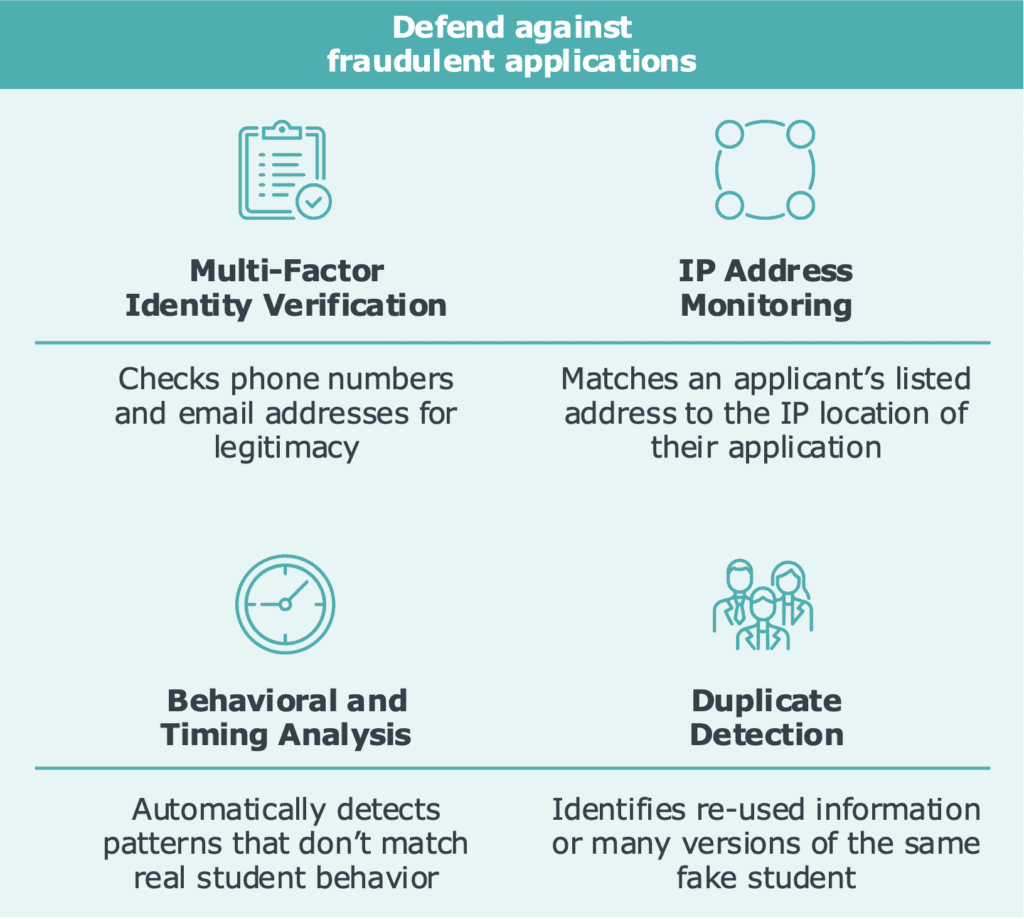
- Accuracy: Use multi-factor identity verification to confirm the legitimacy of contact information and reduce the likelihood of fake or synthetic identities entering the funnel.
- Consistency: Use tactics like IP address monitoring to look for inconsistencies between digital signals, such as application information, geographic location, or email addresses, that may indicate suspicious activity.
- Human Behavior: Behavioral and timing analysis can help monitor for activity that differs significantly from how real prospective students interact with applications.
- Duplication: Watch for repeated contact information or multiple versions of the same applicant appearing across inquiries and applications.
While individuals can commit application fraud, it’s often the work of sophisticated criminal networks who flood institutions’ systems with fake identities. The federal government has even investigated $350 million in fraud schemes that have impacted institutions over just the last five years.
So, as fraud becomes more sophisticated, institutions need technology that can lighten the load on staff capacity and help identify suspicious activity. Solutions like the Navigate360 Enrollment CRM for Graduate Programs can help institutions take a more proactive approach by combining enrollment management and fraud detection capabilities within the same platform, reducing the burden on enrollment teams and freeing up capacity for what they do best: connecting directly with students.

More Blogs

The “4S” challenges reshaping graduate and adult enrollment

How mature is your AI search strategy?